KLAS Contact

Contact KLAS
Contact KLAS
 2026 BEST IN KLAS
Preferences
Related Series

2025

2024

2023

2023

2022

2019

2018

2017

Digital Health Investment Symposium 2026

Author
Justin Long

Author
Kevin Huang

Author
Caleb Simmons
In September 2026, KLAS hosted the tenth annual Digital Health Investment Symposium (DHIS), bringing together healthcare provider, payer, technology, and investment leaders to discuss the forces shaping digital health. In conjunction with the event, KLAS conducted a pre-summit survey with questions based on current HIT industry trends and KLAS’s conversations with healthcare thought leaders. This event overview shares insights from both the pre-summit survey and the event’s small-group discussions, presentations, and panel conversations.
DHIS 2026 Panel Discussion Topics
- Healthcare margin pressures, reimbursements, and investment priorities
- Partnerships, innovation, and precision at scale
- AI adoption, value, and affordability
- Ambient AI, data management, changing ambulatory practice, and revenue cycle management

Margin Pressures Are Driving Investment Discipline
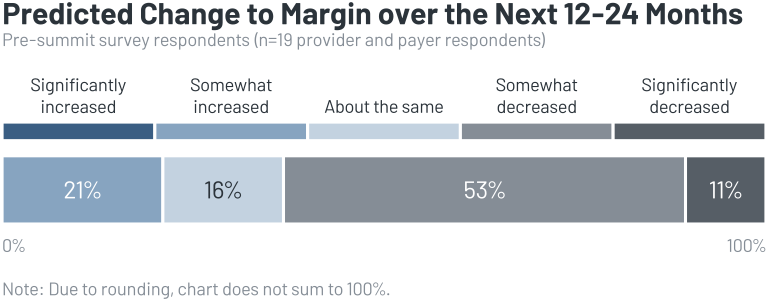
Healthcare organizations face mounting margin pressures and anticipate that these pressures will only continue to grow over the next 12–24 months. Cost reduction, labor discipline, automation, and higher-margin growth are among the immediate responses. Value-based care is also part of the strategy, with a focus on shared savings, care coordination, coding, and value-based contracts.
These pressures are also changing how new technology is evaluated. Respondents to the pre-conference survey emphasized that they are prioritizing investment in solutions that can demonstrate a return within 12–18 of implementation. AI and automation are high priorities, particularly for revenue cycle work and administrative simplification, while optional, low-margin, or long-horizon projects are more likely to be delayed. During the panels, symposium attendees cautioned that ROI is necessary but not sufficient and that a new solution must solve a meaningful problem, fit the organization’s strategy, and deliver benefits that can be sustained in practice and at scale.
For healthcare organizations, there is a tension between near-term financial proof and broader benefits. Some healthcare organization attendees proposed assessing a portfolio of both financial and nonfinancial outcomes, tracing how improvements in documentation or workflow affect coding, denials, quality, and patients over time. Others emphasized that organizations under major financial strain may still require hard, visible returns before expanding a use case.

AI Is Delivering Early Wins, but Enterprise Impact Remains Elusive
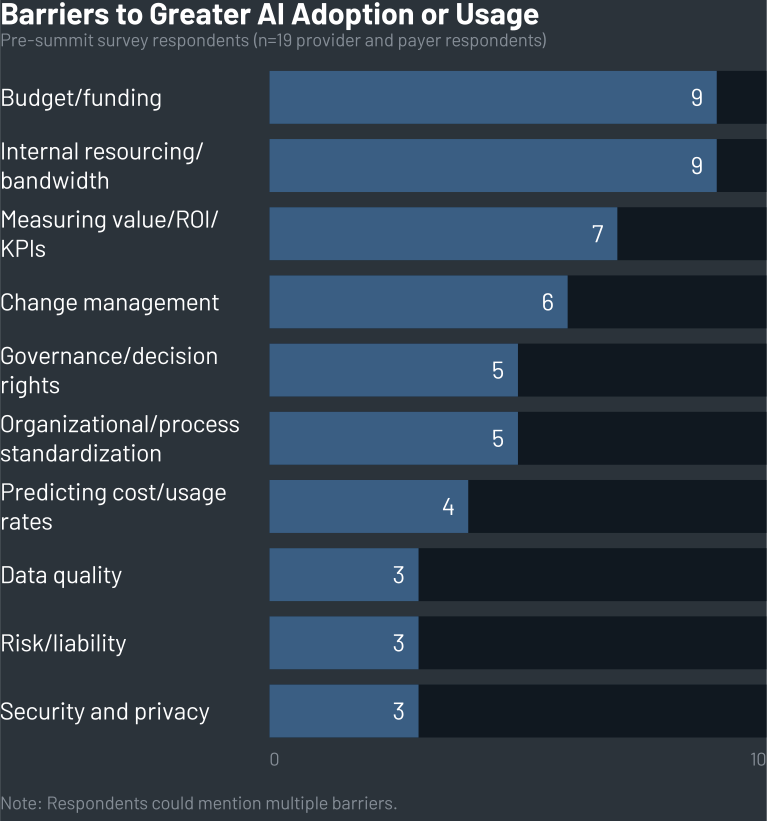
Healthcare organizations are making meaningful progress with specific AI use cases and seeing early benefits. Ambient documentation is the clearest current success, with improved clinician efficiency and satisfaction and reduced burnout being proven benefits. Some healthcare organizations have also been able to use AI to help with call centers and administrative work. Still, many AI initiatives remain in pilots or early deployments, and healthcare organizations are largely not realizing widespread, decisive ROIs.
With AI solutions, cost uncertainty is becoming a limitation and a concern. AI pricing may shift from bundled or introductory arrangements toward usage-based charges, and vendors do not always provide enough information for customers to forecast consumption. As product development speeds up, healthcare organizations face more choices and confront the risk that a feature’s cost or competitive advantage may quickly change. Tracking use, projecting expenses, comparing vendors, and tying scale decisions to proven value is important for healthcare organizations as they seek to be prudent with their AI usage.
AI’s promise of value is tied to redesigning work and reducing workflow friction rather than adding a standalone feature to an existing process. The ability to serve specialized workflows and deliver relevant information at the point of need may differentiate vendors as core AI features become more common.

Healthcare Organizations Expect Deeper Vendor Partnerships
HIT vendors should begin discussions with healthcare organizations by seeking to understand their problems rather than jumping straight to proposing solutions. Healthcare organizations want partners who understand healthcare’s unique workflows, come prepared with specific use cases, and can help make the value case. Product demonstrations are not sufficient—healthcare organizations look for evidence that a solution works in the intended setting and can be integrated into the end users’ daily work.
The pace of innovation is changing what is required of strong partnerships. Shorter product cycles, quickly changing capabilities, and uncertainty about which features will be differentiators are creating an atmosphere in which healthcare organizations expect vendors to partner with depth and commitment. Critically, the quality of a partnership becomes most visible when a product fails or a difficult issue emerges. Responsiveness, honest communication, timely fixes, and willingness to incorporate frontline feedback help determine whether trust lasts. Vendors are expected to support education and change management, provide pricing clarity, and keep ROI and value visible.
For healthcare organizations, governance should help remove barriers to good investment decisions while retaining the discipline to stop low-value work. In a fast-changing market, healthcare organizations and vendors alike need to revisit assumptions as usage, costs, and capabilities evolve.

Other Insights from DHIS Conversations

Ambient Speech
Ambient documentation is a proven AI use case in healthcare because of its fit within an existing encounter and its proven ability to reduce clinician burden. Other benefits include coding support, more complete documentation, and better preparation for patient visits. These examples support the value of ambient tools, but results differ by specialty, setting, workflow, and adoption level. The next wave of ambient use includes AI-enabled chart review, visit preparation, handoffs, coding, prior authorization, and reducing administrative tasks. There is no market-wide consensus when it comes to how readily ambient technology applies to nursing: some see promise in reducing documentation after shifts, while others question whether existing nursing documentation challenges should first be addressed through process changes.

Ambulatory Care EHR
Healthcare organizations may increasingly expect ambulatory care EHR vendors to support the full practice workflow—from patient access and documentation through reimbursement—rather than simply record and store clinical encounters. This expectation is particularly consequential for independent and specialty practices, who need solutions that reduce administrative effort and make financial benefits visible without requiring the resources of a large health system. AI is expected to become part of everyday workflows, though perspectives differ on how much capability should be built into the EHR versus provided by connected partners. AI may make large volumes of information easier to search and summarize, but ambulatory care practices will still need complete workflows, appropriate incentives for data sharing, and clinician review.

Data Management
In the age of AI, data quality is paramount. AI can magnify weaknesses in incomplete or poorly governed data, while a large data repository without effective governance may add cost without making information more useful. Before moving, consolidating, or applying data, healthcare organizations should define what the data needs to support and then design access around users’ needs and workflows. Without a clear purpose, data migration can preserve complexity rather than create value. Application rationalization also requires ongoing decisions about which applications to retain, invest in, migrate from, or retire, and healthcare organizations should revisit these choices as their needs change. Additionally, strong data governance should enable responsible change, not restrict change altogether.

Revenue Cycle Management
In revenue cycle management, AI and automation are expected to help healthcare organizations do more with existing resources. As these capabilities advance, revenue cycle employees may shift from working alongside AI tools to managing or building agentic workflows. Executive sponsorship and organizational readiness will influence how quickly organizations can adopt these solutions. Healthcare organizations must also decide how to balance the costs of developing and maintaining solutions internally with the value of external partners. To assess ROI, healthcare organizations should track increased capacity, higher-value staff work, and improved performance against credible KPIs, rather than focusing only on workforce reductions.
Sponsors


Summit Presenters & Panelists
Thank you to all the keynote speakers, presenters, and panelists who participated in DHIS 2026.
Matthew Anderson, Chief Medical Officer, HonorHealth
Richard Atkin, CEO, Greenway Health
Sean Barrett, Chief Product Officer, Availity
Rob Bart, CMIO, UPMC
Brandon Burnett, Chief RCM Officer, FinThrive
David Chestek, DO, CMIO, UI Health
Dustin Cook, Managing Director, Intermountain Ventures
Joe Depa, Global Chief Innovation Officer, EY
Sriram Devarakonda, Chief Technology Officer, Cardamom
Shawn Griffin, President & CEO, URAC
Jim Griffith, SVP & Chief Strategy Officer, Mary Washington Healthcare
Nate Henderson, CMO & VP Quality, BlueCross BlueShield of South Carolina
Ryan Higgins, Partner, McDermott, Will, & Schulte
Shannon King, Senior Vice President, Guidehouse
Sam Lambson, Vice President, athenahealth
Danny Lee, MD, FACP, CMIO, Johns Hopkins Community Physicians
Michael Meucci, CEO, Arcadia
Abby Polich, SVP of Client Services, Health Data Movers
Donna Roach, Chief Digital Information Officer, University of Utah Hospitals and Clinics
Sam Robinson, Vice President, TripleTree
Jason Rose, CEO, Clearsense
David Sanner, CMIO, Loma Linda University Medical Center
Jacob Shurbet, Partner, PwC
Canaan Stage, VP, Domain Leader Care Team Optimization, HCA Healthcare
Justin Steinman, Chief Marketing Officer, ModMed
Andy Strunk, Founder & CEO, Accretive Edge
Tanya Townsend, Chief Information & Digital Officer, Standford Medicine Children’s Health
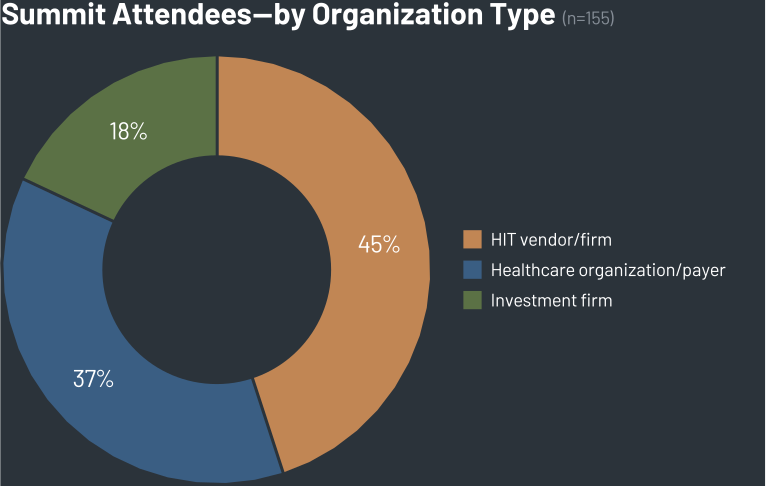
Summit Attendees
Access Corp
Accretive Edge
AGFA HealthCare
Andor Health
Arcadia
Arkstone
ARUP Laboratories
Aspen Advisory Services Ltd
AssistIQ
athenahealth
Augusta Health
Availity
Bain & Company
Ballad Health
Beacon Health System
BlueCross BlueShield of South Carolina
Brighton Park Capital
Candid Health
Cardamom
Castillo Primary Care
Censinet
CereCore
Clearlake Capital
Clearsense
Cleveland Clinic
Cohen Veterans Network
Commure
Corewell Health
CorroHealth
Dayton Children’s Hospital
Deloitte
Diameter Capital
EBSCO Clinical Decisions
Endeavor Health
Epic
EQT
Evergreen Healthcare Partners
EY
EY-Parthenon
FinThrive
Focus
Fulcrum Equity Partners
General Atlantic
General Medicine
Greenway Health
Guidehealth
Guidehouse
GW RhythmX
Harmony Healthcare IT
HCA Healthcare
Health Catalyst
Health Data Movers
Healthrise
Heidi
Hg Capital
HonorHealth
HTC Global Services
Hyro
Imprivata
Infinx
Intermountain Health
Iron Road Healthcare
Johns Hopkins Community Physicians
KKR
Loma Linda University Health
Mary Washington Healthcare
Medical Solutions
Med Tech Solutions (MTS)
MemorialCare Innovation Fund
Mercy
Mission Community Hospital/Bespoke HC
Mizuho Group
ModMed
Morris Technology Solutions
MTS
Neurealm
New Mountain Capital
Nordic
Northwell Health
Novo Holdings
Orlando Health Ventures
OSF Ventures
Parkview Health
Patient Square Capital
Peloton Equity
Penn Medicine
PointClickCare
PwC
QGenda
R1 RCM
Raymond James
Regional Medical Imaging (RMI)
Rhapsody
Rush University System for Health
Sixth Street Growth
Stanford Health Care
Stryker
Sutter Health
TA Associates
Tampa General Hospital
TCV
tebra
Tech Mahindra
THL Partners
Thoma Bravo
TOPMED
TPG Growth
UChicago Medicine
UCI Health | Ventures & Innovation
UI Health
UNC Health Ventures
Universal Health Services
University Health
University of Utah Health
UPMC
UT MD Anderson
Valtruis
Vigor Medical Systems
Warburg Pincus
Reserve Your Spot for DHIS 2026
To join the conversation and secure your spot at DHIS 2027, reach out to your KLAS contact or email events@klasresearch.com.

Project Manager
Andrew Wright
This material is copyrighted. Any organization gaining unauthorized access to this report will be liable to compensate KLAS for the full retail price. Please see the KLAS DATA USE POLICY for information regarding use of this report. © 2026 KLAS Research, LLC. All Rights Reserved. NOTE: Performance scores may change significantly when including newly interviewed provider organizations, especially when added to a smaller sample size like in emerging markets with a small number of live clients. The findings presented are not meant to be conclusive data for an entire client base.