KLAS Contact

Contact KLAS
Contact KLAS
 2026 BEST IN KLAS
Preferences
Related Series
Related Segments

Epic in the Public Cloud 2024
Are AWS & Microsoft Azure Meeting the Expectations of Early Adopters?

Author
Mike Smith

Author
Emily Paxman

Author
Blake Jensen
Over the past three years, a growing number of healthcare organizations have started using public cloud providers for their Epic workloads due to the promised benefits of a cloud environment. In 2023, KLAS published a report exploring the decision-making process of organizations considering the public cloud for their Epic environment; since then, several organizations have gone live with their Epic cloud environment. As an update to last year’s insights, this report examines the viability of Epic in the cloud—looking at the success and scalability of cloud deployments, the strengths and weaknesses of Amazon Web Services (AWS) and Microsoft Azure, the benefits organizations have achieved, and the areas where third-party support is used to facilitate the cloud journey.
Note: Data for this report was collected from May 2024 to August 2024. At the time of this research, around 30 healthcare organizations in North America were live with Epic workloads in the public cloud; all use either AWS or Microsoft Azure. For this report, KLAS interviewed 18 of those organizations, including 10 clients live with a full Epic production environment.
Public Cloud Scalability: While Market Is Still Early, Large Organizations in Full Production Environments Report Success with Both AWS & Microsoft Azure
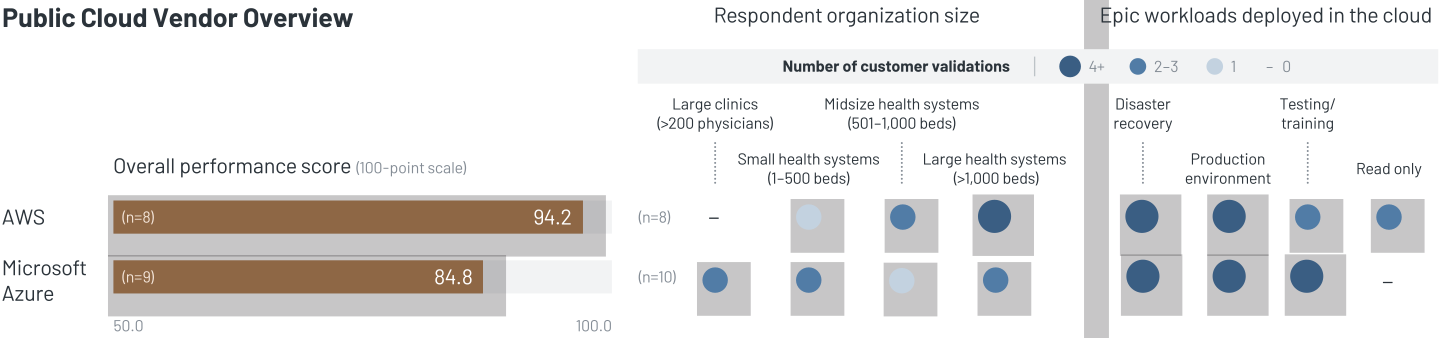
For healthcare organizations wanting to use the public cloud for their Epic environment, scalability is top of mind. Some organizations, particularly large health systems, have questions about the ability of public cloud providers to scale and, as a result, are proceeding cautiously in moving to the cloud. Notably, in this report sample, large health systems in full production environments (most of which are AWS customers) report positive experiences with cloud reliability and scalability, highlighting smooth service with only minor interruptions. Some also cite scalability as one of the primary benefits of the cloud. Additionally, most of these large organizations have implemented Epic disaster recovery, and more than half have implemented testing and training. Across all respondent organization sizes, there is a similar trend—the majority utilize a cloud provider for Epic disaster recovery, and this often serves as the initial step in the Epic cloud migration journey. Furthermore, half of interviewed organizations utilize the cloud for testing and training within their Epic environments.
Future Use of Public Cloud Environments
Nearly all interviewed customers of both AWS and Microsoft Azure plan to expand their cloud usage. Over one-third of respondents intend to move away from on-premises setups as much as possible, with all but one in this subgroup aiming to move all applications and environments to the cloud. Other respondents are looking to expand their Epic cloud environment by adding disaster recovery, production environments, and testing and training.
Technology, Speed & Support Drive Strong Satisfaction for AWS Customers; Microsoft Azure Customers Appreciate Platform, though Inconsistent Support & Relationships Affect Overall Satisfaction
Although both AWS and Microsoft Azure are highlighted for their strong technology, AWS respondents report higher satisfaction in this area (see chart on next page). They particularly appreciate the product’s speed and hope it will help them avoid having to use third-party offerings. Furthermore, the vendor’s relationships are a strength, and all respondents are satisfied with the support, saying AWS team members are strong partners who have expertise. Respondents also note that AWS proactively plans implementations, shares cost projections, and goes beyond contract scope to help customers. Some respondents feel that the vendor could better support them in establishing interoperability with other solutions and optimizing the cloud to get more value for the price.
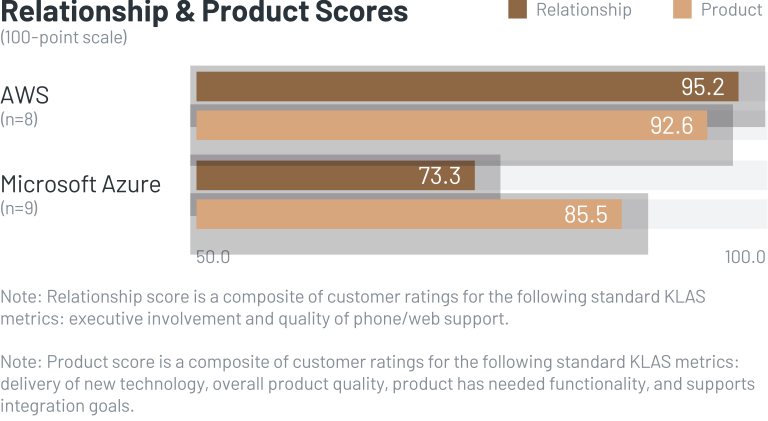 Most respondents using Microsoft Azure say the first-tier support resources aren’t knowledgeable about the intricate nature of the Azure cloud, causing some customers to purchase access to a higher tier of Microsoft support or work with a third-party firm in order to achieve success.† Some customers who use Microsoft’s higher tier of support are more satisfied with Azure and describe the vendor as a partner who provides strategic guidance. In contrast, respondents who report poor support experiences—such as struggles resolving downtime or deploying new features—have a more negative perception of the cloud.
† Microsoft reports that they have recently made changes to their support structure for all Epic installs. Because these changes occurred after the data collection window for this report, KLAS has not interviewed any affected customers, though we intend to do so for future research.
AWS Customers Report Improved Performance & Microsoft Azure Customers See Consistent Results; Cost Savings Not Yet Realized for Either Customer Base
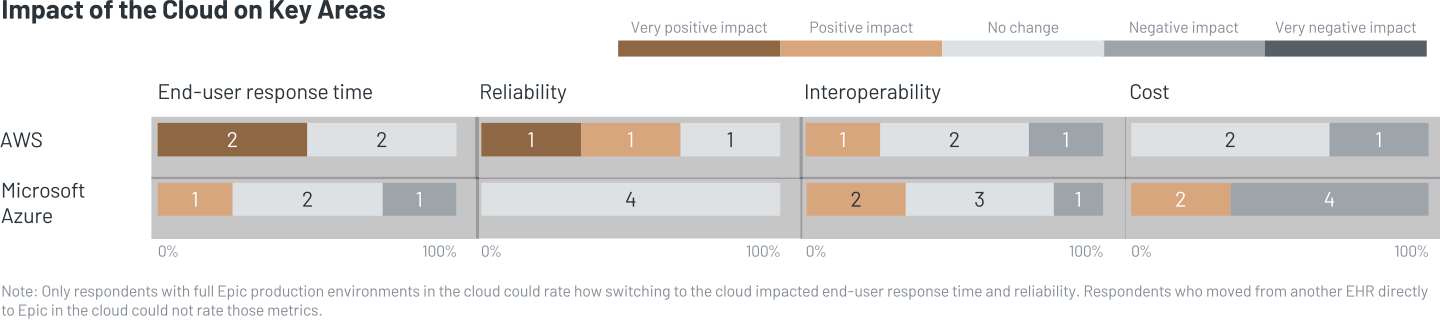
Healthcare organizations move Epic into the cloud for several reasons—e.g., to reduce capital costs, improve performance and reliability, have faster provisioning, and enhance security. Interviewed customers of AWS and Microsoft Azure most commonly report achieving increased scalability, flexibility, and reliability with the cloud; they also appreciate being prepared for disasters and avoiding costs related to on-premises resources. All AWS respondents say their response time and reliability have stayed the same or improved since moving to the cloud, with 75% saying at least one of those metrics has significantly improved. A few customers also report that the process of moving their environment to the cloud was smooth and easy, with no disruptions in response time and reliability. Interviewed Microsoft Azure customers report seeing no significant change in response time and reliability since moving to the cloud. Regarding cost, most interviewed customers of both vendors feel the cloud solutions are as expensive or slightly more expensive than their previous on-premises environments. However, these respondents note that the cost of the cloud solutions meets their expectations and that they hope to eventually achieve some savings related to infrastructure and IT staffing.
Healthcare Organizations Cite Integration & Internal Expertise as Biggest Challenges
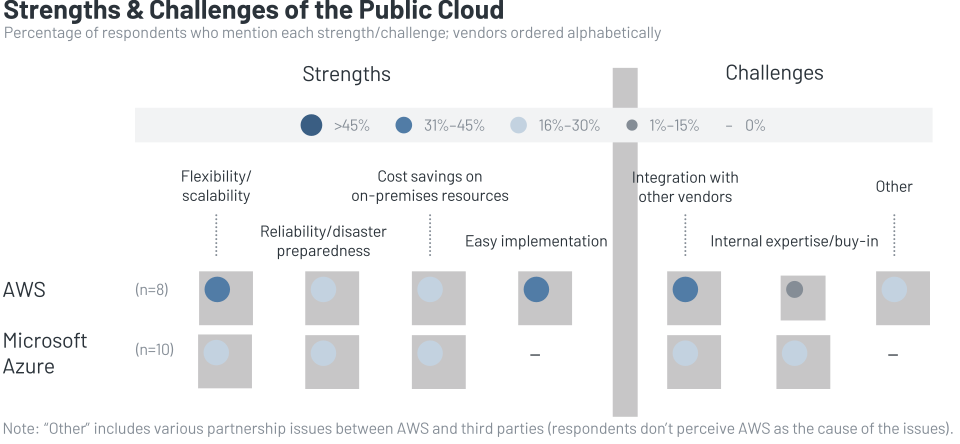 According to interviewed healthcare organizations, the two biggest challenges with being live in the cloud are integration with other vendors’ solutions—such as internet services, lab systems, PACS solutions, and security platforms—and a lack of internal expertise (see next section). While respondents generally experience strong interoperability, some mention that setting up the integration was challenging. One AWS customer says it was difficult to get all the on-premises and hosted systems (i.e., public cloud, hosted cloud, and vendor-hosted systems) to work together. A customer of Microsoft Azure says that achieving interoperability with their on-premises environment was easier than with the cloud, and another customer reports having less control over integration now that the Epic solution is in the cloud.
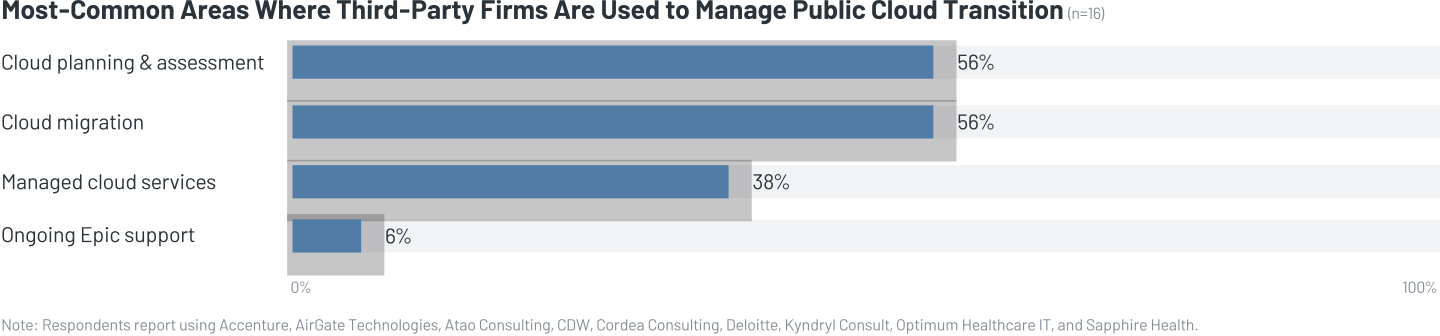
Use of Third-Party Firms for Cloud Planning/Assessment & Migration Is High
Healthcare organizations moving Epic into the cloud are significantly challenged by a lack of internal resources with cloud expertise. Among interviewed organizations, 75% report relying on external consultants from third-party firms—usually firms focused on supporting AWS or Azure environments—to enhance their cloud expertise and bandwidth (see full report for more details on what third-party firms are used). Respondents most often engage third-party consultants during the planning/assessment and migration phases, with some highlighting that the consultants contributed to their success with the cloud. While most respondent organizations who moved from on-premises environments to the cloud continue to use their internal teams to support their Epic environment, new Epic customers moving directly to the cloud are more likely to use third-party firms for ongoing Epic support. Nearly all interviewed AWS customers report engaging a third-party firm for planning and assessment work, whereas 25% of Microsoft Azure respondents report engaging a firm for the same work.
About This Report
The data in this report comes from two sources: (1) KLAS’ standard quantitative evaluation for healthcare software, and (2) a supplemental evaluation tailored specifically for Epic customers using a public cloud offering from Amazon or Microsoft. Interviews were conducted May 2024–August 2024.
Each year, KLAS interviews thousands of healthcare professionals about the IT solutions and services their organizations use. For this report, interviews were conducted using KLAS’ standard quantitative evaluation for healthcare software, which is composed of 16 numeric ratings questions and 4 yes/no questions, all weighted equally. Combined, the ratings for these questions make up the overall performance score, which is measured on a 100-point scale. The questions are organized into six customer experience pillars—culture, loyalty, operations, product, relationship, and value.

To supplement the customer satisfaction data gathered with the standard evaluation, KLAS also created a supplemental evaluation to delve deeper into healthcare organizations’ experiences moving Epic into the cloud. This evaluation asked respondents the following questions:
- What were the primary factors that influenced your decision to move your Epic environment to the public cloud?
- What Epic environments have you moved to the public cloud?
- Why did you select this cloud provider? Who else was considered? Why did you not go with those cloud providers?
- How has the transition to the public cloud impacted the end-user response time and reliability of your Epic environment?
- What challenges or successes have you encountered during and since the migration?
- Since moving to the cloud, how have your overall and operational costs changed?
- Since moving to the cloud, have you noticed any changes in ease of interoperability with non-Epic internal and external systems?
- Did you use third-party firms for any step in your transition to the cloud? If yes, who?
- Beyond moving Epic to the cloud, how else are you using or planning to use the cloud in the future?
Sample Sizes
Unless otherwise noted, sample sizes displayed throughout this report (e.g., n=16) represent the total number of unique customer organizations interviewed for a given vendor or solution. However, it should be noted that to allow for the representation of differing perspectives within any one customer organization, samples may include surveys from different individuals at the same organization. The following table shows the total number of unique organizations interviewed for each vendor or solution as well as the total number of individual respondents.
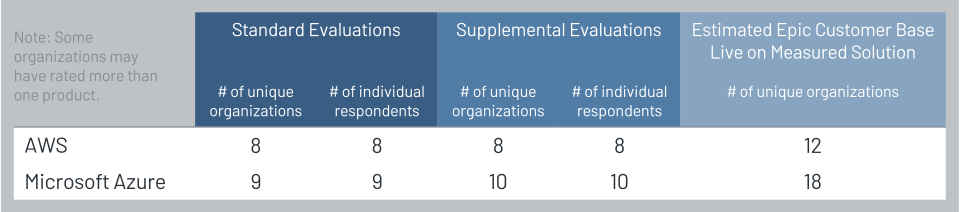 Some respondents choose not to answer particular questions, meaning the sample size for any given vendor or solution can change from question to question. When the number of unique organization responses for a particular question is less than 6, the score for that question is marked with an asterisk (*) or otherwise designated as “limited data.” If the sample size is less than 3, no score is shown. Where textual content relies on limited data, the vendor name is marked with an asterisk. Note that when a vendor has a low number of reporting sites, the possibility exists for KLAS scores to change significantly as new surveys are collected.

Writer
Sarah Brown

Designer
Breanne Hunter

Project Manager
Sydney Toomer
This material is copyrighted. Any organization gaining unauthorized access to this report will be liable to compensate KLAS for the full retail price. Please see the KLAS DATA USE POLICY for information regarding use of this report. © 2026 KLAS Research, LLC. All Rights Reserved. NOTE: Performance scores may change significantly when including newly interviewed provider organizations, especially when added to a smaller sample size like in emerging markets with a small number of live clients. The findings presented are not meant to be conclusive data for an entire client base.