KLAS Contact

Contact KLAS
Contact KLAS
 2026 BEST IN KLAS
Preferences
Related Series
Related Segments

Middle East & Africa EHR 2024
A Look into Vendors’ Broader Portfolios

Author
Everton Santos

Author
Sidney Tate

Author
Spencer Corbett
Over the last five years, the Middle East and Africa healthcare IT markets have expanded and evolved. The Middle East has seen consistent energy around EHR investment and digital transformation, with 10–15 purchase decisions being made annually. Energy in Africa has fluctuated year over year, impacted by some very large regional purchase decisions. When selecting an EHR vendor partner for the digital journey, organizations almost always consider other clinical, administrative, and financial functionalities in addition to the core EHR capabilities the vendor provides. This report both provides an update on EHR vendor performance and market share and offers KLAS’ first holistic look at EHR vendors’ broader portfolios in the Middle East and Africa, specifically highlighting the adoption and performance of ancillary EHR modules.
EHR Market Overview
Health Insights Leads in Customer Satisfaction; Oracle Health Customers Remain Largely Satisfied; InterSystems Customers Note Varied but Improving Relationships & Delivery
 Among fully rated vendors, Health Insights pulled ahead in overall customer satisfaction over the last year with consistently strong delivery of their MEDiCACLOUDCARE platform, which interviewed customers find comprehensive, easy to use, and flexible. Respondents appreciate the vendor’s efforts to build relationships through quick support, customer-centric collaboration, and understanding of local markets—specifically the Saudi Arabian market, where the vendor works through a local reseller. Health Insights was selected for a large ministry-level contract in Egypt in 2021 but has otherwise seen little Middle Eastern growth over the last five years as they have migrated all existing customers to their new platform.
For Cerner—now Oracle Health—the Middle East has been a top-performing global region for over five years where they have won the Best in KLAS award for six consecutive years and the trend has continued since Oracle Health acquired Cerner. Customers find Millennium to be a stable, customizable platform that meets most clinical needs, and respondents appreciate the engagement they receive from the vendor’s helpful resources who drive better use of the system. Some customers feel the system is aging and that Oracle Health has been slow to develop end-user enhancements and respond to regional regulations. Oracle Health has the leading market share in the Middle East, where their client base has grown consistently over the last five years.
In the Middle East, InterSystems customers have reported a steadily stabilizing and improving experience over the last three years, though some inconsistencies remain. Many customers (particularly those in the TrakCare Advance program) appreciate InterSystems’ increased collaboration and work to deliver promised functionalities. Still, many would like to see faster delivery, better communication around new enhancements, and more proactivity around local regulations. Customers continue to report a subpar end-user experience, though they are optimistic that the new mobile-enabled user interface will bring improvements. After a period of intense growth followed by a pause in 2019, InterSystems has consistently grown in the region over the last three years.
IQVIA* Makes Inroads with Strong Focus on Middle East; Epic* Drives Satisfaction through Relationships, though Customers Want Better Localization
 First selected in the Middle East in 2019, IQVIA* has quickly gained energy in the Middle East and Africa, with the second-highest total new hospital wins from 2018–2022. Customer satisfaction is largely driven by IQVIA’s relationships, including local teams that provide close support and engagement for the cloud-based Arcus Air platform. Customers (mostly greenfield hospitals in Saudi Arabia) particularly appreciate IQVIA’s focus on local markets and willingness to adapt to local needs. Notably, amid the vendor’s fast growth, a number of customers reported recent difficulty with implementations and training. Epic* has consistently driven high customer satisfaction in the Middle East among their limited customer base, with many highlighting the vendor’s strong customer partnerships and robust platform that is continually developed. However, respondents feel that Epic’s solutions are not always localized for the Middle Eastern market, and they would like to see more responsiveness to local regulations. The vendor’s growth in the region over the last five years has been smaller due largely to the high price point compared to other vendors selling in the region.
*Limited data
Regional Purchase Decisions Have Driven Changes in Market Share for Many Vendors in the Middle East & Africa over the Past Several Years
Between 2018 and 2022, many large, regional decisions have greatly boosted the market share of vendors in the Middle East and Africa. Notably, there were multiple cluster decisions for Saudi Arabia Ministry of Health greenfield hospitals—Cloud Solutions (three clusters), IQVIA (three clusters), ALERT (one cluster), and Ohum Healthcare (one cluster). After transitioning from paper systems, smaller interviewed hospitals (<200 beds) using Cloud Solutions* are highly satisfied with the EHR’s ability to meet most basic needs. These customers also report that downtime can present issues and there is a need for further development to make functionalities more robust. In Egypt, ministry-level purchase decisions were made in favor of Health Insights and Dedalus Enterprise Management* (then owned by DXC Technology but purchased by Dedalus in 2021). Early feedback from users of Dedalus’ platform shows that the vendor builds good relationships through knowledgeable support resources and engaged executives. However, customers feel the vendor has been slow to develop meaningful enhancements.
*Limited data
Note: Market share data presented below is updated as of December 2022. For details on decisions made in 2023, see KLAS’ upcoming Global (Non-US) EHR Market Share 2024 report.
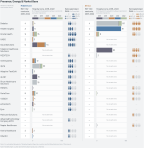
EHR Vendor Portfolio Adoption
Most Vendors Offer Strong Clinical & Administrative Modules; Adoption & Performance of Financial Tools & Other Features Vary
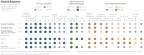
 Most provider organizations in the Middle East leverage additional clinical and administrative modules from their core EHR vendors, and across vendors these modules generally meet clients’ needs. In contrast, billing and revenue cycle management tools have more variable adoption and lower performance in the region; many organizations are working to improve billing workflows, adopt CPT codes, and smoothly integrate their billing solution with their core EHR. Outside of core clinical and administrative/financial areas, adoption of additional features and functionalities varies more widely.
Health Insights & InterSystems Offer Expansive Portfolios with Variable Performance Outside the Core EHR; Oracle Health Delivers Strong Clinical Modules, Less Adopted in Other Areas
 Health Insights stands out for their strong performance and adoption outside of core modules, expanding into data-driven and ancillary functionalities (e.g., business intelligence, patient engagement) as well as other care settings (e.g., community services) with above-average customer satisfaction. Most interviewed customers also use Health Insights’ billing solution and note it meets most of their needs thanks to the vendor’s regional focus, though customers want to see continued development. The vendor’s core clinical and administrative modules are broadly adopted and meet customers’ needs, though customer satisfaction is lower relative to other vendors. While adoption of other modules (e.g., lab, radiology, oncology) is light, interviewed users of these tools are satisfied.
In adoption and customer satisfaction, InterSystems performs best with their core clinical and administrative modules, with many customers reporting the tools meet their needs. Multiple respondents want improved workflows in certain clinical areas such as maternity and oncology as well as improved integration with lab and radiology. InterSystems’ billing solution and additional revenue cycle management tools have above-average adoption, but respondents tend to feel the functionalities are immature and difficult to use. There has been little reported development for ancillary and data-driven functionalities (with patient flow and clinical communications as exceptions), and respondents hope a stronger mobile offering will come with the new mobile-enabled user interface version of TrakCare.
Oracle Health (who has larger-than-average customers) sees wide adoption and high satisfaction with their clinical and administrative tools. In particular, respondents appreciate the PathNet lab solution for its ability to provide critical results immediately. While it still meets most customer needs, the maternity solution is Oracle Health’s only clinical tool with below-average performance. The vendor’s billing solution is used by under half of interviewed customers, and while it meets some needs, adoption and integration have been challenges. Outside of core functionalities, respondents feel the CDS module meets most of their needs; other modules have lower adoption and come with more difficulties—specifically the need for improvement to mobile functionality.


Epic* & IQVIA* See Wide Adoption & Strong Performance among Smaller Live Customer Bases; Dedalus* More Narrowly Adopted
The Epic* platform is extensively adopted by their more limited customer base, and customers report the vendor’s offerings meet nearly all of their needs across clinical and administrative areas. Satisfaction is particularly high for outpatient, ICU, ED, surgery/OR, maternity, and oncology modules. Respondents likewise report high adoption of and satisfaction with the vendor’s data-driven and ancillary functionalities and modules for other care settings, noting that their offerings for areas such as mobile functionality, patient engagement, clinical communications, and patient flow/bed management meet nearly all of their needs. Notably, Epic has not implemented their billing module in the Middle East. Some respondents report difficulties integrating Epic’s EHR with third-party billing solutions.
Among the four interviewed IQVIA* customers (three of whom are small greenfield hospitals), there is extensive adoption and high satisfaction across core clinical areas. IQVIA’s ICU and maternity modules are especially noted for their ability to meet customer needs; respondents rate some other clinical areas lower, such as radiology, but are still satisfied overall. The vendor also has above-average adoption and performance with their administrative/financial modules, and respondents highlight the well-integrated registration/scheduling tool along with the vendor’s commitment to improving the billing module. Adoption is lower for ancillary functionalities (with the exceptions of clinical communications and patient flow), and respondents would like more development around BI and CDS to better leverage EHR data.
The Dedalus Enterprise Management* portfolio is more narrowly adopted overall. All three respondents interviewed customers use the administrative/financial modules and feel they meet most needs. The clinical modules, with slightly lighter adoption, are likewise reported to meet the majority of customer needs when used. Adoption of ancillary and data-driven features as well as use in other care settings is limited.
*Limited data
About This Report
Data for this report comes from three sources: (1) KLAS performance data, (2) a KLAS supplemental questionnaire specific to this report, and (3) KLAS market share data.
KLAS Performance Data and Supplemental Questionnaire
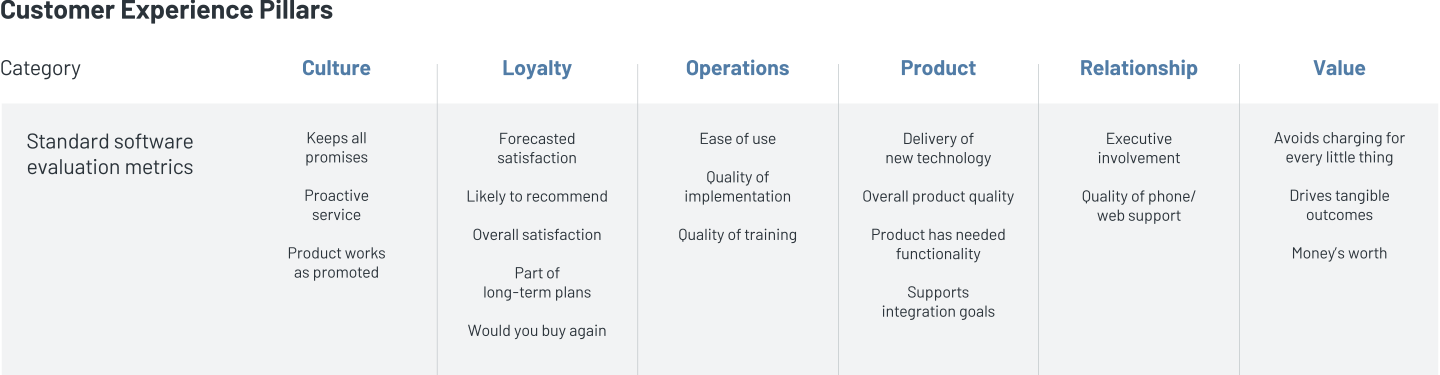
Each year, KLAS interviews thousands of healthcare professionals about the IT solutions and services their organizations use. For this report, interviews were conducted over the last 18 months using KLAS’ standard quantitative evaluation for healthcare software, which is composed of 16 numeric ratings questions and 4 yes/no questions, all weighted equally. Combined, the ratings for these questions make up the overall performance score, which is measured on a 100-point scale. The questions are organized into six customer experience pillars—culture, loyalty, operations, product, relationship, and value.
To gain deeper insights into EHR vendors’ portfolios and performance in the region, KLAS also collected supplemental questionnaires via interviews and online surveys over the last 12 months. In the supplemental questionnaire, organizations reported which modules and functionalities outside of the core EHR they have adopted from their EHR vendors and the degree to which adopted modules are meeting their needs. Additional questions were asked around how well EHR vendors have localized their products for the Middle East and Africa markets, strategic guidance provided by EHR vendors in driving adoption of their solutions, and the strength of integration of outside sources of patient data into the EHR.
Sample Sizes
Unless otherwise noted, sample sizes displayed throughout this report (e.g., n=8) represent the total number of unique customer organizations interviewed for a given vendor or solution. However, it should be noted that to allow for the representation of differing perspectives within any one customer organization, samples may include surveys from different individuals at the same organization. The table below shows the total number of unique organizations interviewed for each vendor or solution as well as the total number of individual respondents.
Some respondents choose not to answer particular questions, meaning the sample size for any given vendor or solution can change from question to question. When the number of unique organization responses for a particular question is less than 6, the score for that question is marked with an asterisk (*) or otherwise designated as “limited data.” If the sample size is less than 3, no score is shown. Where textual content relies on limited data, the vendor name is marked with an asterisk. Note that when a vendor has a low number of reporting sites, the possibility exists for KLAS scores to change significantly as new surveys are collected.

KLAS Market Share Data
In this report, any given vendor’s EHR market share is defined as the total number of inpatient hospital facilities (as opposed to organizations, which may be comprised of multiple hospitals) whose most recent contract is with that vendor. For example, if a vendor signs a contract with a four-hospital organization, that vendor’s market share would increase by four. KLAS acknowledges that in some countries the term “hospital” may be used to refer to an organization with multiple inpatient facilities. However, in this report, “hospital” is used to refer to a single inpatient facility.
Hospitals that have contracted for a new EHR normally continue to use their previous system for one or more years before/after going live with a new one. During this time, the hospital might be considered a customer of both vendors, but only the most recently contracted vendor receives market share credit in this report. Likewise, there may be a space of time between when a previous vendor’s contract ends and a new contract is formalized.In these cases, the previously contracted vendor is recognized as the current vendor until the new agreement is formalized. However, provider organizations have the final say on their own status, so in rare cases when an organization has directly informed KLAS of a decision, a win might be counted before a contract is legally signed.
When measuring market share, KLAS counts any facility that offers inpatient services. Most of the contracts discussed in this report were made by general acute care hospitals, including community hospitals and facilities offering sub–acute or step-down care services (as long as those facilities have overnight inpatient beds). However, this research also includes some EHR decisions made by inpatient rehabilitation facilities, inpatient psychiatric hospitals, and specialty acute care facilities (e.g., for oncology, pediatrics, or ophthalmology). Outpatient facilities, urgent care centers, day hospitals, and residential treatment facilities are excluded.
In cases where two or more healthcare organizations join together to make an EHR purchase decision, KLAS regards the decision as a single contract even if multiple contracts are signed with each participating entity because there was a single, collective decision-making and selection process.
Where Does Market Share Data Come From?
The market share data reported in this study is based on hospital EHR contracts that were in place as of 31 December 2022 in primarily Arabic-speaking countries in Western Asia and Egypt. The data comes from multiple sources, including publicly available information and the numerous conversations KLAS has each year with provider organizations around the globe.
KLAS also provides vendors with the opportunity to report their annual hospital EHR wins. In all cases, KLAS makes a best-effort attempt to use third-party sources and our vast provider network to independently validate all recently signed EHR contracts. While KLAS believes the data in this report is directionally correct, we acknowledge that some variation may result from lack of vendor transparency/participation.
A Note about Terminology and What Counts as an EHR
Though the nomenclature used to describe the core patient record used throughout a hospital varies from region to region or language to language (e.g., EHR, EPR, EMR, EPD, EPJ, DPI, KIS, HCE, PEP, etc.), the term that will be used in this research is EHR (electronic health record).
The EHR is the core record used by hospitals for day-to-day clinical tasks, such as clinical noting and documentation, ordering, results reporting, and ePrescribing. Some systems in this research may not include all of these clinical functions, but they are all viewed by their users as their core patient record. Solutions used solely for document management or scanning are excluded from this research even though they are the primary clinical system in use at some hospitals.
Additionally, the term “vendor” is used throughout this report to refer to the company supplying the EHR technology. KLAS recognizes that different countries may have different terminology, including “supplier.”

Writer
Carlisa Cramer

Designer
Jessica Bonnett

Project Manager
Sydney Toomer
This material is copyrighted. Any organization gaining unauthorized access to this report will be liable to compensate KLAS for the full retail price. Please see the KLAS DATA USE POLICY for information regarding use of this report. © 2026 KLAS Research, LLC. All Rights Reserved. NOTE: Performance scores may change significantly when including newly interviewed provider organizations, especially when added to a smaller sample size like in emerging markets with a small number of live clients. The findings presented are not meant to be conclusive data for an entire client base.