KLAS Contact

Contact KLAS
Contact KLAS
 2026 BEST IN KLAS
Preferences
Related Series
Related Segments

Small-Hospital EHR (1–200 Beds) 2024
Buyer’s Remorse among Recent Decision-Makers

Author
Tyson Blauer

Author
Paul Warburton
Small acute care organizations face unique challenges—such as financial constraints and limited internal resources—that impact or even delay their EHR purchase decisions. As a result, according to KLAS’ 2024 acute care EHR market share report (which tracks all hospital EHR wins and losses), 42% of the small independent hospitals (1–200 beds) still use legacy systems. Still, progress is being made: between 2021 and 2023, KLAS validated go-forward EHR decisions made by 184 such hospitals (almost 14% of the market). This report examines how a sample of those organizations are faring with their new EHR, including what their decisions suggest about future buying energy in this space, how much value they have realized, and how their training experience has been.
Note on Report Sample & Methodology: Data for this report comes from three main sources: (1) KLAS Decision Insights data, (2) KLAS market share data, and (3) KLAS performance data. KLAS Decision Insights data includes all EHR purchases from small standalone hospitals (1–200 beds) between August 2022 and August 2024. The rest of the data comes from a subset of small hospitals that have made an EHR purchase decision in the last three years and have been live for at least three months. Of the vendors with recent wins, only Epic, MEDITECH Expanse, Oracle Health, and TruBridge EHR have sufficient performance data to be included.
Future Buying Energy Coalescing around Epic Community Connect, MEDITECH Expanse & Oracle Health
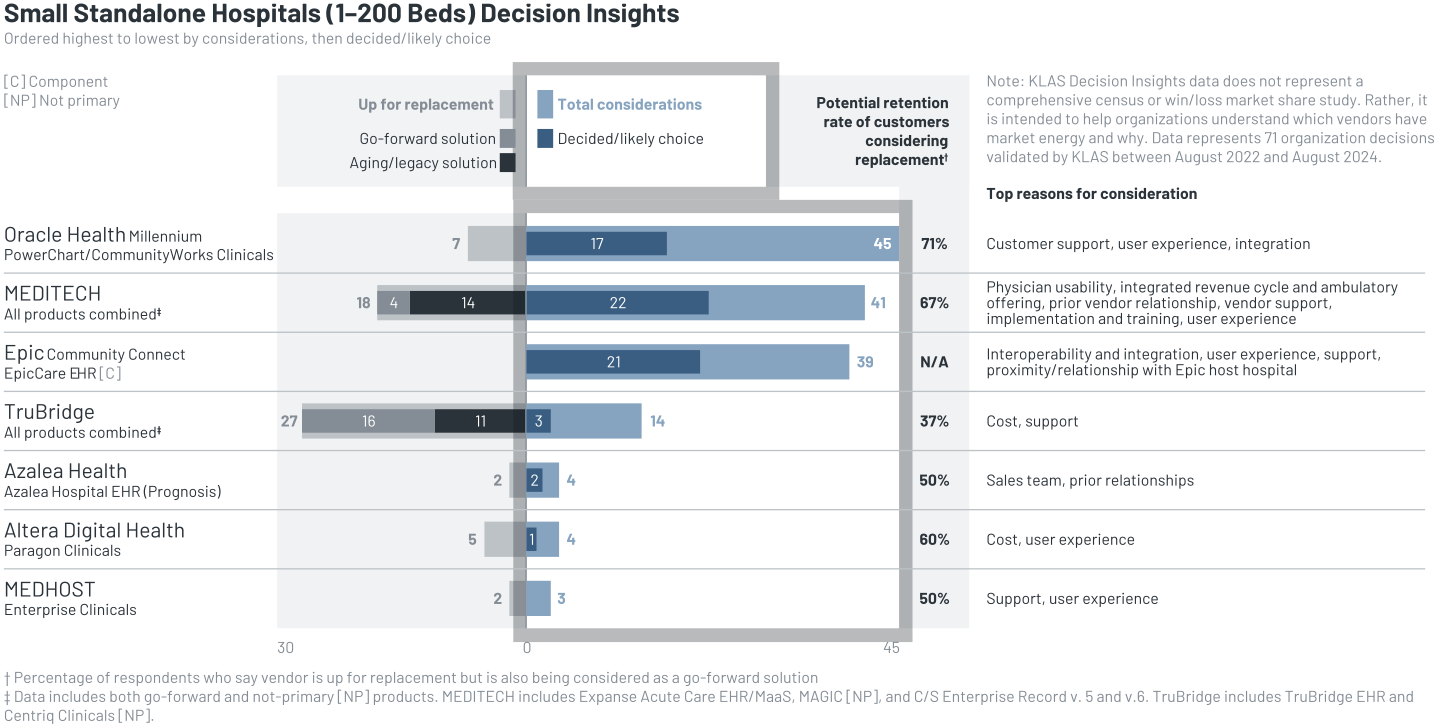
While small standalone hospitals have historically considered a wide array of competitive options for EHR vendors, more recently, these hospitals have increasingly focused their considerations on just three vendors: Epic, MEDITECH, and Oracle Health. In decisions made so far in 2024, most organizations who selected a vendor have gone with Epic or MEDITECH. Organizations consider Epic Community Connect (hosted by larger Epic customers) for the potential to enhance internal integration and clinician satisfaction. Cost and the lack of direct support from Epic can be limiting factors up front. No current customers in this sample plan to replace Epic Community Connect. MEDITECH Expanse is primarily considered as an option to improve usability; most considerations and selections come from organizations on a legacy MEDITECH product (i.e., C/S v.5 and 6.x, MAGIC). Still, provider organizations not already on MEDITECH’s solution often consider the Expanse platform as well. Organizations who selected Expanse did so due to past vendor experiences and high physician usability.
Oracle Health is the most considered solution among interviewed small standalone hospitals in the last two years. Potential customers say they see value in the broad platform and appreciate its low up-front cost. They also consider Oracle Health for the promised strong support. Further, market share data shows that Oracle Health had the most net-new small-hospital wins in between 2021 and 2023 (see next section). Interviewed organizations who selected Oracle Health primarily cite promised improved integration and expanded functionality. In validated 2024 purchase decisions, the frequency of provider organizations saying Oracle Health is their likely choice has declined, with only one respondent saying Oracle Health is the likely choice so far. Some respondents mention not considering or going with Oracle Health because of prior experiences with the vendor—concerns include ad hoc costs and lack of flexibility in the shared model, as any change requires approval from other customers on the same instance of Millennium.
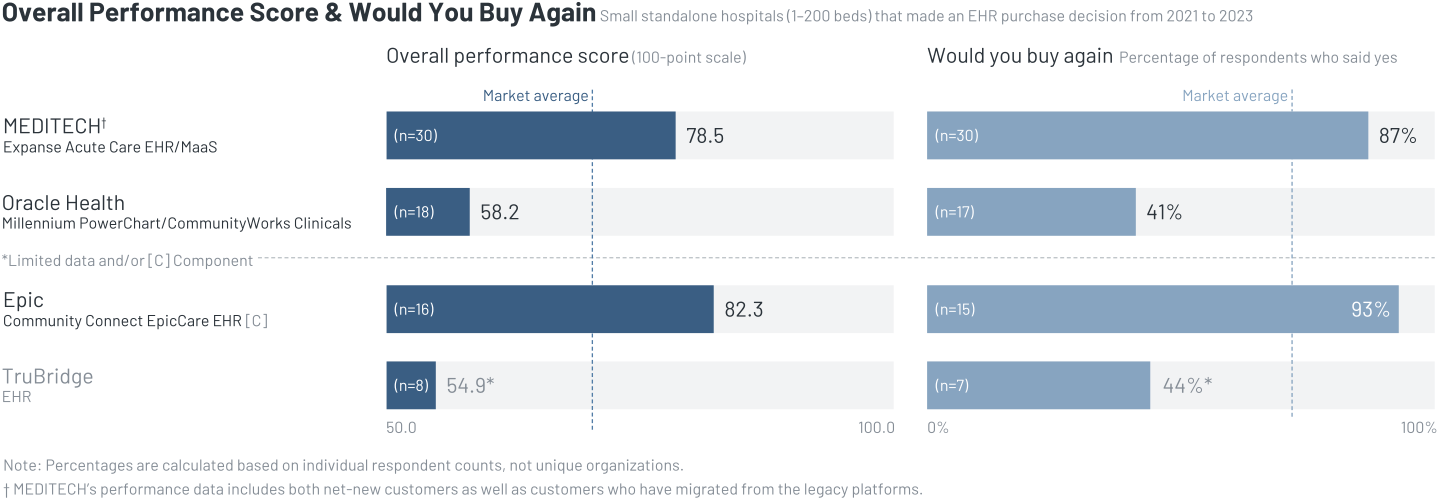
Majority of Oracle Health & TruBridge* Respondents Would Not Buy Solution Again
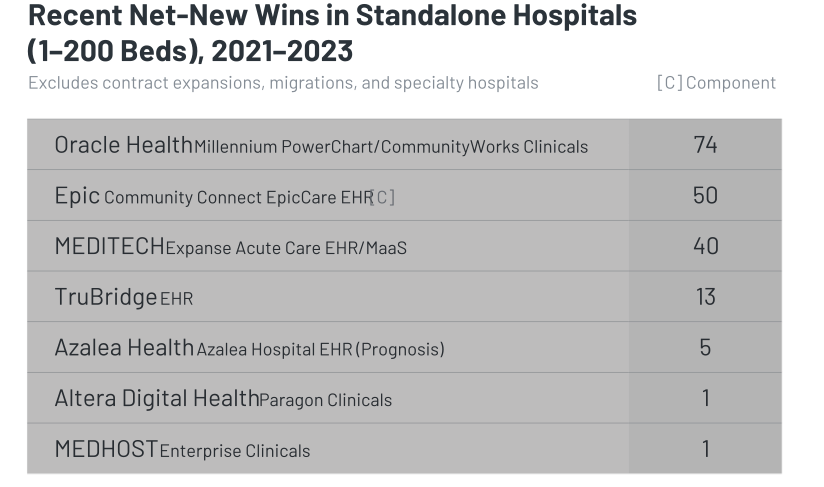 As mentioned above, KLAS’ market share data shows that interviewed small hospitals most often chose Oracle Health in net-new decisions between 2021 and 2023. Though many interviewed new customers hoped for improved integration and functionality, overall, they feel their expectations have not been met. Low satisfaction is driven by inefficient vendor processes around implementation, training, and support, which leave respondents feeling overwhelmed and left to work through challenges (e.g., integration) on their own. No interviewed customers plan to leave Oracle Health, though more than half would not purchase the solution again. Respondents often feel stuck because of the expense and feel obligated to make the solution work. TruBridge* was selected by a smaller number of organizations primarily for the solution’s cost. These customers are the most dissatisfied in this report sample—they report an old, difficult-to-use user interface, issues integrating with other technologies, and a lack of vendor guidance on solution optimization. Despite having recently purchased the system, a few respondents are so dissatisfied that they plan to move away from TruBridge and are considering Epic Community Connect, MEDITECH, and Oracle Health.
Newer customers of Epic Community Connect and MEDITECH Expanse are more satisfied with their solutions’ current performance and are optimistic their experience will continue to improve. Respondents of both vendors feel they have received the modern tools they were hoping for and that there have been few misalignments between sales promises and deliverables.
*Limited data
MEDITECH Highlighted for Few Unanticipated Costs; Epic Customers Find Value in Broad Functionality
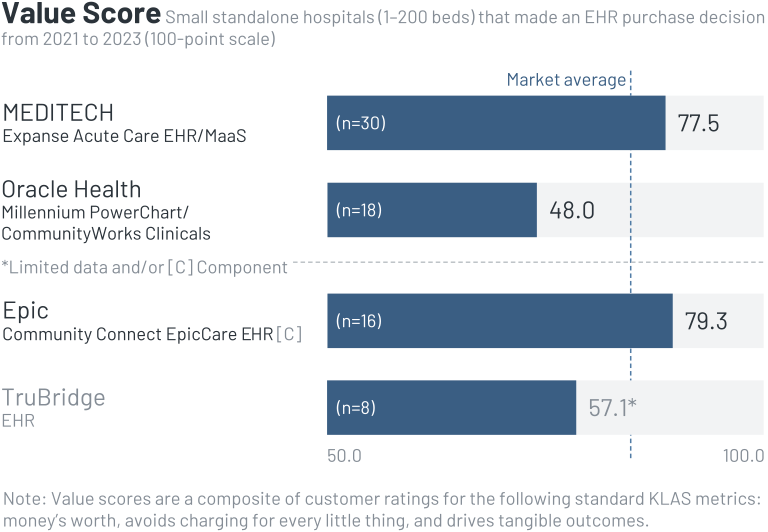 Because small standalone hospitals’ finances are often limited, the value and ROI that they realize from their technology investments are critical to their satisfaction. Although interviewed MEDITECH customers note the expense of moving to Expanse, they feel the vendor has done their best to reduce additional costs. Some respondents opt for MEDITECH as a Service (MaaS) because of the standardized experience and lower up-front costs. Interviewed customers would like to see greater analytics functionality and more guidance on how to optimize their tools and further drive value. Epic Community Connect respondents feel that the cost is high but is also somewhat balanced by the breadth of the offering. Additionally, they say recruiting Epic-certified staff is made easier given Epic’s prevalence in the market. Being hosted by another organization has downsides that affect value—for example, cost of interfaces, irregular price increases determined by the host organization, and unanticipated additional charges for on-site training. Oracle Health respondents report the lowest value score among measured vendors, as many feel a lack of clear up-front pricing has led to missed expectations around the system’s value. Respondents report unexpected costs for new modules and workflow customizations they feel should be included in the initial scope of the project; these ad hoc costs have prevented some from achieving the integration they hoped for across the vendor’s broad functionality set. TruBridge*, often purchased specifically for the perceived lower cost, falls short in delivering strong value because of the need for additional third-party tools for functions outside clinical documentation and billing, such as analytics and a portal. Respondents’ sense of value is also dragged down by support that doesn’t sufficiently respond to and solve problems.
*Limited data
Though Critical to Reducing Clinician Burnout, Initial & Ongoing Training Not Prioritized by Vendors or Provider Organizations
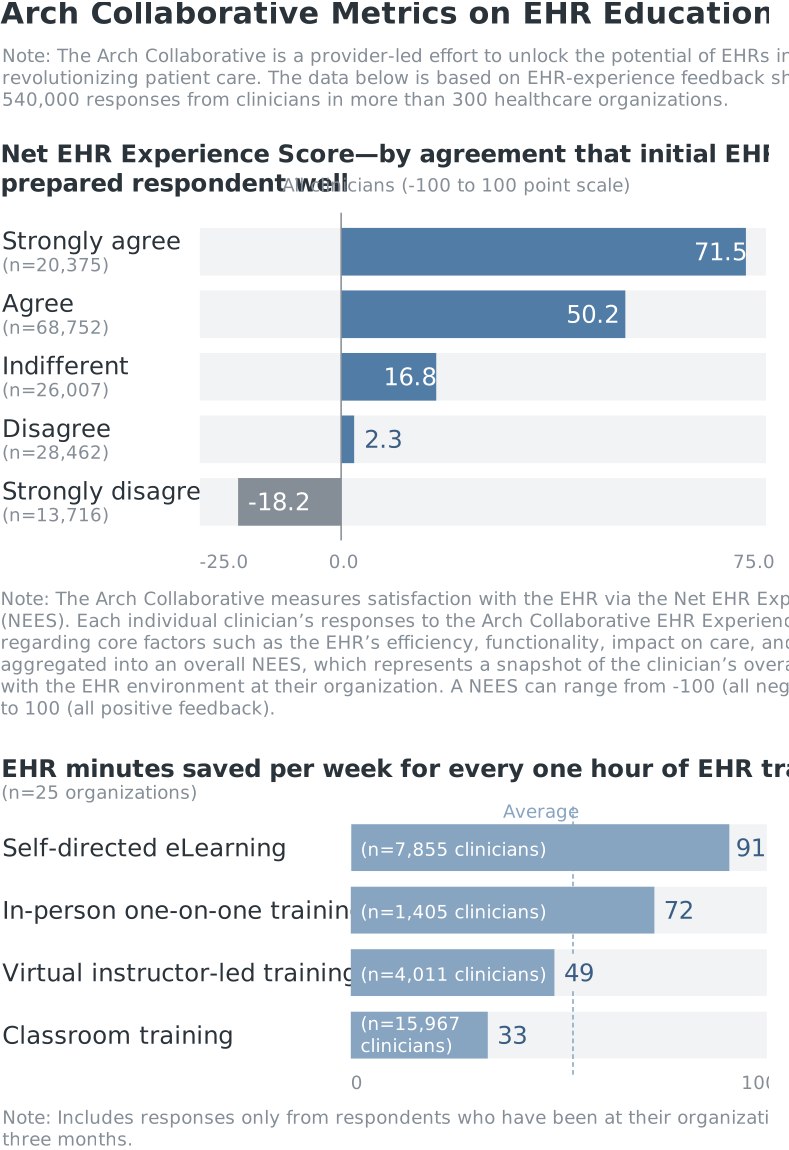
Research from the KLAS Arch Collaborative (a provider-led effort to unlock the potential of EHRs by improving the end-user experience) shows that EHR education is one of the biggest factors in clinicians’ EHR satisfaction. While EHR education, specifically preimplementation and ongoing training, is something vendors can directly support, investment in and dedicated resources for training and implementation are often among the first things to be reduced or eliminated by smaller hospitals due to cost. Both vendors and provider organizations need to work together to increase investment and improve processes—vendors by being more prescriptive and provider organizations by avoiding understaffing and training cuts. Across vendors, interviewed customers are disappointed with their implementation and training.
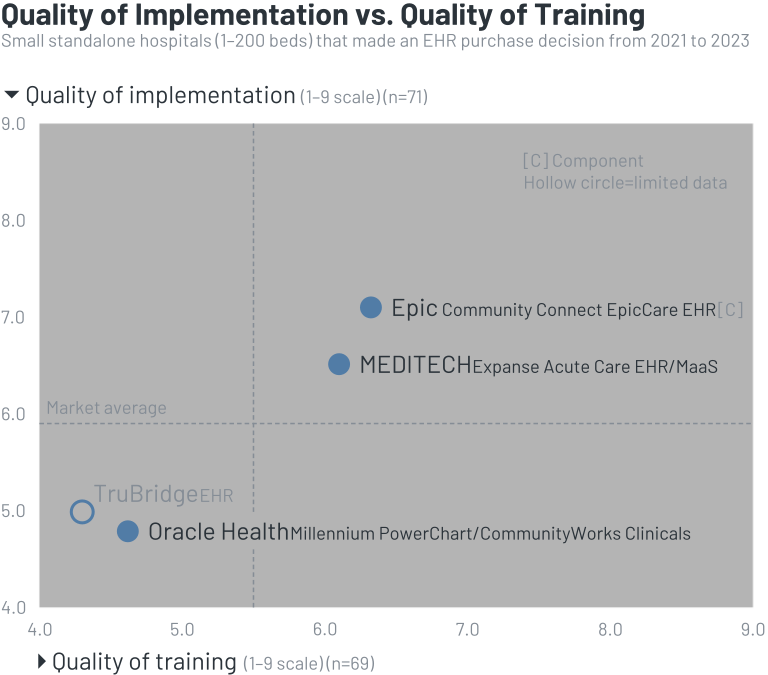
Training and implementation guidance for Epic Community Connect reflects the efforts of and support from the host provider organizations rather than Epic directly. While some hosts have standardized and created robust implementation and training programs, the quality of training and implementation varies vastly by host site. And respondents often recommend getting very specific details on what will and will not be covered as part of the implementation—e.g., on-site training, interfaces that will and won’t be built, and documentation about the go-live process. Organizations using MEDITECH appreciate the vendor’s knowledgeable resources. Still, customer satisfaction on the quality of implementation and training is relatively lower than other MEDITECH metrics—respondents want more guidance and structure around the actual build and go-live processes to ensure all data flows well between the respective tools. Interviewed Oracle Health customers specifically note that expectations set in the sales process were ultimately not met due to insufficient resources and turnover during implementation, ultimately leading to unoptimized workflows. Respondents also feel the training materials are insufficient; many have had to resort to third-party implementation resources and thus rate value lower. TruBridge* respondents report inconsistent quality of personnel, noting that success often depends on knowing the right experts and going to them directly to get additional guidance and help. While most respondents feel dissatisfied with the vendor’s training and implementation, two report high satisfaction, as they feel they were able to get in touch with the right experts.
*Limited data
About This Report
Data for this report comes from three main sources: (1) KLAS Decision Insights data, (2) KLAS market share data, and (3) KLAS performance data. KLAS Decision Insights data includes all EHR purchases from small standalone hospitals (1–200 beds) between August 2022 and August 2024. The rest of the data comes from a subset of small hospitals that have made an EHR purchase decision in the last three years and have been live for at least three months. Of the vendors with recent wins, only Epic, MEDITECH Expanse, Oracle Health, and TruBridge EHR have sufficient performance data to be included.
KLAS Decision Insights Data
All references in this report to organizations’ purchasing motivations come from KLAS’ Decision Insights data. Since 2017, KLAS has been gathering information as to which vendors are being replaced, considered, and purchased and what factors drive these decisions. KLAS Decision Insights data does not represent a comprehensive census or win/loss market share study. Rather, it is intended to help organizations understand which vendors have market energy and why. The data set in this report comes from 71 small standalone hospitals (1–200 beds) that are making or have recently made an acute care EHR purchase decision validated by KLAS between August 2022 and August 2024.
KLAS Market Share Data
The market share data reported in this study is based on acute care EHR purchasing activity (i.e., executed contracts) by small standalone hospitals (1–200 beds) that occurred in the United States from January 1 to December 31, 2023. The data comes from multiple sources, including publicly available information and the thousands of conversations KLAS has with provider organizations each year. KLAS also gives vendors the opportunity to report their annual acute care hospital EHR wins, which KLAS then validates with provider organizations. While KLAS believes the market share data is directionally correct, we acknowledge that some variation may result from lack of vendor participation. See full 2024 market share report for more details.
KLAS Performance Data
Each year, KLAS interviews thousands of healthcare professionals about the IT solutions and services their organizations use. For this report, interviews were conducted over the last 12 months using KLAS’ standard quantitative evaluation for healthcare software, which is composed of 16 numeric ratings questions and 4 yes/no questions, all weighted equally. Combined, the ratings for these questions make up the overall performance score, which is measured on a 100-point scale. The questions are organized into six customer experience pillars—culture, loyalty, operations, product, relationship, and value.

Sample Sizes
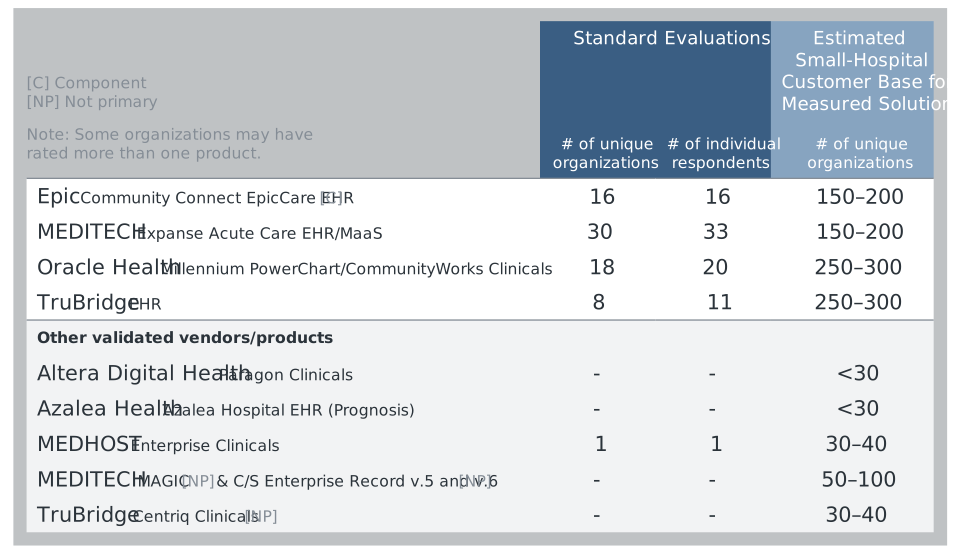
Unless otherwise noted, sample sizes displayed throughout this report (e.g., n=16) represent the total number of unique customer organizations interviewed for a given vendor or solution. However, it should be noted that to allow for the representation of differing perspectives within any one customer organization, samples may include surveys from different individuals at the same organization. The following table shows the total number of unique organizations interviewed for each vendor or solution as well as the total number of individual respondents.
Some respondents choose not to answer particular questions, meaning the sample size for any given vendor or solution can change from question to question. When the number of unique organization responses for a particular question is less than 15, the score for that question is marked with an asterisk (*) or otherwise designated as “limited data.” If the sample size is less than 6, no score is shown. Where textual content relies on limited data, the vendor name is marked with an asterisk. Note that when a vendor has a low number of reporting sites, the possibility exists for KLAS scores to change significantly as new surveys are collected.
Product Designations Used in This Report
- Component [C]: Product that typically includes most but not all components that comprise a complete system or that serves only a subset of the market. Epic is designated Component, as the Community Connect solution is sold and supported through host organizations rather than through Epic directly.
- Not Primary [NP]: Product that is not the vendor’s lead product in the market segment but can still be purchased and is still supported. In some cases, the product may not be actively sold.

Writer
Carlisa Cramer

Designer
Kath Spencer

Project Manager
Andrew Wright
This material is copyrighted. Any organization gaining unauthorized access to this report will be liable to compensate KLAS for the full retail price. Please see the KLAS DATA USE POLICY for information regarding use of this report. © 2026 KLAS Research, LLC. All Rights Reserved. NOTE: Performance scores may change significantly when including newly interviewed provider organizations, especially when added to a smaller sample size like in emerging markets with a small number of live clients. The findings presented are not meant to be conclusive data for an entire client base.