KLAS Contact

Contact KLAS
Contact KLAS
 2026 BEST IN KLAS
Preferences
Related Series

2025

2024

2022

2020
2018

2017

Enterprise Imaging Summit 2026

Author
Monique Rasband

Author
Jonathan Christensen

Author
Maddie Calder
In September 2026, KLAS hosted our two-day Enterprise Imaging Summit in Park City, Utah. Enterprise Imaging (EI) thought leaders from healthcare organizations and IT vendors gathered to discuss how to more clearly recognize value and outcomes from imaging AI solutions and how to quickly and successfully move past the pilot phase when bringing an EI solution on board. This report summarizes the key takeaways from the summit’s tabletop discussions, including the key factors for successfully incorporating AI into imaging workflows, quantifying the value of these kinds of solutions, and understanding when to pivot. It also examines what makes a pilot successful for all stakeholder groups and how to set pilots up for success.
Defining Enterprise Imaging
Based on input from healthcare organizations, KLAS defines enterprise imaging as the ability to store and/or view images across the enterprise in one place from more than one service line and/or from multiple PACS or long-term storage solutions, enabling improved patient care through integrated image access throughout the organization.
Provider & Vendor Priorities Align, with AI at the Top; Operational AI Is Increasingly Important to Healthcare Organizations
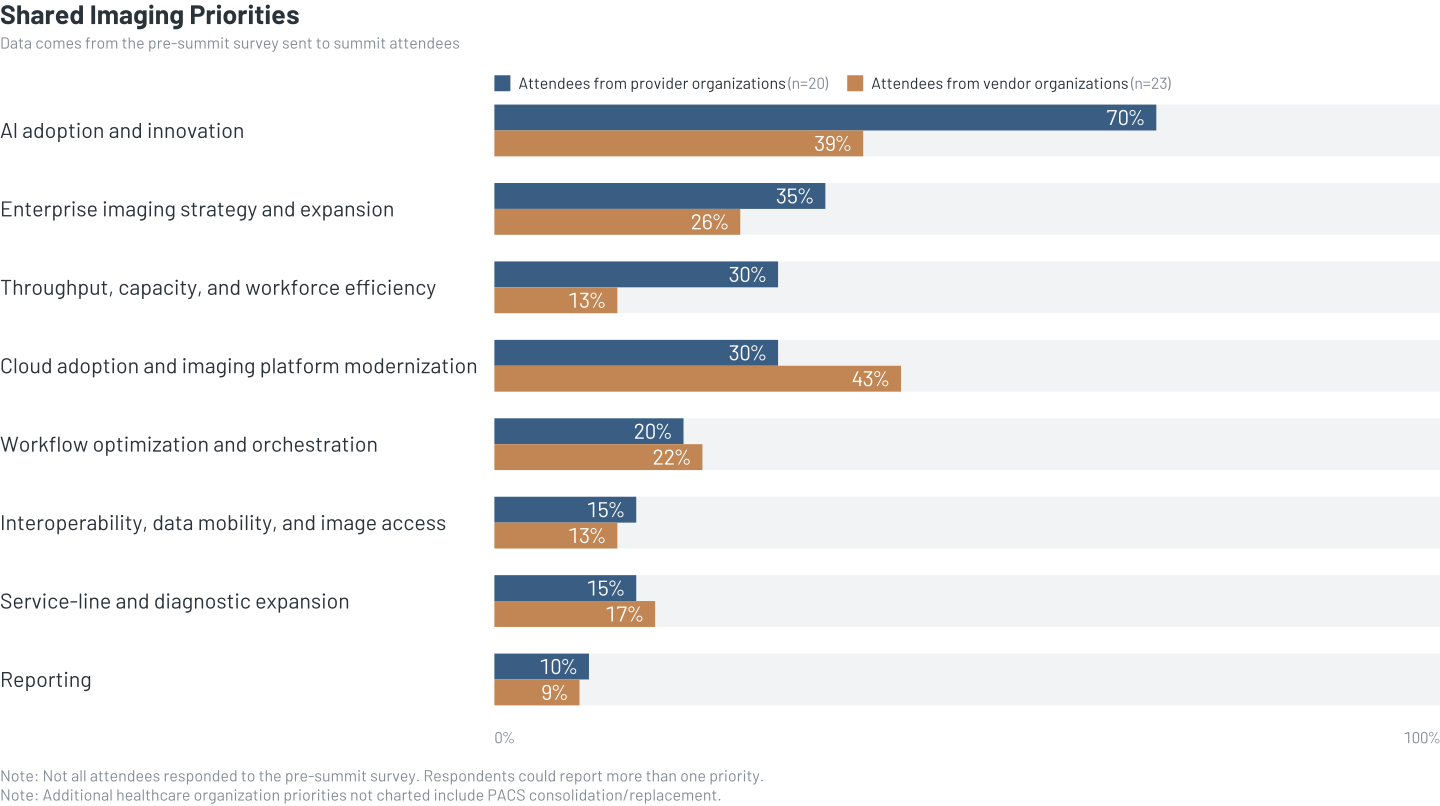
Prior to the summit, KLAS asked attendees to complete a pre-summit survey regarding their top imaging priorities for the next one to two years. The results from those who responded show that healthcare organizations and IT vendors are aligned in several areas, the most prominent being AI and related initiatives. 70% of healthcare organization respondents reported AI adoption and innovation as a top priority. While AI innovation was not cited as frequently among vendor participants (it was the number-two most-reported priority), AI-adjacent initiatives like cloud adoption and imaging platform modernization came in at number one.
While AI solutions can provide many benefits in healthcare imaging, they can also introduce complexity into imaging workflows; this is especially true of pixel AI solutions. This is likely a contributing factor in the fact that almost one-third of healthcare organization respondents reported throughput, capacity, and workforce efficiency as a top priority, while one-fifth cited workflow optimization.
Key Takeaways from Summit Discussions on Imaging AI
What Types of AI Technologies Demonstrate the Clearest Value?
Summit attendees discussed which of the various types of imaging AI technologies demonstrate the clearest value. Operational AI tools were most commonly mentioned, followed by reporting AI tools and then pixel AI tools. (To learn more about the different kinds of AI tools being used in imaging workflows, see KLAS’s recent Imaging AI report.)
Operational AI
Operational (or workflow) AI can reduce care-delivery friction by prioritizing urgent studies, improving patient flow and access, automating repetitive tasks, coordinating follow-up, and helping teams use staff and equipment more efficiently. Healthcare organization attendees stressed the importance of fitting new AI tools into existing systems, rather than complicating the workflow by adding tools that are not integrated into current workflows.
Success stories from summit attendees
- 83% reduction in patient placement time with the addition of an operational AI tool
- 10-minute reduction in procedure time due to operational ultrasound workflow that produces AI-generated measurements, populates report templates, and routes studies to appropriate radiologists
- 10% increase in radiologist speed due to using patient summaries with AI imaging insights
- 20% reduction in the time it takes to turn around cardiac studies due to cardiac imaging automation
- Increase in engagement-to-appointment conversion rates due to the use of AI workflow; 125% increase in ultrasound rates and over 400% increase in breast MRI rates
- Increase of 5 MRI patients per day thanks to decreased scan times, shorter wait times, and marketing for same-day appointments
Reporting AI
The benefits of using AI in reporting are often seen in workflow and user satisfaction improvements rather than in clear organization-wide financial returns. Healthcare organization attendees reported gaining efficiency through faster dictation and report completion and improved radiologist productivity; they noted that radiologists often use the time during impression generation for another image review.
Success stories from summit attendees
- Efficiency gains of 20%–30% due to AI reporting tools
- 19% decrease in time spent dictating due to impression generation tools
Pixel AI
Pixel AI solutions have been broadly adopted for many use cases, including stroke detection, breast cancer detection and triage, fracture detection, PE and incidental PE detection, lung nodule findings, prostate and thyroid findings, cardiology exam analysis, coronary artery calcification scoring, and other scenarios. These tools can support earlier action and better patient pathways, but pixel AI is often considered as a “nice-to-have” tool rather than a necessity. Many healthcare organization attendees said their organizations are still working out how to quantify the benefits of pixel AI. Providers raised concerns about false positives, extra review work with slower turnaround times, lack of workflow fit, and the cost of tools when the clinical or operational benefit is unclear. With the increase in incidental findings through pixel AI, providers noted that they need expanded orchestration and workflow AI to help manage the follow-up and added complexity.
Success stories from summit attendees
- Increase of 323% in the number of patients routed into the high-risk breast cancer program, with more than a 100% improvement in patients successfully completing the next step in the care pathway; however, pixel AI did not improve interpretation efficiency
- Reduction in sign-out time from 20 minutes to 5 minutes using AI solution for pap test analysis
- Reduction in the number of readers for mammograms from 2 to 1 in some international cases, though diagnostic AI may add work to some workflows
- Other outcomes include faster clinical decision making, earlier discharge, increased exam volume without increased hours, and faster patient throughput
Keys to Successful, Valuable AI Implementation for Healthcare Organizations
At the summit, attendees discussed ways that healthcare organizations can ensure the AI tools they implement deliver the desired value.
- Start with a defined problem and measures for success: Be clear about what needs to improve, who the AI is for, and why AI is an appropriate way to address it. Define what success would look like before selecting a tool and agree on success criteria. Track a range of metrics—such as clinical and patient outcomes, workflow, turnaround time, capacity, adoption, satisfaction, and financial impact—not just algorithm accuracy. Some value may be clinical or operational rather than directly financial, but the organization should still be able to explain how they will evaluate that value.
- Integrate AI into existing systems while allowing room for adjustment to meet local needs: Providers who have successfully implemented meaningful AI tools emphasized the importance of fully integrating the tool into existing workflows, rather than simply switching it on. As AI solutions are integrated, some process changes may be needed. However, to the degree possible, AI should fit into the systems and worklists clinicians already use, making relevant patient context available and adding minimal extra screens, clicks, or review loops. Orchestration can route findings, coordinate follow-up, and get information to the right clinician. Workflows differ across organizations and clinicians, so solutions need room for local preferences and personalization with appropriate guardrails. As one participant noted, “AI itself is not the strategy. Success comes from combining people, processes, workflow, and technology.”
- Involve the people who will use, support, and govern the AI: Bring clinician, operational, IT, informatics, security, and leadership teams into the planning early to ensure broad buy-in. Include the vendor’s sales representatives as well as their technical staff. Establish governance, clinical sponsorship, clear ownership, and alignment on priorities to ensure that the go-live is followed by adoption and sustained use.
- Treat the vendor relationship as a working partnership: Set expectations about capabilities, limitations, implementation requirements, security, cost, and timelines up front. To feel empowered for success, healthcare organizations need verifiable data, practical guidance and references, help with integration and workflow redesign, strong project management, and clarity about current solution capabilities versus future development. Vendors emphasized that customers find more value in solutions when organizations engage, communicate their workflow needs, and partner in product development.
What Can Vendors Do to Ensure AI Tools Are Valuable for Customers?
- Prioritize deeper, more seamless, and more affordable integration into existing workflows
- Work more collaboratively with customers on prototypes
- Offer prescriptive guidance, share lessons from other deployments, study local workflows and adapt solutions to each organization’s environment
- Understand both the organization’s current workflow requirements and their long-term direction
- Be transparent with both positives and shortcomings to build trust with providers
Key Takeaways from Summit Discussions on Achieving Success with Pilots
Recommendations for Ensuring Imaging Pilots Are Successful During the Implementation
The word “pilot” is a bit of a catch-all. Healthcare organization attendees noted that pilots can be understood to encompass different things, such as trials, proofs of concept, and staged rollouts. Because of this, it is important for each organization to clearly define what “pilot” means for them in each case and ensure that they have a shared understanding with the IT vendor. Attendees offered the following recommendations to ensure success with a pilot:
Begin with the end in mind
For healthcare organizations
- Start with an organizational problem and a decision: Agree on what the pilot is meant to establish and what outcomes will lead the organization to scale, revise, or stop.
For vendors
- Anchor the pilot in the customer’s problem and intended outcome: Before proposing a pilot, make sure you understand what the healthcare organization is trying to solve and what decision the evaluation should support.
Establish clear ownership and expectations up front
For healthcare organizations
- Define the scope and terms up front: Clarify what kind of pilot is being engaged in, e.g., a trial, proof of concept, pilot, staged deployment, etc.; specify users, locations, time frame, and what is in and out of scope.
For vendors
- Plan the evaluation with the customer: Agree on the problem, baseline, KPIs, scope, timeline, roles, resource commitments, and scale or stop criteria; work through the customer’s governance process rather than with an isolated clinician.
- Make the commercial path clear: Explain pilot and scale costs, discuss shared investment where appropriate, and make any contract or purchase decision criteria explicit.
Build trust in the outcomes
For healthcare organizations
- Set measurable success and stop criteria before starting: Establish a baseline and track relevant outcomes, which may include clinical or operational impact, workflow fit, adoption, user feedback, risk, and financial or other organizational value.
- Test with representative users and real workflows: Avoid relying only on enthusiastic early adopters; check whether the solution works for different users and fits day-to-day practice.
For vendors
- Make the test realistic enough to inform a decision: Where appropriate, use the customer’s data and production-like workflows, and explain which parts of a pilot differ from full deployment.
- Help measure and interpret results: Share actionable usage and outcomes data, explain methods and limitations, and review findings with the healthcare organization so they can verify the evidence.
Ensure pilots are well supported
For healthcare organizations
- Put governance and the right people in place early: Include clinical, operational, IT, security, and financial stakeholders, with a named owner who can keep the work moving if staffing or priorities change.
- Plan for resources, funding, and change management: Account for the IT and integration work, staff time, training, communications, and funding needed to support both the evaluation and a possible wider rollout.
- Make the scale decision while the pilot is underway: Review results regularly, address issues, and agree on the next step before the evaluation drifts into an open-ended trial.
For vendors
- Set realistic expectations early: Be candid about product maturity, current limitations, evidence behind claims, required infrastructure and security reviews, integration work, staffing, costs, and what scaling will involve.
- Bring technical and implementation expertise into the conversation early: Involve the people who can answer architecture, security, integration, and workflow questions, alongside sales and clinical specialists.
- Provide hands-on project and change support: Assign a capable project lead, help with implementation and training, and support workflow changes and adoption beyond the initial group.

Writer
Elizabeth Pew

Designer
Kath Spencer

Project Manager
Evan Young
This material is copyrighted. Any organization gaining unauthorized access to this report will be liable to compensate KLAS for the full retail price. Please see the KLAS DATA USE POLICY for information regarding use of this report. © 2026 KLAS Research, LLC. All Rights Reserved. NOTE: Performance scores may change significantly when including newly interviewed provider organizations, especially when added to a smaller sample size like in emerging markets with a small number of live clients. The findings presented are not meant to be conclusive data for an entire client base.