KLAS Contact

Contact KLAS
Contact KLAS
 2026 BEST IN KLAS
Preferences
Related Series

2024

2022

2020
2018
2017

Enterprise Imaging Summit 2025

Author
Monique Rasband

Author
Ciera Walker

Author
Spencer Corbett
In September 2025, KLAS hosted our two-day Enterprise Imaging Summit in Park City, Utah. Enterprise imaging (EI) thought leaders from healthcare organizations and IT vendors came together to discuss how to push the frontiers of EI and take advantage of advancing technologies amid industry-wide budget constraints and staff shortages. This report summarizes the key learnings from the summit, focusing on AI adoption, workflows and core platform needs, and ongoing provider-vendor alignment for industry progress.
 The following insights come from:
- A presummit survey sent to provider and vendor attendees
- Tabletop discussions among summit attendees
- Keynote presentations: Dr. Nina Kottler (Radiology Partners), Dr. Asad Tariq (Baptist Health Jacksonville)
- Healthcare organization success stories: Dr. David Kaelber (MetroHealth), Ellie Lapidus (Northwestern Medicine)
- Healthcare organization panels
- Approaches to AI in Imaging: Dr. Ram Chadalavada (University of Cincinnati), Dr. Howard Haronian (Novant Health Heart & Vascular Institute), Dr. Peter Harri (Emory University), Dr. Nina Kottler (Radiology Partners)
- Cloud Adoption in Imaging: Stacie Barnard (University of Rochester Medicine), Oliver Galicki (Memorial Hermann Health System), Tiffany Lemmen (The Queen’s Health Systems), Clark Warren (Northern Lights)
- Overcoming Challenges Around EI: Jeff Agricola (UNC Health), Ellie Lapidus (Northwestern Medicine), Amy Radonich (UC San Diego Health)
Based on input from healthcare organizations, KLAS defines enterprise imaging as the ability to store and/or view images across the enterprise in one place from more than one service line and/or from multiple PACS or long-term storage solutions, enabling improved patient care through integrated image access throughout the organization.
Healthcare Organizations Prioritize AI Adoption to Address Capacity Challenges; Workflow Integration Remains a Barrier to Adoption
Presummit Survey Insights
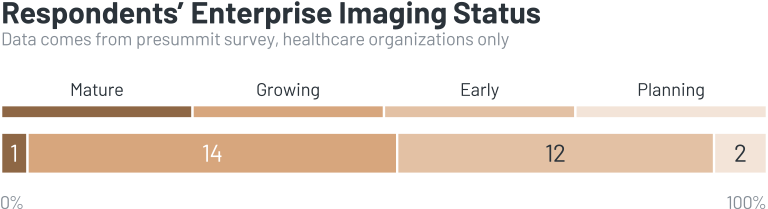
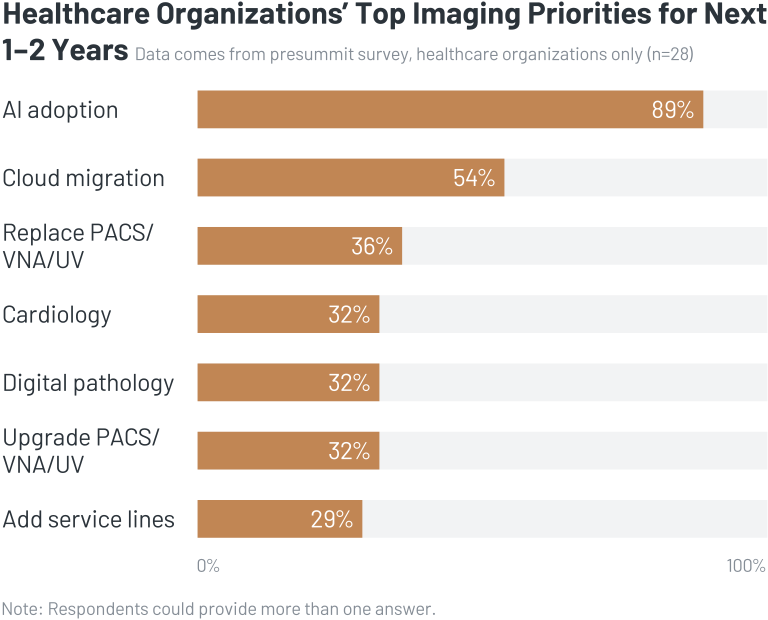
Healthcare organizations emphasize the overlap between addressing urgent, short-term needs—such as workforce pressures, workflow efficiency, reliable core systems, and appropriate infrastructure—and making strategic investments in long-term innovation. Nearly all provider respondents prioritize AI for imaging, saying that it is a rapidly evolving solution that meets both needs by augmenting efficiency amid radiologist shortages and increasing imaging volumes. Cloud migration is also top of mind for many healthcare organizations, who plan to lean on the cloud infrastructure to enable ongoing optimizations.
Despite AI being a high priority, healthcare organizations are facing multifaceted barriers to AI adoption, including financial, resource, and technical constraints. These are especially noted for organizations while the AI market is still viewed as early or volatile.
 Healthcare Organizations’ Barriers to AI Adoption
Financial
- Tight budgets
- Reimbursement concerns
- High cost of licenses/
algorithm implementation - No direct way to offset AI costs
Resource
- Heavy resource lift to drive change management for AI, including resources for:
- Building trust in AI
- Leading implementations
- Building out governance and operational leadership
Technical
- Lack of consistently integrated AI workflows
- Existing infrastructure and data-formatting standards
The above findings highlight a key gap that is currently hindering the progression of imaging AI: Healthcare organizations want to invest in and adopt AI but feel vendors haven’t made enough progress in incorporating integrated AI workflows to lift barriers and make scalable adoption feasible. Additionally, organizations want vendors to provide guidance on AI tools (1) before deployment, including on validating algorithms, identifying ROI to justify costs to leadership, and suggesting algorithms to realize needed outcomes, and (2) after deployment to ensure outcomes are being reached. AI must demonstrate tangible efficiency gains and be seamlessly embedded into workflows to be worth the cost and resources needed for organizations to adopt.
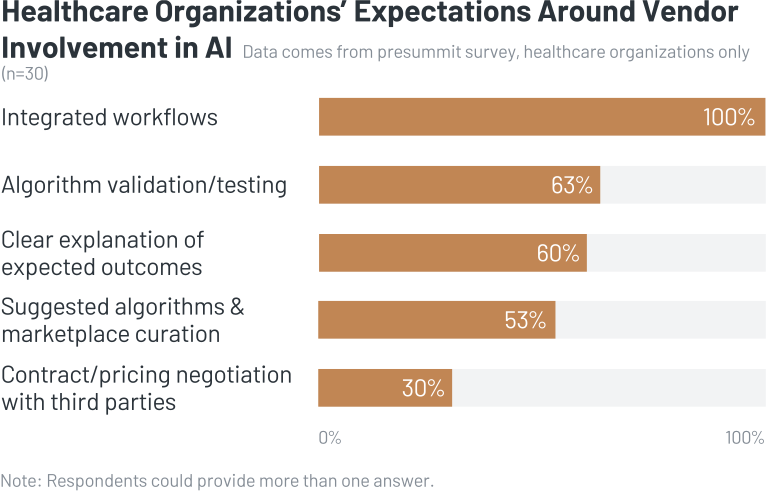
Summit Takeaways Around AI & New Technologies

For vendors:
- To help customers overcome the most common barrier to ongoing AI adoption, vendors need to tightly integrate AI directly in the PACS or other system in use to eliminate the need for organizations to use AI as a separate app.
- With emerging technologies, healthcare organizations often see overpromising, poor usability, financial instability, and start-up churn from vendors. Vendors need to provide more transparency about what features are built and ready for use and their potential impact.
- Market fragmentation is a real hinderance to healthcare organizations, who often want more one-stop-shop platforms. Organizations want to be able to consolidate to fewer, broader platforms with staying power.
- Some organizations struggle with pilot fatigue; vendors need to more directly ensure customers realize the outcomes they need from pilots. Efforts include testing large data sets for faster validation, ensuring both parties have a concrete understanding of what is required for a smooth rollout, and scaling technical components needed to full enterprise usability.

For healthcare organizations:
- To overcome adoption inertia and align IT, clinical, and legal parties, multi-stakeholder governance and organizational alignment are essential. Organizations with higher AI adoption levels tend to have (1) an agile clinical operations team that communicates with governing bodies while moving quickly and (2) clinical champions who drive momentum by advocating for solutions to specific problems to operating groups. Successful AI deployments rely on strong clinical champions and widespread demos of new features.
- AI is promising for many when paired with human collaboration and essential safeguards, including managing bias, offering clinicians transparency on models, and ongoing algorithm monitoring. Also important is the continuous monitoring of accuracy, drift, utilization, and ROI. Risk management often outweighs innovation unless value is clear.
- With the rising need for alignment with regulation, transparency, and bias safeguards, healthcare organizations need efforts and resources dedicated to managing highly variable and shifting state regulations.
- Healthcare organizations and staff need to understand that AI is a tool to augment rather than replace human clinical roles—education and transparency are critical for building trust around AI. Adoption requires broader metrics than just ROI; organizations should track efficiency, turnaround times, burnout, and incidental findings.
Read more KLAS findings on imaging in AI in the recent 2024 report.
Healthcare Organizations Stress the Importance of Foundational Technologies—Efficient Workflows, Enterprise-Wide Core Solutions & Modern Infrastructure
Presummit Survey Insights
Workflow efficiency is top of mind for healthcare organizations—radiologists want tools that reduce their cognitive load and repetitive tasks so that they can better focus on patient care. While specific requests for workflow improvement vary, user requests center around two main themes: (1) workflows that are centralized in or seamlessly integrated with core solutions and (2) AI-driven capabilities that reduce unnecessary clicks and manual effort. Healthcare organizations also want vendors to focus on providing native enterprise solutions as opposed to radiology-focused solutions; the addition of point-of-care ultrasound (POCUS) capabilities is especially top of mind, as well as other service lines like dermatology, GI, and ophthalmology. As mentioned above, cloud migration is a top imaging priority for many organizations, though the decision to move to the cloud is more often driven by wider enterprise cloud strategies rather than by strategies around specific imaging workflows and solutions.
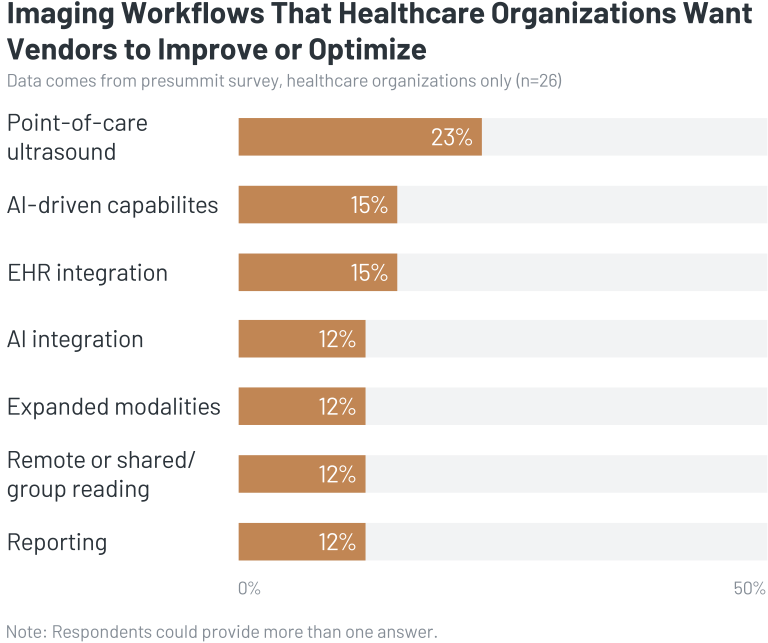
Summit Takeaways Around Workflows & Core Technology
For vendors:
- Build technology that seamlessly integrates into existing PACS workflows without adding new complexity or requiring more clicks or apps.
- Ensure core platforms are stable and efficient before adding flashy new capabilities.
- Success in imaging requires solutions that are broader than just radiology.
- Vendors should focus on interoperability with other solutions to improve the overall success of EI strategies.
- Examples of how to establish a better multi-location experience include the use of DICOM, open APIs , federated worklists, and universal patient identifiers.
For healthcare organizations:
- Success around large-scale initiatives require an explicit understanding of the problem to be solved, clear scoping, early security engagement, and set expectations from leadership to minimize surprises.
- To ensure cloud adoption of radiology solutions:
- Define cloud migration scope, including prefetch rules and the scope of migrated images.
- Leverage marketing and encourage internal advocates for the cloud.
- Keep devices patched, updated, and tracked for end of life to maintain security.
Healthcare Organizations & Vendors Align on EI Success Methods; Still, a Gap Remains Between Vendors’ Push for Innovation & Organizations’ Readiness for Adoption
Presummit Survey Insights
With very different day-to-day realities, healthcare organizations and vendors have unique responsibilities when it comes to driving EI success. One of the intentions of the summit was to provide a checkpoint for both parties to align priorities. In the presummit survey, both vendors and healthcare organizations shared what they think both parties can do to most meaningfully drive EI success. The parties were very aligned on key product and relationship-based factors; however, healthcare organizations note two additional needs: vendors need to be (1) cognizant of budget constraints and willing to discuss manageable pricing models and (2) more actively involved in including service lines and modalities in their imaging solutions. KLAS data shows that when service lines outside of radiology and cardiology are brought into an organization’s VNA, that effort is driven by healthcare organizations. Vendors need to work to make their offerings true enterprise solutions rather than standalone products or solutions that focus solely on radiology and cardiology.
When survey respondents were asked what healthcare organizations can do to drive EI success, responses were less aligned. Vendors hope organizations will focus on the future and consult vendors on how to expand solution capabilities and adopt new tools. Meanwhile, organizations are occupied with upstream considerations that affect adoption, like current technical infrastructure and the maintenance and alignment of internal support. Both parties agreed that having strong governance and change management is crucial to success.
 How Can Parties Drive Enterprise Imaging Success?
What can vendors do?
(n=28 healthcare organizations, 24 vendor respondents)
Healthcare organizations and vendors agree:
- Improve interoperability
- Facilitate seamless workflows
- Drive innovation (e.g., AI, cloud)
- Foster authentic, trust-based partnerships rather than transactional interactions
Healthcare organizations also say:
- Help address cost/value
- Expand the scope of enterprise imaging solutions beyond radiology and cardiology service lines
What can healthcare organizations do?
(n=28 healthcare organizations, 24 vendor respondents)
Healthcare organizations and vendors agree:
- Implement strong governance and change management
Vendors also say:
- Collaborate deeply with vendors
- Adopt new tools
- Engage clinicians and IT
Healthcare organizations also say:
- Address technical infrastructure and architecture
- Gain executive support and align organizational strategy
Summit Takeaways Around Alignment & Collaboration
For vendors:
- Vendors should be up front about what is real and what is aspirational regarding timelines, product readiness, staffing constraints, and road maps. Overpromising and underdelivering erodes trust, but clearly communicating what can and cannot be prioritized keeps expectations in check.
- Ongoing ownership, accountability, and follow-through are critical to healthcare organizations; broken promises or escalation responses without closure quickly destroy trust. The most successful vendors are those who co-own the journey with their customers. Vendors should provide consistent, engaged contacts who maintain regular, structured touchpoints with customers. Healthcare organizations also appreciate engaging with vendor technical experts and product managers.
- Healthcare organizations feel a tension between addressing short-term needs and investing in long-term innovation, as they must strike a balance between delivering quick wins and making plans for the future. As a result, vendors should be mindful of budget constraints and share best practices, benchmarks, and market insights to help their customers make stronger business cases for investment.
- Multi-stakeholder alignment at healthcare organizations is crucial, and delays can be avoided if vendors engage IT early in the sales cycle.
For healthcare organizations:
- Governance within healthcare systems (radiology, cardiology, pathology, IT, finance, legal, etc.) is important, but its complexity can cause delays and silos, sometimes resulting in vendors having to mediate internal politics. To avoid these challenges, seek alignment among internal stakeholders and operational teams and be transparent with vendors about internal priorities and constraints so that expectations are realistic.
- Although leadership buy-in depends on hard ROI metrics like cost savings, revenue growth, or reduced liability, healthcare organizations can also gain buy-in by measuring and communicating soft ROI—e.g., time savings, reduced burnout, and improved outcomes.
2025 Summit Attendees
Healthcare Organizations
Stacie Barnard, IT Director of Integrated Clinical Systems, University of Rochester Medicine
Matthew Bishop, Enterprise Imaging Architect, UnityPoint Health
Thiago Braga, Radiologist & VC of IT/AI, University of Miami
Richard Bruce, Vice Chair of Informatics, Radiology, University of Wisconsin
Ram Chadalavada, Vice Chair of Radiology/Informatics, Professor of Radiology & Surgery, University of Cincinnati
Yeang Chng, Radiologist, Spectrum Healthcare Partners
Quinn Cordae, Director, Ancillary Applications, Alameda Health System
Albert Roh, Chair of Radiology, Alameda Health System
Peter Harri, Associate Professor & Medical Director of Imaging Informatics, Emory University School of Medicine, Department of Radiology & Imaging Sciences
Howard Haronian, SVP, Physician in Chief, Novant Health Heart & Vascular Institute
Adrian Jimenez, Senior Manager, SOIN
Jacqueline Johnson, Imaging Director, Skagit Regional Health
David Kaelber, Chief Health Informatics Officer, MetroHealth
Nina Kottler, Associate CMO, Clinical AI, Radiology Partners
Ellie Lapidus, Director, IS, Northwestern Medicine
Tiffany Lemmen, Director, Technology Strategy, Transformation, & Integration, The Queen’s Health Systems
Carlos Medina, Lead IT Analyst, Sharp HealthCare
Rajeev Nowrangi, Director of Imaging Informatics, Loma Linda University Health
Theresa Peel, IT Director of Clinical Solutions, Memorial Hermann Health System
Cheryl Petersilge, Radiologist, University of Pittsburgh Physicians
Amy Radonich, Director of Enterprise Imaging, UC San Diego Health
Ario Rezaei, Radiologist/President, MCB Radiology
Karissa Rothkopf, Executive Director of IT Clinical Strategy, Froedtert Thedacare Health
Leonard Santos, Director of Applications Services, MultiCare Health System
Daniel Albertson, Division Chief Anatomic Pathology (University of Utah) & President, University Business Unit, ARUP Laboratories
Asad Tariq, Director Physician & Community Optimization, Baptist Health Jacksonville
Ian Vallely, System VP, Physician & Clinical Enterprise, CommonSpirit Health
Carlos Vasquez, VP & COO, Franciscan Health
Clark Warren, CIO, Northern Light
Adrian Wilhelmsen, Director of IT, Radiology & Imaging Sciences, University of Utah
Justin Stinnett-Donnelly, Chief Health Information Officer, University of Vermont Health
Tracy Stenseth, Enterprise Imaging Manager, UnityPoint Health
Vendor/Consultants
Eitan Aschner, VP of Integrated Diagnostics, Philips
Sheraz Bhatti, CIO & Co-founder, 3verest
Stephanie Berry, Customer Engagement, Philips
Bret Borota, Managing Director of Healthcare and Payor, AWS
Vikram Chhabra, GM of Diagnostics Solutions, Microsoft
Michael Campbell, EVP/Chief Product Officer, Hyland
Cameron Craig, Software Developer, Epic
Mike Doyle, VP of Carbon Business Development, Siemens Healthineers
Ashutosh Dhar, Business Lead for Medical Imaging, AWS
Matt Ferrant, VP of Product Management & Imaging Informatics, Philips
Andrei Gonzales, VP of Product Management, Merge by Merative
Hillary Gordon, ACE Executive, Mach7 Technologies
Eric Grunden, Chief Customer Officer, Intelerad
Andreas Haug, Partner, Vor Capital
John Insko, Chief Commercial Officer, GE HealthCare
Leah Johnson, Product Informatics, Epic
Torbjörn Kronander, President & CEO, Sectra
Tomer Levy, SVP of Product Engineering, Merge by Merative
Véronique Lessens, Global Head of Strategy, Marketing & Communication, AGFA HealthCare
Nathalie McCaughley, President, AGFA HealthCare
Scott Miller, CEO, Solutions for Enterprise Imaging, GE HealthCare
Lyle McMillin, Associate VP of Product Management, Hyland Software, Inc.
Rishi Nayyar, CEO, PocketHealth
Morris Panner, President, Intelerad
Ashish Sant, EVP & GM, Merge by Merative
Mike Seagraves, Customer Engagement Leader, Philips
Dave Smarro, President & CEO, INFINITT North America
Kim Stavrinakis, Principal Strategy & Solutions Marketing Leader, Hyland
Coleman Stavish, CTO, Proscia
Omar Sunna, Chief Customer Officer, AGFA HealthCare
Ivan Tarapov, Senior Director, Microsoft
Bob Tranchida, VP of Partner & Customer Program Development, Mach7 Technologies
Gregory Royston, Investment Analyst, Vor Capital
Isaac Zaworski, President, Sectra

Writer
Carlisa Cramer

Designer
Nikki Christensen

Project Manager
Amanda Wind
This material is copyrighted. Any organization gaining unauthorized access to this report will be liable to compensate KLAS for the full retail price. Please see the KLAS DATA USE POLICY for information regarding use of this report. © 2026 KLAS Research, LLC. All Rights Reserved. NOTE: Performance scores may change significantly when including newly interviewed provider organizations, especially when added to a smaller sample size like in emerging markets with a small number of live clients. The findings presented are not meant to be conclusive data for an entire client base.