KLAS Contact

Contact KLAS
Contact KLAS
 2026 BEST IN KLAS
Preferences
Related Series
Related Segments

Contact Center as a Service (CCaaS)
2026 Vendor Guide

Author
Adam Cherrington

Author
Spencer Snyder
Cloud contact centers are becoming the foundation of modern healthcare access strategies, and adoption of cloud-native Contact Center as a Service (CCaaS) platforms is accelerating. These solutions offer EHR interoperability, AI capabilities, and advanced workforce management tools to improve operational efficiency, enhance the patient experience, and help healthcare organizations scale their digital front door. In response to the increasing number of healthcare leaders asking for information about these solutions, KLAS compiled this vendor guide, which provides an overview of CCaaS options available to healthcare organizations today. As KLAS explored this space and conducted due-diligence conversations with both healthcare leaders and vendors, six vendors were consistently mentioned and, thus, are featured in this guide.

About the Information in This Guide
KLAS invited the six featured vendors to submit a description of their CCaaS offering, each of which is included below (Cisco and Five9 did not share a description). In addition, KLAS asked leaders from a few healthcare organizations about their experiences in the CCaaS market; their insights helped inform the “Market Overview” section.
Vendors included in this guide:
- Amazon Web Services (AWS)
- Cisco†
- Five9†
- Genesys
- NiCE
- Talkdesk
† Because the vendor did not share a description of their CCaaS solution, KLAS used publicly available sources to compile information about the vendor’s offering.
Other known vendors:
- 8x8
- Avaya
- Bright Pattern (payer focused)
- Dialpad
- Verint (payer focused)
Market Overview
Why Do Healthcare Organizations Want to Use CCaaS?
Patients now expect 24/7 frictionless engagement across voice, chat, and digital channels: Access delays and poor communication are major drivers of patient dissatisfaction. Because the call center is often the first interaction a patient has with a healthcare organization, CCaaS is positioned to directly influence patient satisfaction, trust, and brand perception.
Healthcare organizations are moving away from legacy on-premises infrastructure to automate call-center workloads and improve uptime, security, flexibility, and scalability: Across the world, the healthcare industry faces severe healthcare worker shortages and chronic burnout, and healthcare organizations are looking for solutions to help alleviate operational burdens. CCaaS coordinates communication across multiple departments (central scheduling, referrals, billing, care coordination, etc.), so efficiency, revenue, and patient-outcome benefits can be realized across a broad operational front.
What Is CCaaS Being Used For?
Legacy transformation: As mentioned above, healthcare organizations are transitioning away from legacy on-premises infrastructures. Staffing shortages across call centers and care teams, along with the need to efficiently scale resources, have prompted increased adoption of workforce management, automation, and AI-powered self-service tools to maintain service levels with fewer human resources.
Platform consolidation: Organizations increasingly want single platforms for voice, digital, analytics, and workforce optimization capabilities. They also want solutions that can manage communication with both external customers and internal teams, where CCaaS and UCaaS (Unified Communications as a Service) converge.
EHR-centric workflows: EHR integration is essential and often a top driver for CCaaS selection. Organizations also expect integration with CRM and scheduling/billing solutions.
AI capabilities: Organizations are exploring various AI use cases, such as reception and call routing, and are increasingly applying AI to more complex workflows, such as scheduling and identity verification. Also, they cite AI containment and routing-accuracy improvements as leading ROI drivers.
Workforce optimization: Workforce-engagement tools that analyze patient-interaction data are frequently included in ROI discussions related to quality improvement, staff coaching, and evolving patient-engagement strategies.
What Is on the Horizon for CCaaS?
Patient journey orchestration will expand to unify patient access with care management and revenue cycle, similar to how enterprises view customer journeys in other industries.
Vendors want to enhance their healthcare focus: This would shorten deployment times and enable better embedding within EHR workflows and other healthcare solutions.
Agentic AI development, adoption, and use will expand: Agentic AI will progress beyond automating individual touchpoints to orchestrating broader patient journeys, driving organizational efficiencies at scale while also delivering more personalized experiences for each patient.
Three Healthcare Organizations’ Thoughts on CCaaS

“Using [a CCaaS] solution is a no-brainer. If an organization is still operating legacy on-premises solutions, like their grandfather’s contact center environment, they are behind the times. Organizations need to have the multiple channels and all the bells and whistles that come with the CCaaS environment.” —Executive director of marketing and experience
“Think beyond the core telephony. The real value comes from layering AI and automation on top of a CCaaS environment to improve both patient and agent experience.” —Enterprise chief digital transformation officer
“I would say the more an organization can centralize, the more it takes things off the respective practices’ plates when it comes to fielding requests, scheduling, making changes and cancelations, and so on. The focus should go back to patient enablement, patient empowerment, and patient self-direction.” —VP

Vendor Overview
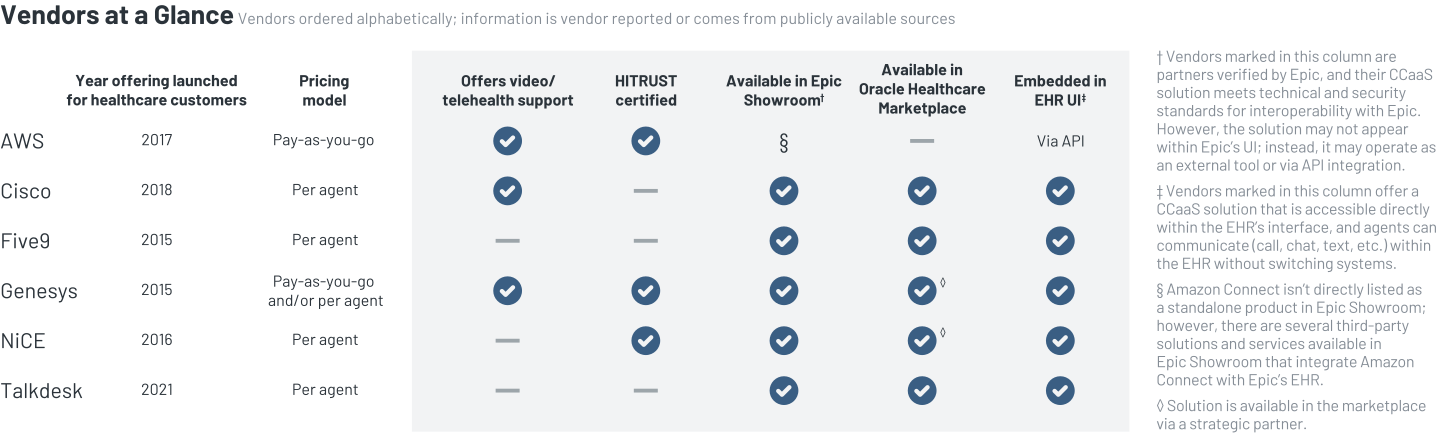
All six vendors featured in this report are cross-industry, HIPAA-compliant vendors that offer omnichannel support, AI virtual agents, and chatbots. The chart and write-ups below provide details on how vendors differentiate their solutions. Note that all information in this section is vendor reported or comes from publicly available sources.
 Amazon Connect
Amazon Connect provides scalability, personalized experiences, and pricing flexibility through its pay-as-you-go model, enabling health systems to deploy across contact centers, departments, and clinics without per-agent licensing constraints. AWS differentiates themselves through the AI-native architecture built on Amazon Bedrock’s foundation models, allowing automatic access to ongoing AI updates without migration or reimplementation. According to AWS, the efficient, personalized experiences through AI lead to real-time speech analysis, sentiment detection, patient self-service, and conversation summarization. The healthcare capabilities include real-time EHR access and healthcare AI agents. AWS says they ensure data security by running AI services within customer environments—data never trains external models, and recordings and transcripts are under customer control. Amazon Connect integrates with Amazon Comprehend Medical, AWS HealthLake, and Amazon Bedrock, running on the AWS global infrastructure and delivering strong uptime reliability.
 Webex Contact Center
Webex Contact Center offers tight integration with the broader Webex communications suite and Cisco’s established footprint in enterprise IT infrastructure. Cisco claims to offer native integration for voice, video, and messaging within a single platform, allowing patients to seamlessly transition from a phone call to a virtual visit when needed. Cisco is also one of a few vendors to offer native integration within Epic’s Cheers interface, allowing agents to access embedded patient context directly within their workflows. Cisco’s broad presence in the networking and telephony market often provides a natural entry point into CCaaS discussions for healthcare organizations who are already using Cisco’s infrastructure, and the vendor’s global services organization and partner ecosystem help support complex deployments. Cisco further differentiates themselves through their emphasis on enhanced survivability, supporting local gateway configurations that allow contact center operations to remain functional during cloud outages.
Note: Because the vendor did not share a description of their CCaaS solution, KLAS used publicly available sources to compile information about the vendor’s offering.
 Five9 Intelligent Cloud Contact Center
Five9 has an established track record in CCaaS and is used by both enterprise health systems and home health/post–acute care organizations. Five9’s product was the first CCaaS platform accredited in Epic’s Toolbox program, which enables native integration directly within the Epic environment. The open API architecture makes the platform highly adaptable for hybrid or incremental implementations, allowing healthcare organizations to integrate it with existing EHRs, CRMs, scheduling platforms, or homegrown systems.
Note: Because the vendor did not share a description of their CCaaS solution, KLAS used publicly available sources to compile information about the vendor’s offering.
 Genesys Cloud CX
Genesys reports that their growth in the healthcare CCaaS market comes through their advanced security, comprehensive voice and digital engagement capabilities, native workforce engagement management, and enterprise-grade operational maturity. They have HITRUST certification, which exceeds HIPAA requirements and addresses the higher security and compliance standards of healthcare providers. The platform supports enterprise voice, proactive outbound engagement, rich asynchronous messaging, and journey continuity, enabling patients to initiate and resume interactions across inbound and outbound channels including web, mobile, SMS, and voice. Genesys also has native workforce engagement management. The vendor is a featured CCaaS vendor in Epic’s Workshop program, embedding call controls, automated documentation, and synchronized patient context directly into Epic workflows. Drawing on experience from highly regulated industries, Genesys reports more than 700 healthcare customers and recently secured a $1.5B investment from Salesforce and ServiceNow.
 CXone Mpower
NiCE is HITRUST certified and promotes in-depth asynchronous messaging capabilities via channels such as SMS, web chat, Facebook Messenger, WhatsApp, and other messaging apps. The vendor claims to offer some of the most comprehensive workforce engagement management capabilities in the market, as the platform is intended to support complex agent pools (e.g., access center staff, nurse triage). NiCE also reports being able to embed contact center functionality directly into clinical workflows, reducing the need for agents and clinicians to toggle between EHRs and external applications. The vendor reports more than 600 healthcare customers and more than one million agents globally on the platform; more than 10,000 agents are integrated with Epic, and thousands more agents are integrated with other EHRs.
 Talkdesk Healthcare Experience Cloud
Talkdesk’s offering is designed specifically for the healthcare industry, with AI agents and workflows tailored to patient access, revenue cycle, care coordination, and payer services. Talkdesk was the first CCaaS vendor accepted into Epic’s Workshop program, reflecting a formal partnership model with validated integrations. The platform is reported to provide out-of-the-box integration with athenahealth and Oracle Health and within Epic’s Cheers interface, enabling embedded workflows for appointment scheduling, patient identity verification, and AI-driven triage—all with minimal IT lift. Talkdesk’s platform integrates with EHR platforms without requiring partner middleware. Furthermore, Talkdesk supports an embedded deployment model that allows the contact center functionality to live directly inside EHR/CRM systems such as Salesforce, Microsoft Dynamics 365, and Pega. Talkdesk reports having more than 300 healthcare customers, including over 180 provider organizations.
About KLAS Research
Driven by a mission to improve healthcare, KLAS publishes research data intended to help healthcare providers, health plans, and employers make informed purchasing decisions. With the collective insights from thousands of these organizations, KLAS seeks to create transparency in the healthcare market and act as a catalyst to help vendors improve their products and services.

Writer
Sarah Brown

Designer
Kath Spencer

Project Manager
Andrew Wright
This material is copyrighted. Any organization gaining unauthorized access to this report will be liable to compensate KLAS for the full retail price. Please see the KLAS DATA USE POLICY for information regarding use of this report. © 2026 KLAS Research, LLC. All Rights Reserved. NOTE: Performance scores may change significantly when including newly interviewed provider organizations, especially when added to a smaller sample size like in emerging markets with a small number of live clients. The findings presented are not meant to be conclusive data for an entire client base.