KLAS Contact

Contact KLAS
Contact KLAS
 2026 BEST IN KLAS
Preferences
Related Series

2021

2019
Related Segments

Patient Privacy Monitoring 2023
How Are Vendors Delivering amid Developing AI Technology & Market Consolidation?

Author
Justin Porter

Author
Ciera Walker

Author
Ruirui Sun
By preventing and detecting unauthorized access to patient data, patient privacy monitoring solutions play an integral role in helping provider organizations maintain patient confidentiality, comply with regulations, and build trust. In recent years, the market has seen multiple acquisitions, and vendors have begun to provide artificial intelligence (AI) offerings. This report looks at how these changes have affected customer satisfaction and provides early insights on outcomes related to AI.
Protenus Customers Use AI Functionality to Decrease False Positives and Improve Efficiency
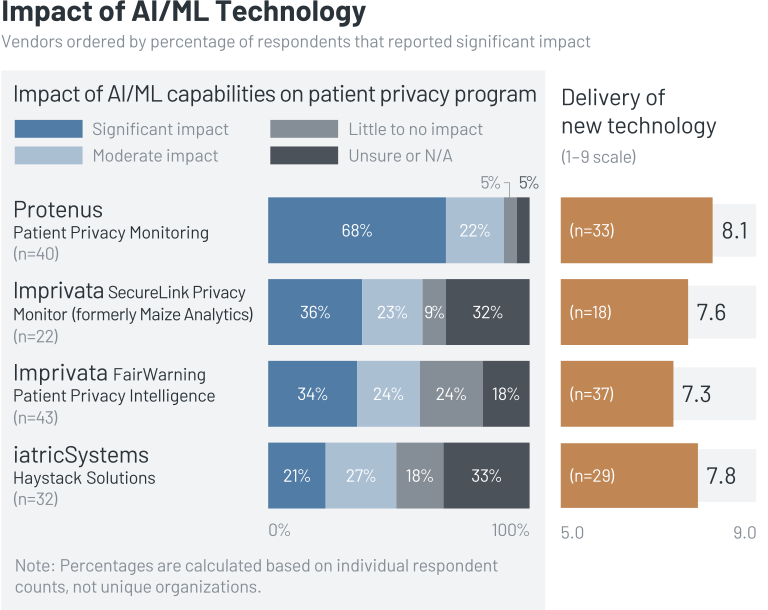
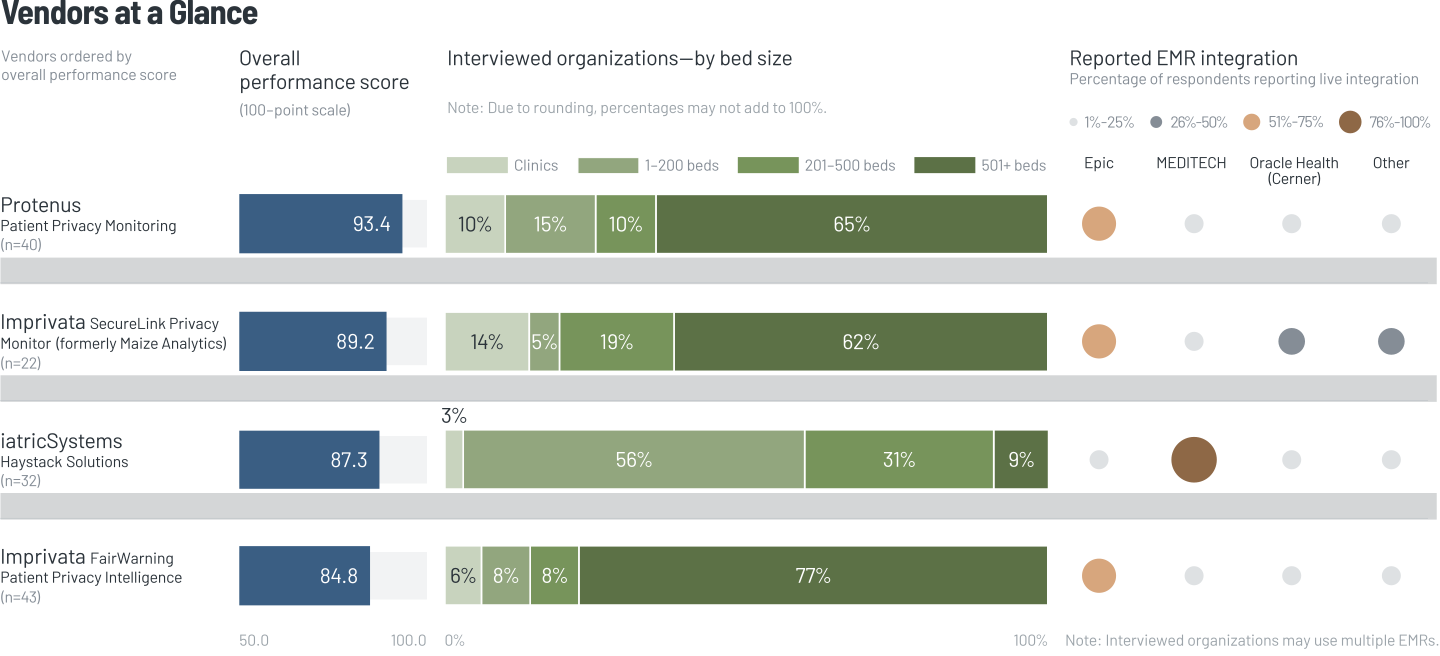
2023 Best in KLAS winner Protenus has a large customer base; most interviewed customers are Epic sites with over 500 beds. Respondents appreciate the vendor’s innovation and customer service, and those who highlight the benefits of AI say it significantly decreases manual work by reducing false positives and enabling users to focus on real cases and complete investigations faster. Additionally, respondents who previously used other patient privacy monitoring solutions note that their experience with Protenus is an improvement thanks to better vendor communication and more automation. Some customers mention the product needs further development, such as more detailed reports and more integration with non-EMR third-party solutions (e.g., privacy incident management systems).
Imprivata FairWarning and SecureLink See Decreased Customer Satisfaction after Acquisitions; FairWarning Customers Note High Costs for Data Storage
In the last few years, Imprivata has acquired two vendors: FairWarning in 2020 and SecureLink in 2022 (who acquired Maize Analytics in 2021). Most Imprivata FairWarning Patient Privacy Intelligence customers are larger organizations, and some smaller organizations who lack needed IT infrastructure use the solution to help them meet regulations. Customer satisfaction initially decreased post-acquisition due to lacking points of contact, insufficient vendor communication, untimely issue resolution, and nickel-and-diming for support and training (not previously a concern). Data storage costs from moving to the cloud are also noted as a dissatisfier. Due to these issues, some very dissatisfied customers have switched to other vendors. Since the initial decrease, customer satisfaction has steadily improved, and a few recently interviewed respondents note the FairWarning acquisition was smooth. Respondents who say the AI functionality moderately or significantly impacts outcomes report benefits such as reduced false positives and more efficient audits. Those who report little to no impact feel that it is too early to see outcomes or that there are still too many false positives. Some also feel hindered by buggy upgrades, lost data, and a constantly changing interface.
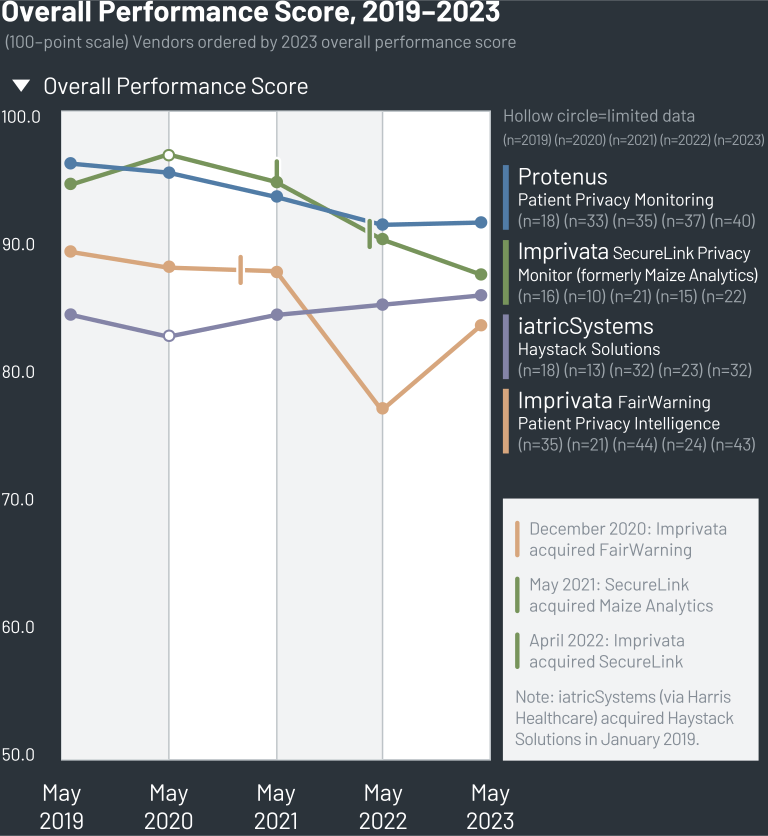
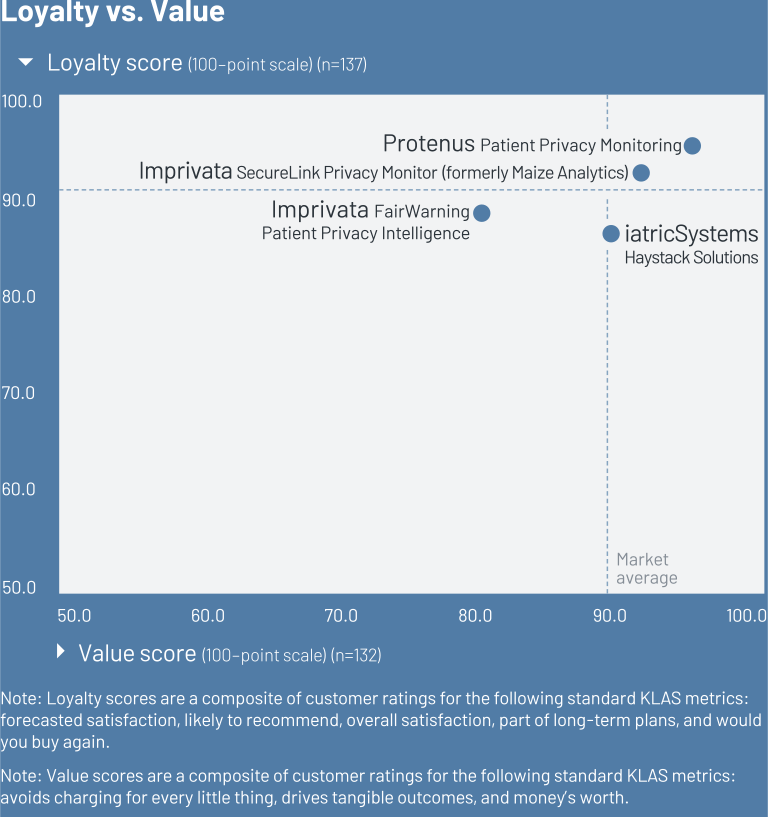
Historically high customer satisfaction slightly declined after SecureLink acquired Maize Analytics, and the current customer experience with Imprivata SecureLink Privacy Monitor varies. Most respondents say the acquisition was smooth, and a couple feel optimistic about future development Imprivata will bring; others say the vendor is less responsive than preacquisition. In general, customer loyalty remains high due to the solution being seen as affordable. Some customers aren’t yet using the AI functionality, but those who are highlight the decision-making support and the ability to handle large amounts of data while reducing manual work. Respondents also note the anomaly-detection reports, but some feel they don’t know how to fully use them.
iatricSystems a Strong Performer for Small Organizations; Larger Customers Are Dissatisfied, Plan to Replace
The majority of iatricSystems customers are smaller or midsize organizations using MEDITECH; many of these organizations say iatricSystems’ performance has been stable over time due to solid relationships. All three larger customers (over 500 beds) interviewed report dissatisfaction and plan to replace the solution, citing a high amount of noisy data and bugs discovered during implementation. Across sizes, one-third of interviewed customers report feeling unsure about the AI’s impact because they either haven’t upgraded to it (often due to cost) or aren’t using it. Interviewed customers who are using the AI functionality say it helps them track multiple investigations and stay proactive. Overall, several respondents say the technology and AI functionality are still maturing—users on the older version especially struggle with manual processes and too many false positives, making it difficult to identify true instances of inappropriate data access. Customers expect to receive fewer alerts as the AI functionality keeps learning, and those that have transitioned to the new version note that the usability has improved.
Additional Insights
Voice of the Customer
Vendors ordered alphabetically
iatricSystems Haystack Solutions
 “In using Haystack Solutions, we have seen more visibility. We are monitoring any HIPAA violations, and Haystack Solutions gives us access to every single record. The system is very smart. It has AI functionality that can trigger a warning and find any incident. The tool is helping to detect incidents that we couldn’t see before. With the logic that the system has, we can track that somebody changed a patient’s last name or lives on the same block as a patient whose record they looked at. The system alerts us to investigate that incident that could be related to a HIPAA violation.” —Director
 “We would like the vendor to focus on AI and machine learning to further drive surveillance. The vendor is scratching the tip of the iceberg, but there is plenty of room to grow. The vendor’s challenge is that the product needed some fairly major basic performance corrections, and that impacted the vendor’s product road map.” —Manager
Imprivata FairWarning Patient Privacy Intelligence
“Imprivata’s strength is that their product is one of the few systems that can help companies without a significant IT infrastructure to be able to ensure that policies and procedures for patient privacy are taken seriously. The product kicks things up a notch to ensure that we are able to convey to our patients and government agencies that we take monitoring seriously. The product also allows us to address users who shouldn’t be looking at patient records that they have no need to see. So the product really helps us with employees snooping on each other or with patients who feel that a personal contact might have looked at their record. We can assure patients that our employees uphold the privacy standards that we have set forth.” —VP
“When the vendor was FairWarning, more things were built into the pricing. If we needed to add an additional data source or we needed to have a project in the middle of things, there wasn’t necessarily an additional cost for that. But with Imprivata, there are additional costs for everything we do with them, despite how much we paid up front for the product. They charge us for everything they can charge for. For example, we wanted to make a change to a table, and we had to pay a lot for that. We wanted that change many months ago and are still waiting for it. Previously, with FairWarning, a change like that would have taken two weeks at the most. I don’t believe we receive our money’s worth. I don’t feel like the product should cost as much as it does.” —Director
Imprivata SecureLink Privacy Monitor (formerly Maize Analytics)
“We looked at a number of different solutions, and SecureLink Privacy Monitor had the most competitive price by far. The vendor continues to work with us as we expand our business, and the licensing agreement is more than reasonable. The value for our money has been fantastic. I would absolutely recommend Imprivata to others. The value of the product, the vendor’s support, and the insights that the platform gives us are pretty great.” —VP
“My cohorts have noticed the system has been running slower since it was acquired by Imprivata. We have not been accustomed to that. Since the acquisition, we have had to reach out and ask for help more than ever before. For example, we were used to running our data reports outside of business hours so the system wouldn’t get bogged down. Maize Analytics would do that for us. Nowadays, that doesn’t always happen. We are seeing a lot of dissatisfaction with the data. The reports are sometimes missing things, so we have to reach out and figure out why certain data is not there. We never experienced that until Imprivata’s acquisition.” —Manager
Protenus Patient Privacy Monitoring
“We used to do manual, line-by-line reviews, sometimes over several years’ worth of records, and that was a nightmare. The tool allows us to review HIPAA-related access issues more quickly and thoroughly using indicators for whether something looks risky so we can spend our time more effectively and efficiently by looking at what is actually risky. The system is a great filter that helps us get rid of the noise and focus on what looks odd. Protenus’ product has a scoring system based on how suspicious the activity is.” —Director
“We have seen some glitches here and there with Protenus’ integration. There are other systems that connect to our main system that we haven’t connected to the Protenus system. Connecting those systems would give us a better integration, but we are not sure that the outcome would be worth the effort because it would take a lot of work on both ends to try and integrate additional systems with the Protenus system. We have other systems that interface with our main system, and there is really a mixed bag.” —VP
About This Report
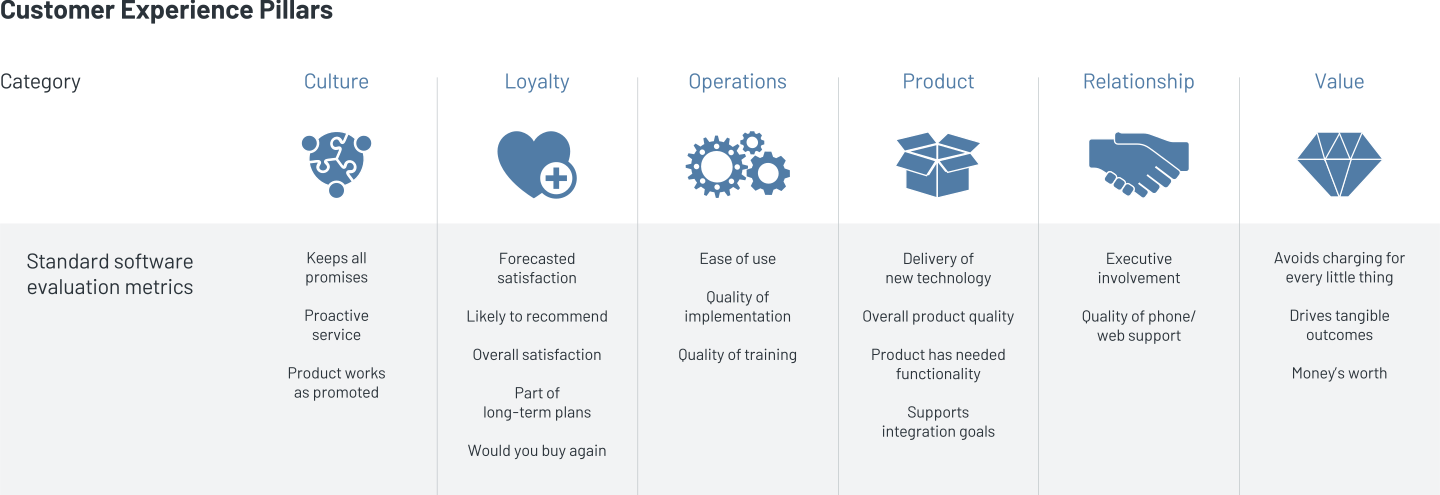
Each year, KLAS interviews thousands of healthcare professionals about the IT solutions and services their organizations use. For this report, interviews were conducted over the last 12 months using KLAS’ standard quantitative evaluation for healthcare software, which is composed of 16 numeric ratings questions and 4 yes/no questions, all weighted equally. Combined, the ratings for these questions make up the overall performance score, which is measured on a 100-point scale. The questions are organized into six customer experience pillars—culture, loyalty, operations, product, relationship, and value.
To supplement the customer satisfaction data gathered with the standard evaluation, KLAS also asked customers the following questions specific to patient privacy monitoring:
- What EMR and/or ERP systems are currently integrated with your patient privacy monitoring solution?
- What impact have your vendor’s AI/ML capabilities had on your compliance/privacy program?
Sample Sizes
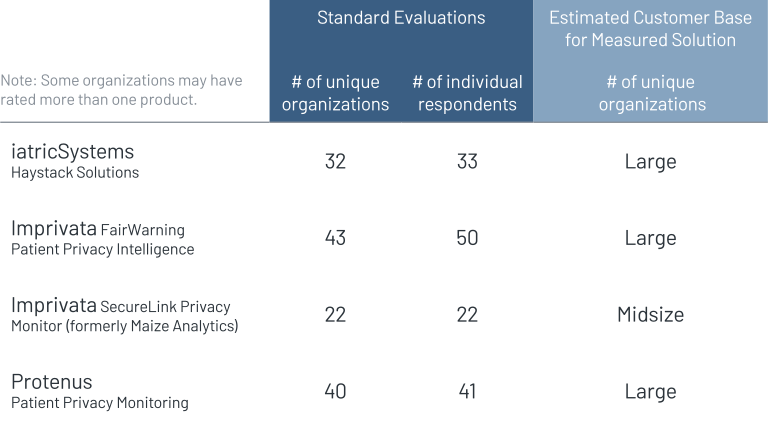
Unless otherwise noted, sample sizes displayed throughout this report (e.g., n=16) represent the total number of unique customer organizations interviewed for a given vendor or solution. However, it should be noted that to allow for the representation of differing perspectives within any one customer organization, samples may include surveys from different individuals at the same organization. The table below shows the total number of unique organizations interviewed for each vendor or solution as well as the total number of individual respondents.
Some respondents choose not to answer particular questions, meaning the sample size for any given vendor or solution can change from question to question. When the number of unique organization responses for a particular question is less than 15, the score for that question is marked with an asterisk (*) or otherwise designated as “limited data.” If the sample size is less than 6, no score is shown. Note that when a vendor has a low number of reporting sites, the possibility exists for KLAS scores to change significantly as new surveys are collected.

Writer
Natalie Hopkins

Designer
Jessica Bonnett

Project Manager
Andrew Wright
This material is copyrighted. Any organization gaining unauthorized access to this report will be liable to compensate KLAS for the full retail price. Please see the KLAS DATA USE POLICY for information regarding use of this report. © 2026 KLAS Research, LLC. All Rights Reserved. NOTE: Performance scores may change significantly when including newly interviewed provider organizations, especially when added to a smaller sample size like in emerging markets with a small number of live clients. The findings presented are not meant to be conclusive data for an entire client base.