KLAS Contact

Contact KLAS
Contact KLAS
 2026 BEST IN KLAS
Preferences
Related Series

2025

2021

2018

2016

2014

2013

2012

2011

2010

2005
Related Segments

Data & Analytics Platforms 2023
Which Vendors Can Handle Complexity and Deliver Outcomes?

Author
Bradley Hunter

Author
Jennifer Hickenlooper
Healthcare organizations manage a plethora of data sets, and they have continual need for consolidated, end-to-end data and analytics platforms that offer strong capabilities (e.g., ability to track and benchmark desired outcomes). Organizations are looking for reporting with digestible metrics that can help staff make better decisions as well as excellent support when implementing and actualizing different use cases. This report examines how many data source types that solutions can ingest, how well solutions deliver results for complex use cases, and how well vendors partner with customers to help them achieve success.

Dimensional Insight & Innovaccer Drive Outcomes with Easy-to-Use Metrics
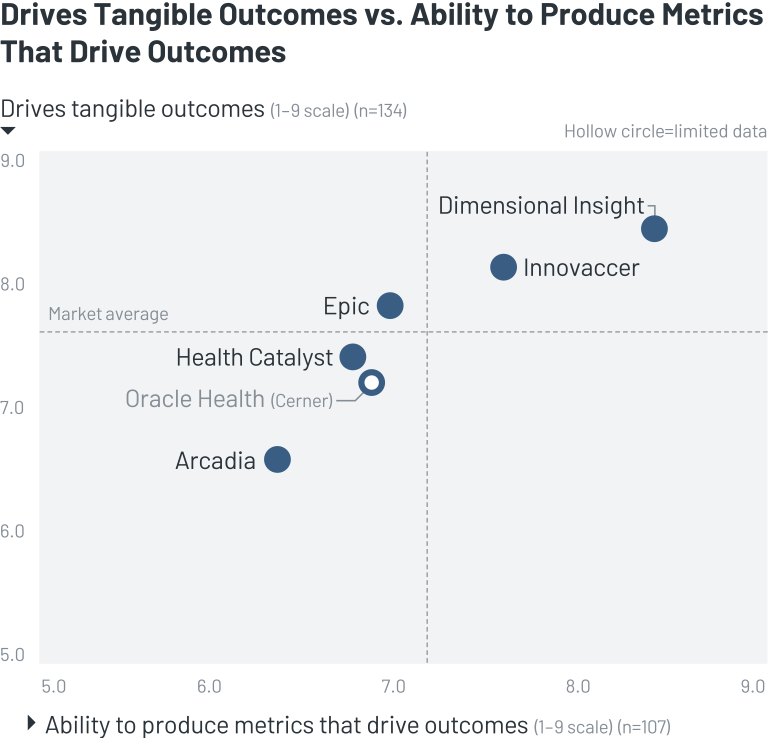
Interviewed customers of Dimensional Insight and Innovaccer highlight that their vendor’s solution produces metrics that track the progress of outcomes. Dimensional Insight’s platform is seen as a powerful, easy-to-use tool with broad functionality, and most respondents say they get their money’s worth thanks to easily digestible metrics that help drive desired outcomes (e.g., related to risk and HCC scoring, pharmacy, readmissions). Respondents are optimistic about Dimensional Insight’s product development, noting that the vendor regularly upgrades the system. A few are worried the platform’s advanced analytics capabilities, such as AI and predictive analytics, are falling behind. Innovaccer is known for their nimble and innovative culture that leads to quick product development and customization; interviewed customers also appreciate their extensive executive involvement and support. Many note they can get outcomes-driving metrics and information into users’ workflows, and some mention achieving outcomes related to health equity and SDOH data sources (e.g., ability to refer to community-based agencies). A few respondents report that bumpy implementations have impeded their success due to ongoing challenges with timelines and integration. On average, Innovaccer respondents bring in fewer data source types than other vendors’ customer respondents.
Health Catalyst Customers Often Use Vendor for Complex Projects; Some Struggle Due to Lack of Proactivity
Among measured vendors, Arcadia (more details on page 5), Health Catalyst, and Innovaccer are validated most frequently as taking on high-complexity projects. Health Catalyst is often used by large organizations and offers both software and services, enabling customers to either run the software in-house or develop it with the vendor. Many respondents note that the solution is highly customizable, which leads to mixed customer experiences with getting it up and running. The most-satisfied respondents highlight that Health Catalyst executives and account managers are involved and provide expertise that helps drive success, and the majority of respondents note that when they ask for help, the vendor is responsive. Additionally, all respondents using the vendor’s new tech-enabled management services express high satisfaction. Those who are less satisfied report a lack of proactivity and guidance from the vendor, saying they often have to do the heavy lifting to make the solution usable; some respondents also feel Health Catalyst let them down by not requiring their organization to have a certain number of internal resources to support the solution. A few interviewed customers say the solution is expensive and report being nickel-and-dimed because Health Catalyst didn’t proactively set up all needed functionality.

Both Epic & Oracle Health Customers Struggle with Ease of Use; Epic Balances Challenges with Good Support, while Oracle Health Customers Report Frustrations
Interviewed Epic customers appreciate that the vendor can easily bring clinical data and other data from Epic’s broad ecosystem into the analytics platform, and a couple note they are also able to bring in other non-Epic data sources. Less-satisfied respondents feel the training inadequately addresses the complex solution and the knowledge required to use it. Despite this, most respondents point out that Epic is willing to support them via account managers; 93% feel the vendor keeps all their promises, and many are hopeful that Epic will continue to develop more advanced functionalities. Interviewed customers of Oracle Health (Cerner) report the solution can bring in EHR data but that it isn’t immediately easy to use and requires more of an internal lift than expected. Many respondents also feel the vendor’s training is lacking. Customer perceptions of the solution post-acquisition are mixed—a few have seen improved support and hope Oracle Health will improve the platform by moving it to the cloud, while others are less optimistic about the future due to inconsistent support caused by turnover and layoffs.

Arcadia Struggles to Deliver Promises to Customers
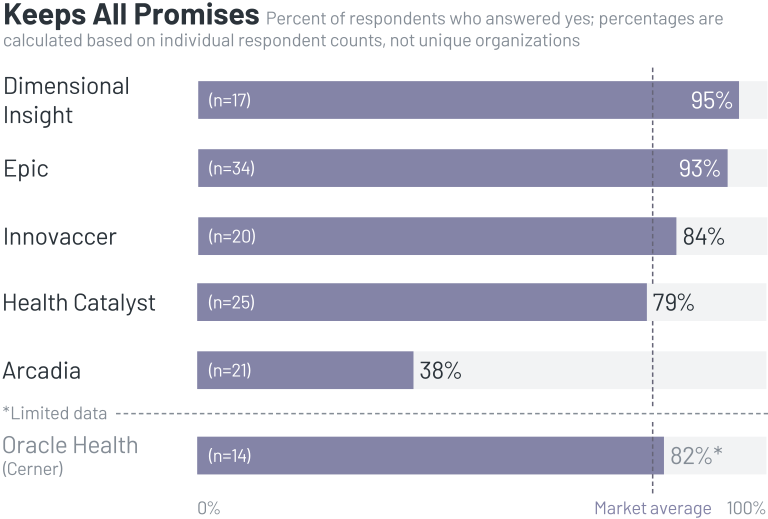
Customers using Arcadia’s population health platform for value-based care are the only users of the vendor’s data and analytics solution. This solution is known for being very customizable, and respondents note that successfully getting it up and running requires a large number of resources and that their projects are very complex in nature. Many use the solution for quality/risk management and ingesting claims and clinical data; others have expanded (with mixed results) to other use cases, such as cost reduction. In recent years, Arcadia has seen a decline in their overall performance, partly due to customer dissatisfaction with Arcadia replatforming the data and analytics solution. 62% feel the vendor hasn’t kept their promises, citing insufficient training, poor implementations and upgrades, customization challenges, turnover among support staff, and a lack of proactivity. Additionally, in contrast to other vendors’ customer bases, several Arcadia respondents feel the data is not reliable and the platform is not stable. However, customers report that the vendor’s performance has recently begun to stabilize; some mention that the current Arcadia executives are starting to make changes to improve the support and resolve problems. 95% of respondents report Arcadia is part of their long-term plans.
1Clearsense
Clearsense is a data and analytics vendor that provides a software-as-a-service model to their small client base. KLAS interviewed 5 of the <25 clients live on Clearsense’s offering, 1Clearsense. Early insights indicate that most client organizations are satisfied; one respondent expressed frustration with the vendor.
About This Report
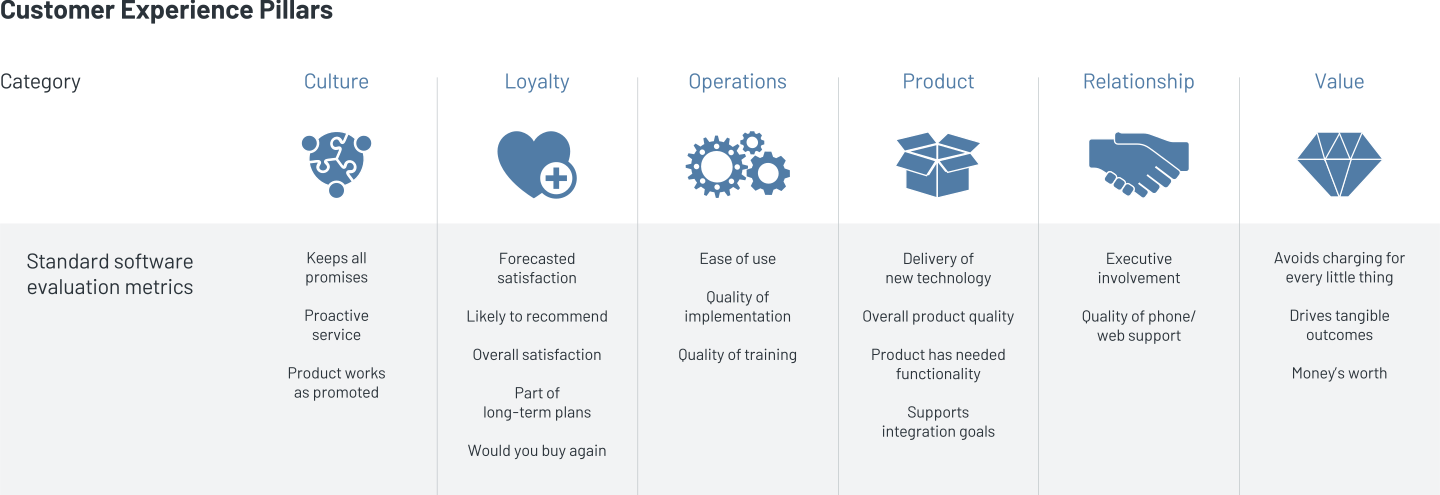
Each year, KLAS interviews thousands of healthcare professionals about the IT solutions and services their organizations use. For this report, interviews were conducted over the last 12 months using KLAS’ standard quantitative evaluation for healthcare software, which is composed of 16 numeric ratings questions and 4 yes/no questions, all weighted equally. Combined, the ratings for these questions make up the overall performance score, which is measured on a 100-point scale. The questions are organized into six customer experience pillars—culture, loyalty, operations, product, relationship, and value.
To supplement the customer satisfaction data gathered with the standard evaluation, KLAS also created a supplemental evaluation to delve deeper into several questions specific to the data and analytics platforms market. This evaluation asked respondents (1) which data domains they are using their vendor for as a primary trusted source, (2) how well their vendor can produce metrics pertaining to analytics that track progress toward specific outcomes, and (3) how complex their project is (including data environment, sourcing, and curation).
Sample Sizes
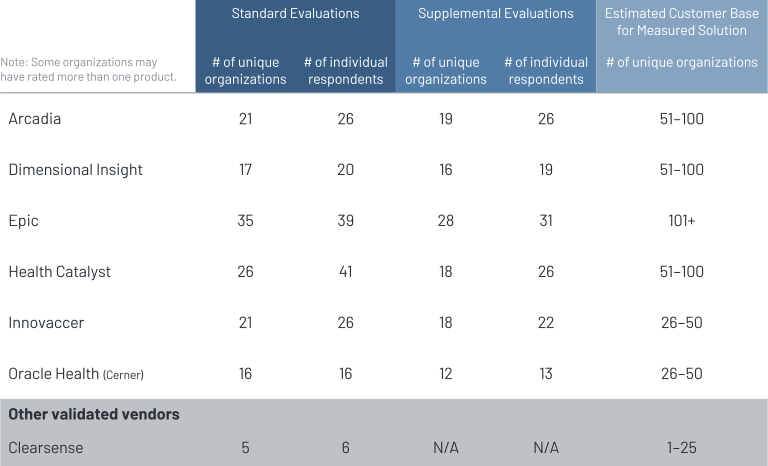
Unless otherwise noted, sample sizes displayed throughout this report (e.g., n=16) represent the total number of unique customer organizations interviewed for a given vendor or solution. However, it should be noted that to allow for the representation of differing perspectives within any one customer organization, samples may include surveys from different individuals at the same organization. The table below shows the total number of unique organizations interviewed for each vendor or solution as well as the total number of individual respondents.
Some respondents choose not to answer particular questions, meaning the sample size for any given vendor or solution can change from question to question. When the number of unique organization responses for a particular question is less than 15, the score for that question is marked with an asterisk (*) or otherwise designated as “limited data.” If the sample size is less than 6, no score is shown. Where textual content relies on limited data, the vendor name is marked with an asterisk. Note that when a vendor has a low number of reporting sites, the possibility exists for KLAS scores to change significantly as new surveys are collected.

Writer
Natalie Hopkins

Designer
Bronson Allgood

Project Manager
Andrew Wright
This material is copyrighted. Any organization gaining unauthorized access to this report will be liable to compensate KLAS for the full retail price. Please see the KLAS DATA USE POLICY for information regarding use of this report. © 2026 KLAS Research, LLC. All Rights Reserved. NOTE: Performance scores may change significantly when including newly interviewed provider organizations, especially when added to a smaller sample size like in emerging markets with a small number of live clients. The findings presented are not meant to be conclusive data for an entire client base.