KLAS Contact

Contact KLAS
Contact KLAS
 2026 BEST IN KLAS
Preferences
Related Series

2021

2011
Related Segments

Extended Business Office Services 2024
How Are Provider Organizations & Firms Responding to New Market Pressures?

Author
Mollie Hunt

Author
Jonathan Christensen

Author
Shawn Howell
Provider organizations are facing intensifying revenue cycle complexity, payer relations, cost pressures, and staffing shortages, along with the resulting loss of resources and expertise. To find relief from some of these pressures, many are seeking outsourced extended business office services (EBOS) offered by firms that can execute revenue cycle management (RCM) work more economically and with greater efficiency than organizations can in-house. To share insights into a shifting market, this report provides (1) an update on client satisfaction and adoption and (2) a look into provider plans for outsourced revenue cycle services and satisfaction with offshore resources.
Performance Insights
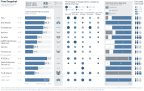
A note about component firms: GetixHealth, R1 RCM, State Collection Service, and TruBridge are designated “Component” for varying reasons. See the About This Report section for more information.
PwC Excels in Performance Visibility & Relationships; AGS Health Improves Client Partnerships
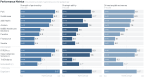
For firms that serve organizations of all sizes, high client satisfaction is driven by partnership, consistent knowledge and abilities across staff, and positive outcomes. With their broad revenue cycle consulting portfolio, PwC leads in overall performance, and interviewed clients feel the firm maintains strong relationships, responds quickly, and accommodates their needs. Respondents also value PwC’s analytical tools, which increase visibility into PwC’s performance. While a few respondents would like the firm to be more hands-on and engage more proactively in identifying and addressing performance gaps, all would purchase the services again. Client satisfaction with AGS Health has significantly improved over the last year, partly due to resolved turnover issues. Likewise, respondents report greater transparency from AGS leaders that has led to a strengthened partnership, and many also appreciate their account managers’ responsiveness and proactive problem-solving. Respondents also report general satisfaction with offshore resources. Dissatisfied respondents want AGS to improve their strategic engagement by offering best practices and handling complexity in billing/collections. Guidehouse respondents appreciate the firm’s strong revenue cycle expertise, attentiveness, and collaboration in addressing problems. Most feel the firm drives strong value through their work on cash collections and A/R management. One client experienced misses due to insufficiently trained frontline staff. Acclara (formerly Tegria) was recently acquired by R1. Their most satisfied respondents, especially those at larger organizations, highlight the firm’s involved executive team and willingness to listen to and accommodate client needs, such as returning accounts to the client or assisting with additional projects. Small interviewed clients feel Acclara struggles training staff to have necessary expertise and the ability to work accounts with sufficient speed and quality. Firstsource’s client experience is inconsistent. Some would like the firm to be more collaborative in teaching clients how to improve the revenue cycle. Respondents also mention additional work caused by staff mistakes, poor handoffs, and inflexibility regarding client needs. While some are satisfied overall and note an improved attention to quality, respondents generally wish the firm were more proactive and did more to meet their engagement expectations.
For Smaller Organizations, R1 RCM’s Partnership Drives Meaningful Outcomes; TruBridge & Savista* Fall Short Due to Inconsistency
For R1 RCM validations, all but one come from small organizations (<200 beds), and all are Oracle Health customers. R1 is transparent and collaborative in guiding responding organizations to improve their revenue cycle operations, and respondents highlight R1’s partnership in optimizing processes and achieving prioritized outcomes, such as improved A/R and cash on hand. While some report challenges with undertrained offshore staff that affected the firm’s execution, all would buy the services again. TruBridge respondents—all small organizations—report challenges with the firm’s staff, saying frontline workers don’t have the necessary training and expertise to proactively identify problems, find solutions, and improve the overall revenue cycle. Respondents report the firm has struggled to hire and retain staff, resulting in some offshore work that has introduced high variability into the client experience. The lowest-scoring respondents feel TruBridge struggles with transparency and producing accurate reports and cash postings, resulting in clients having to do additional audits to ensure information is correct. That said, respondents often speak highly of the firm’s account managers and higher-up leaders and point to strengths such as the firm’s responsiveness and partnership. Four interviewed Savista* clients with 1–500 beds say their experience has been heavily influenced by staff and management turnover, noting disruptions to cash collection efforts and the level of expertise of those working accounts. Two very dissatisfied clients say Savista has struggled to execute in meeting deadlines and other expectations. That said, challenges appear to arise mainly from frontline staff, and most respondents agree that the firm has good managers and leaders.
*Limited data
Note: See the Firm Insights section for more details on the satisfaction difference between small and large clients.
Market Dynamics
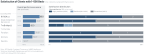
Nearly One-Third of Organizations Plan to Expand Outsourcing within Their Revenue Cycle
Data shows that the strength of a firm’s partnership drives an organization to broaden their plans with the same firm. Respondents who plan to decrease their scope are typically less satisfied with their firm’s partnership. Firms need to focus on actively partnering with clients to help them achieve their organizational goals.

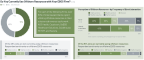
Offshoring Generally Perceived Negatively, but Most with First-Hand Experience Report Benefits
Both inside and outside of the healthcare industry, it is generally believed that offshoring results in lower-quality work and should be avoided, though it isn’t clear whether that perception is the result of unfamiliarity with offshoring or negative past experiences. However, the reality is that as cost pressures continue to mount, EBOS firms—and therefore the health systems working with them—will send work overseas. As that has happened, respondents have reported difficulties but have also realized benefits. Commonly reported frustrations include language barriers, limited knowledge and strategic expertise among frontline staff, and the need for additional client oversight to ensure quality in day-to-day execution. Realized benefits include cost savings, access to a larger pool of resources, and the ability to receive work anytime, as the resources aren’t restricted to normal US business hours.
Despite some industry-wide stigma, client satisfaction with offshore resources is possible, depending heavily on how well a firm:
- Manages client expectations for the ability and knowledge of the resources
- Proactively monitors the quality of work
- Fosters partnership through transparency and responsiveness
- Trains staff to handle complexities and think outside of the box
- Retains staff
 “Sometimes there is a perception that we get with the offshore people who have PhDs and medical MDs, but we all deal with the same things every day, including people calling in sick, turnover, inflationary pressures, holidays, and funerals. In many ways, our offshore people are really no different. In fact, managing the work can take more work. We have to be very explicit, almost like we are with coding or preparing automation. There are different cultures and perceptions. It is hard to describe the amount of management and oversight that is involved and required. That is probably what catches a lot of companies off guard.” —VP (GeBBS Healthcare Solutions client)
Note: KLAS began asking about sentiments toward offshore resources in May 2023. Thus, the sample size is smaller than elsewhere in the report. KLAS will continue to monitor and report on the adoption and perception of offshore resources with EBOS firms.
About This Report
Each year, KLAS interviews thousands of healthcare professionals about the IT solutions and services their organizations use. For this report, interviews were conducted over the last 18 months using KLAS’ standard quantitative evaluation for healthcare services, which is composed of 9 numeric ratings questions and 3 yes/no questions, all weighted equally. Combined, the ratings for these questions make up the overall performance score, which is measured on a 100-point scale. The questions are organized into five client experience pillars—loyalty, operations, relationship, services, and value.
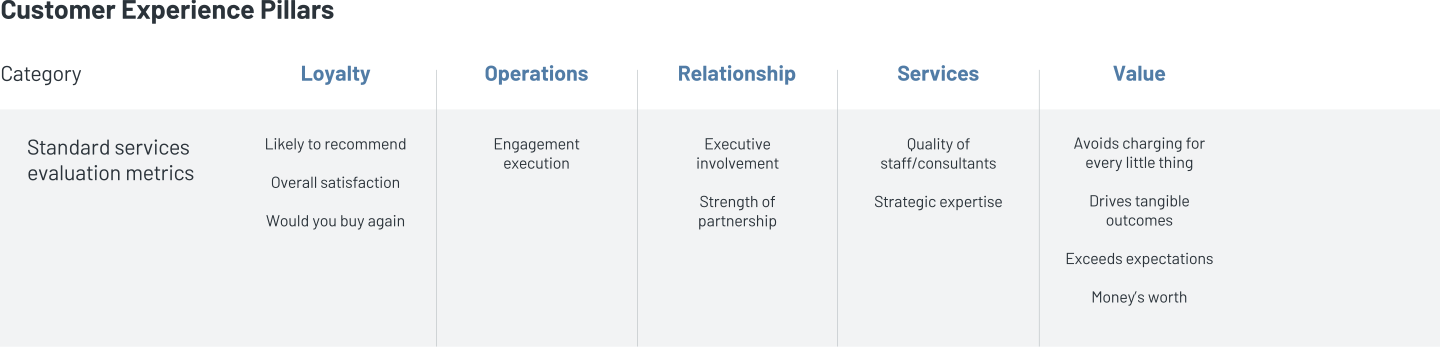
In addition to the standard questions, KLAS asked the following supplemental questions:
- What types of work is your firm doing for you?
- What is your sentiment toward the offshoring of extended business office services?
- Are you currently using offshore resources from your firm? If so, how often do you directly interact with the firm’s offshore resources?
- What changes, if any, does your organization plan to make to the scope of outsourcing within your revenue cycle?
- What changes, if any, does your organization plan to make to the number of firms you currently use for outsourced revenue cycle services?
Sample Sizes
Unless otherwise noted, sample sizes displayed throughout this report (e.g., n=16) represent the total number of unique client organizations interviewed for a given firm or service. However, it should be noted that to allow for the representation of differing perspectives within any one client organization, samples may include surveys from different individuals at the same organization. The table below shows the total number of unique organizations interviewed for each firm or service as well as the total number of individual respondents.
Some respondents choose not to answer particular questions, meaning the sample size for any given firm or solution can change from question to question. When the number of unique organization responses for a particular question is less than 6, the score for that question is marked with an asterisk (*) or otherwise designated as “limited data.” If the sample size is less than 3, no score is shown. Where textual content relies on limited data, the firm name is marked with an asterisk. Note that when a firm has a low number of reporting sites, the possibility exists for KLAS scores to change significantly as new surveys are collected.
A small number of ambulatory sites are included in the sample, though average satisfaction at these sites was similar to average satisfaction at acute sites. As marked, these sites are not included in any information broken out by sizing. Going forward, KLAS intends to more strictly differentiate between RCM services for acute organizations and RCM services for ambulatory care organizations, after which non-hospital organizations will be measured in a different market segment.

Product Designations Used in This Report
- Component [C]: Product that typically includes most but not all components that comprise a complete system or that serves only a subset of the market. In this report, GetixHealth and State Collection Service are considered component, as the majority of their offerings are early-out self-pay services. R1 RCM and TruBridge are considered component for their difference in sizing, with the majority of their clients under 100 beds.

Writer
Carlisa Cramer

Designer
Jessica Bonnett

Project Manager
Sydney Toomer
This material is copyrighted. Any organization gaining unauthorized access to this report will be liable to compensate KLAS for the full retail price. Please see the KLAS DATA USE POLICY for information regarding use of this report. © 2026 KLAS Research, LLC. All Rights Reserved. NOTE: Performance scores may change significantly when including newly interviewed provider organizations, especially when added to a smaller sample size like in emerging markets with a small number of live clients. The findings presented are not meant to be conclusive data for an entire client base.