KLAS Contact

Contact KLAS
Contact KLAS
 2026 BEST IN KLAS
Preferences
Related Series

2017
Related Segments

Payer Claims & Administration Platforms 2023
Vendor Performance in a Segmented Market

Author
Joe VanDeGraaff

Author
Jennifer Hickenlooper

Author
Ruirui Sun
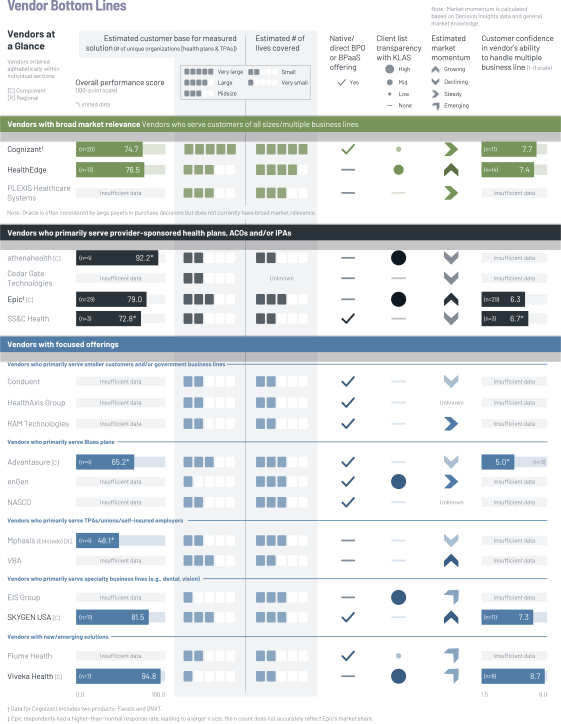
In recent years, the complex payer claims and administration market has seen several changes. Historically, payers have used multiple technology vendors and homegrown tools to meet their broad functionality needs. Now, payers are looking to consolidate platforms to improve efficiency and their ability to manage multiple business lines. As finding a platform that meets payers’ complex needs can be challenging, this report provides a comprehensive look at which business lines vendors are focused on, which vendors are gaining or losing market considerations, and how satisfied customers are with their platforms.
Note: In this market, vendors that serve only certain types of health plans are designated as component solutions and marked with a [C]. For a complete view of all vendors and their target clients, please see Vendors at a Glance.
Vendors with Broad Market Relevance
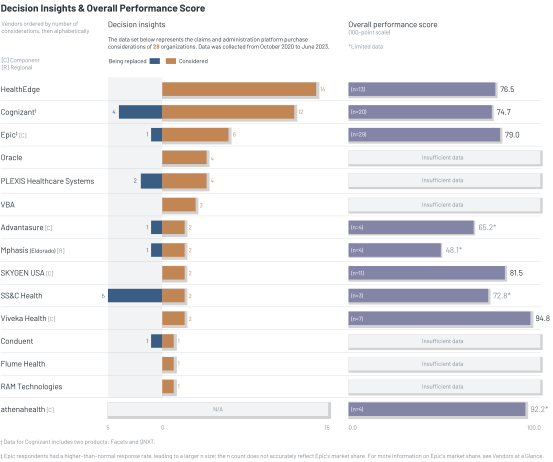
Cognizant & HealthEdge Are Clear Mindshare Leaders; Support & Delivery Challenges Remain for Both
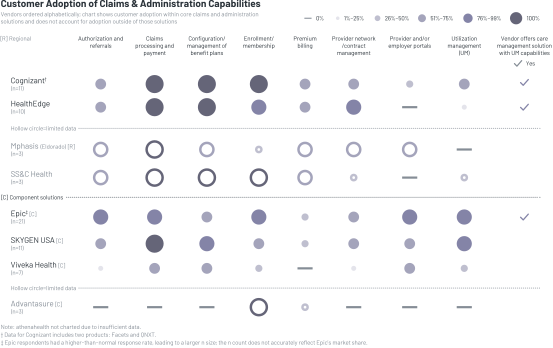
Cognizant has the largest market footprint and is often considered in purchase decisions. Their solutions (including TriZetto Facets and QNXT) provide broad functionalities and are used by payers of all sizes, who report confidence in the software’s ability to manage multiple business lines. Most respondents are satisfied, and many note that functionality and efficiency have improved over the years. Some customers note a lack of timely vendor support and problems with overcustomization (which can sometimes lower efficiency and decrease product stability), leading a few dissatisfied customers to look elsewhere. However, despite these issues, nearly all Cognizant respondents plan to stay with the vendor. HealthEdge has gained momentum in the number of payers considering and selecting their solution, with purchasing organizations citing the advanced technology and modern UI. Existing customers say the solution drives operational efficiency, improves automated adjudication rates, and provides strong capabilities for benefit configuration and processing claims. Some respondents want improvement to the billing functionalities and more vendor engagement (e.g., training, timely development and support). Other reported challenges include defects after upgrades as well as insufficient project management during implementations.
Vendors Who Primarily Serve Provider-Sponsored Health Plans, ACOs, and/or IPAs
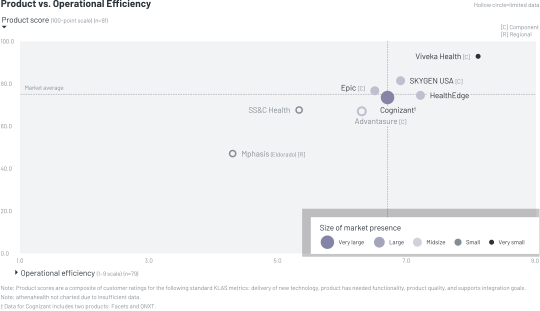
Provider-Sponsored Health Plans Frequently Consider Epic; SS&C Health* Continues to Lose Customers
Epic is frequently considered by provider-sponsored health plans using Epic’s EMR in clinical settings; reasons include consolidation, efficiency via clinical–health plan integration, and existing strong relationships with Epic (leading to high customer loyalty). Current customers use the platform for utilization management as well as claims and administration functionalities. A few note that Epic’s health plan implementation team isn’t as experienced as the clinical team, leading to issues like bugs and poor usability. Lacking functionality has lowered several customers’ confidence in Epic’s ability to handle multiple business lines; respondents also want reporting for referrals and authorizations. Interviewed athenahealth* customers highlight the solid product, EMR integration, and smooth upgrade experiences. Respondents feel the system’s ease of use could improve. Few payers have considered athenahealth in purchase decisions due to ownership changes and an unclear road map; KLAS validated no recent wins. SS&C Health* customers mainly use the system for ACO contracts. They feel the vendor is slow to develop and deliver new technology. Most respondents feel uncertain about SS&C’s road map, though one mentioned having a good conversation with the new leadership. KLAS validated no new wins but several replacements; replacing customers cite old technology and lacking innovation and scalability.
Vendors with Focused Offerings
SKYGEN USA & Viveka Health Seen As Solid for Specialty Plans & Small Plans (Respectively); Mphasis (Eldorado)* Still Falling Short of Customer Expectations
SKYGEN USA customers view the product as easy to use and configure, highlighting how it supports specialty business lines (e.g., dental, vision) and Medicaid. Customer experiences with the vendor vary. Some report SKYGEN is a partner and willing to adapt the product to their needs; others feel the vendor doesn’t proactively alert users about bugs, provide training, or explain customization choices. A few respondents also want better customization and more functionality for supporting certain commercial plans. Regarding purchase decisions, KLAS validated two health plans who selected SKYGEN due to strong configurations and integration with clearinghouses and cybersecurity tools. Viveka Health is used by only smaller health plans (mostly self-insured organizations and TPAs). Customers report high executive engagement, noting Viveka is easy to work with, proactive, and innovative with technology. Users especially appreciate the member-facing mobile app and the provider and patient communication feature. A couple of customers want the vendor to continue to develop functionalities.
Advantasure* is mostly used for Medicare Advantage (MA) membership enrollment. In April 2023, they were acquired by UST HealthProof; it remains to be seen how this will affect customer satisfaction. Overall, customers feel the solution does well at checking MA eligibility in real time. Due to the platform’s focus, they don’t feel it is able to manage multiple business lines; they also report an inefficient workflow because of separate billing and enrollment functionalities. Most want the vendor to improve their timeliness in resolving issues, and some are planning to leave due to an unsatisfactory vendor relationship. Limited data on Mphasis (Eldorado)* indicates that customers (mostly TPAs) are disappointed with the platform quality and implementations. Customers also note Mphasis offers slow support and nickel-and-dimes for customizations. Respondents feel stuck with the product, and none plans to purchase it again.
Vendors Who Are Considered but Not KLAS Rated
Payers making purchasing decisions also consider vendors not currently measured by KLAS. enGen (formerly HM Health Solutions) mainly serves Blues plans, and they also offer BPaaS services. Flume Health has seen recent growth and contracted with several newer payer types (e.g., start-ups, nontraditional plans) and self-insured employers; potential customers see the vendor as technologically innovative with new features in network management. Oracle is often considered due to their reputation of working with large payers and ability to scale. Oracle’s solution is more often adopted in non-US markets; US payers question the vendor’s ability to handle US business lines. PLEXIS Healthcare Systems has gained momentum in recent years thanks to advanced technology in the newer product version. Two organizations have replaced the vendor. KLAS validated a few considerations for VBA, who is mostly focused on the TPA market; potential customers note VBA has a good reputation serving that market. For other nonrated vendors’ claims and administration offerings, see KLAS’ 2022 vendor guide.
Voice of the Customer
Fully Rated Vendors
Cognizant (Facets and QNXT)
 “The product works well. In our legacy system, we were working Medicare claims manually. With QNXT, I don’t need to worry. The system automatically works. Because of how our last system worked, I needed two different databases in the same environment, and data had to be shared between the two systems. With QNXT, I don’t need two systems because it is a single database. If we acquire another business and want to integrate that company into our system, we can do that because of QNXT.” —CIO
 “The product doesn’t always work in the way we would expect or the way it was promoted. The product doesn’t meet our needs because of all of the subsequent custom code that we have written on the side. We have to have other solutions and third-party products in place.” —VP
HealthEdge
“The platform’s configuration, adaptability, and flexibility have benefited our business. The vendor has natural language in regard to benefit configuration, and that has helped our call center. We had a situation during the COVID-19 pandemic where some things needed to be updated, and HealthEdge was able to do that in a very short time frame. In our old system, that would have taken a couple of weeks. Our adjudication rates are very good. We weren’t able to achieve those rates with our other system. From a business perspective, it appears that the vendor has a lot of strength when it comes to configurations and claims, and that has helped them make business areas look good and be successful.” —VP
“HealthRules Payer breaks between upgrades. The vendor has consolidated the number of upgrades they do per year, but we are still seeing several quality defects in upgrades. We are then forced to take ad hoc patches and maintenance releases. That is disruptive to our IT, claims, and business teams. The defects are slowing us down.” —CIO
Limited Data/Other Vendors
Advantasure [C]
[C] Component
“Advantasure does very well with Medicare enrollment, and they have all the connections to CMS, and we have messages from CMS coming back in an automated way. Medicare Advantage is the vendor’s sweet spot. They understand the regulations; they put in the necessary changes. We have very few pain points with the Medicare enrollment product.” —VP
“The vendor takes too long to provide estimates for potential change requests. When the estimates do come out, they are super excessive in terms of the number of estimated hours and the cost. The estimate seems very wasteful. The vendor doesn’t seem efficient in that regard. We simply can’t wait 8–10 weeks while the vendor processes all our estimations. The house is burning now, and the answer we get is that help could take 8–10 weeks. That impacts us negatively, and we either have to figure out manual workarounds or have to be noncompliant.” —Director
athenahealth [C]
[C] Component
“Overall, the product works really well, and I like that it is flexible for each client and the different rules that clients can manage themselves in the system. There is a ticketing site where we can work with engineers at athenahealth on any issues that come up or questions that we have about the product. They have a good team of engineers that are very knowledgeable and able to assist with items that we bring to them.” —Director
“The vendor is not proactive. It would be better for them to do a forecast for three to five years and communicate that to all the vendor’s clients because every client will be looking at new technology and at what will be on the road map for three to five years. I would like to know what version we need to upgrade, what version the vendor sunsetted, and all of that. That document might be somewhere on the vendor’s website, but I would like for the vendor to push that document out to the client.” —Director
Epic [C]
[C] Component
“The things we have implemented have definitely led to better outcomes as far as satisfaction and improved efficiency in the department go. We have automated some of the referral types so that they don’t have to be actually reviewed by eyeball. We also did a cleanup of the queues, and that has streamlined the process somewhat, so we are not looking at so many different things in different places anymore. Our pending and incomplete referrals that have to be reviewed are all in one place now, and that has been helpful for my team.” —Director
“Our initial implementation was a bit rough. We could not reliably process claims for months after we went live. The implementation teams tend to only know the module they are working with but not how that module impacts all of the other little modules. With some things built around a bunch of shared tables, there are some underlying infrastructures specific to one application. However, all of the applications have certain things they share, and sometimes the implementation teams do not know what a switch is actually going to do in our system.” —COO
Mphasis (Eldorado) [R]
[R] Regional
“HEALTHpac’s functionality is very minimal, so it is fast. We haven’t had to reach out to the vendor often, but anytime we have, our experience has been positive.” —Analyst
“The time to market for any Eldorado enhancement is extremely long, and we are not used to working that slowly. Eldorado is not as technical as we expected them to be. So we are running into a lot of issues in terms of replications and integrations into the vendor’s systems. There seems to always be one hurdle after the next. Even though this system deals with the heart and soul of what we need to do, we are finding ourselves building a lot around the system rather than within the system. That process impacts our ability to meet metrics for our networks. The system impacts our ability to have quick claims-processing turnaround times for our members and clients. The system impacts our overall business overhead by not allowing us to streamline and automate processes. The system creates more manual processes, and that generally increases expenditures.” —CIO
SKYGEN USA [C]
[C] Component
“A strength of the solution is specialization. SKYGEN USA understands specialties; they are not just an afterthought, and the system is more than a repurposed medical claims system. It is built with specialty lines from the ground up. I like the fact that the platform is modern. When evaluating multiple vendors, we didn’t want to go from our legacy system to another legacy system. SKYGEN USA’s system has modern architecture and is high quality.” —VP
“The only thing I wish had been different regarding the vendor’s implementation was increased support on architectural reviews, especially because we were looking at customizations that required significant development. If we wrote a requirement, the vendor immediately went to develop the requirement instead of sitting down and talking to us. They possibly could have offered alternatives that were cheaper and faster. We probably asked for too much customization. I fell into a bit of a trap of trying to make the new system like the old system. Now, all major business processes are functioning correctly and appropriately.” —VP
SS&C Health
“SS&C Health has a new CEO that is in charge of the vendor’s healthcare side. I have had some direct conversations with the vendor to try to understand things from their perspective. The product is going in a really good direction. We have had a really positive experience with it.” —Director
“We have been with SS&C Health for a long time, and they have gone through a lot of identity crises. The vendor wanted to sunset AMISYS Advance, bring up a new platform based on AMISYS Advance, and have everyone move to that platform. The vendor was struggling a bit, and customers were asking why they would want to go to something else when they already had and were using AMISYS Advance on-premises. The situation was one that didn’t make sense to anybody. SS&C Health is heading in the right direction in terms of not replacing their core system. But they are still supporting AMISYS Advance and a few other platforms, so the vendor might not have the right focus. The vendor has been losing market shares for a number of years.” —VP
Viveka Health [C]
[C] Component
“Our partnership with Viveka Health could be for a long period of time because they are never satisfied in the sense that they are always adding something to the product. Enough is not enough. The vendor is out there at any conference looking for new clients and new ideas. A Viveka Health representative always asks me what I think about something new for our solution, and they suggest ideas. Viveka Health is always texting or calling me about the next thing.” —Manager
“There are certain formats and restrictions in Viveka Health’s system because the product is specifically meant to be used by large entities that either are self-administering things or don’t have certain midmarket requirements for things like stop-loss or eligibility reporting modules. We are evaluating the system to identify the gaps and working with the vendor to potentially create a product that does claim inception through delivery to the end members.” —COO
About This Report
Data for this report comes from two sources: (1) KLAS Decision Insights data and (2) KLAS performance data.
KLAS Decision Insights Data
All references in this report to organizations’ purchasing motivations come from KLAS’ Decision Insights data. Since 2017, KLAS has been gathering information as to which vendors are being replaced, considered, and purchased and what factors drive these decisions. KLAS Decision Insights data does not represent a comprehensive census or win/loss market share study. Rather, it is intended to help organizations understand which vendors have market energy and why. The data set in this report comes from 28 payer organizations that are making or have recently made a claims and administration platform purchase decision validated by KLAS between October 2020 and June 2023.
KLAS Performance Data
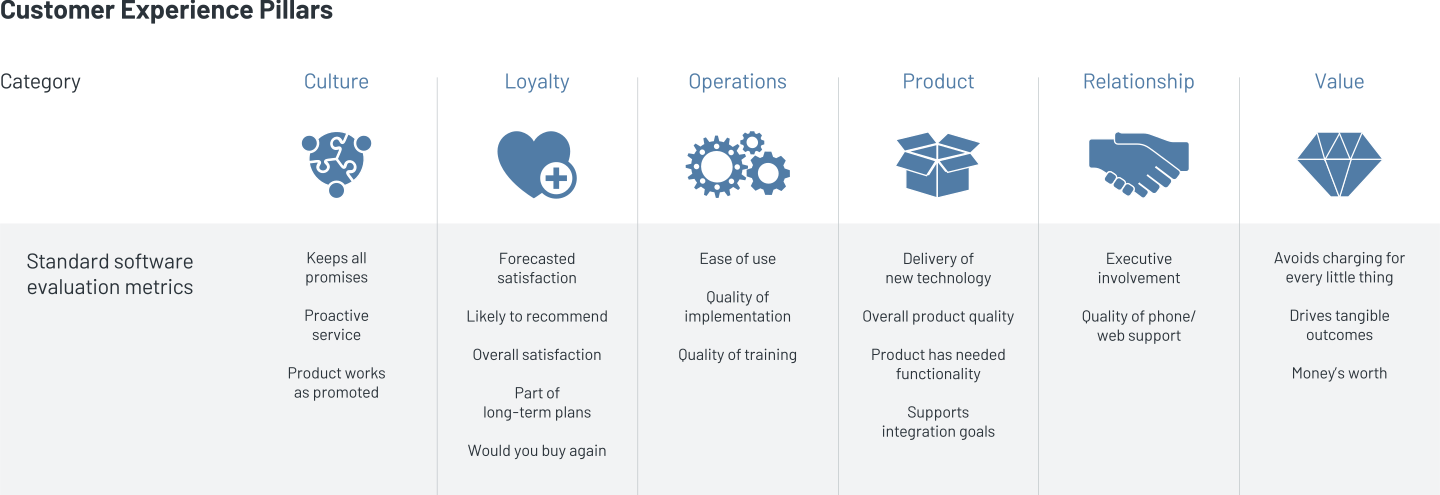
Each year, KLAS interviews thousands of healthcare professionals about the IT solutions and services their organizations use. For this report, interviews were conducted over the last 18 months using KLAS’ standard quantitative evaluation for healthcare software, which is composed of 16 numeric ratings questions and 4 yes/no questions, all weighted equally. Combined, the ratings for these questions make up the overall performance score, which is measured on a 100-point scale. The questions are organized into six customer experience pillars—culture, loyalty, operations, product, relationship, and value.
To supplement the customer satisfaction data gathered with the standard evaluation, KLAS also asked payer customers the following questions specific to claims and administration platforms:
- How well does your vendor help you improve operational efficiency (e.g., automate administrative functions, save time)?
- How confident are you in your vendor’s ability to support the needs of multiple different business lines?
- What capabilities are you using your vendor for?
Sample Sizes
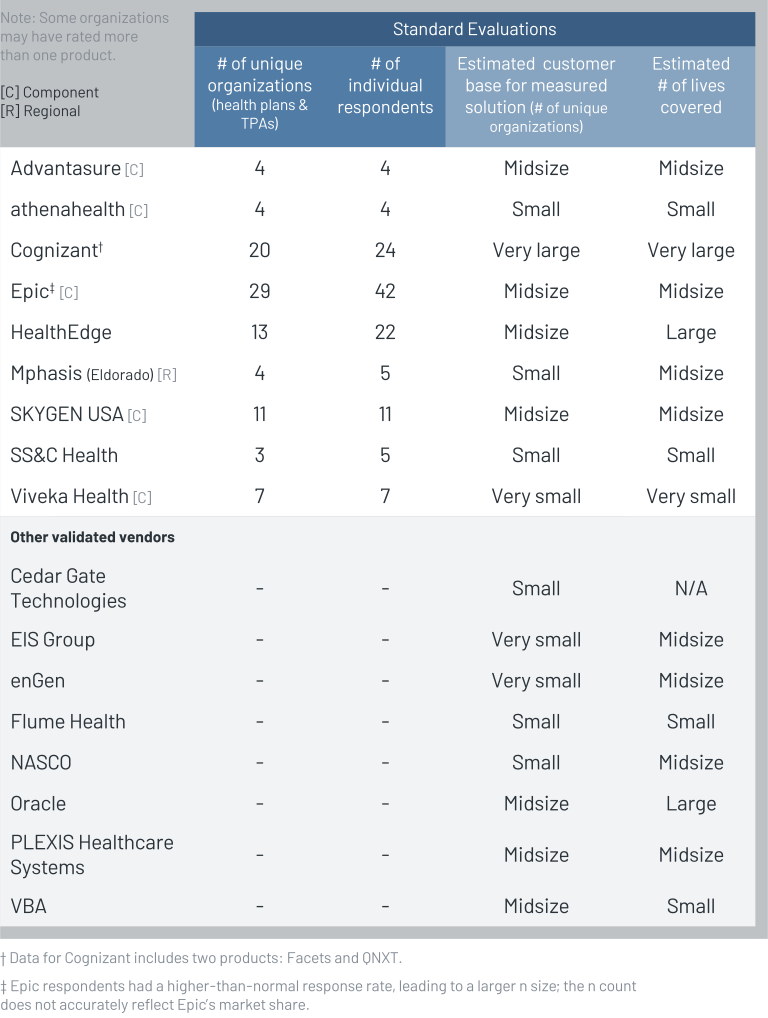
Unless otherwise noted, sample sizes displayed throughout this report (e.g., n=16) represent the total number of unique customer organizations interviewed for a given vendor or solution. However, it should be noted that to allow for the representation of differing perspectives within any one customer organization, samples may include surveys from different individuals at the same organization. The table below shows the total number of unique organizations interviewed for each vendor or solution as well as the total number of individual respondents.
Some respondents choose not to answer particular questions, meaning the sample size for any given vendor or solution can change from question to question. When the number of unique organization responses for a particular question is less than 6, the score for that question is marked with an asterisk (*) or otherwise designated as “limited data.” If the sample size is less than 3, no score is shown. Where textual content relies on limited data, the vendor name is marked with an asterisk. Note that when a vendor has a low number of reporting sites, the possibility exists for KLAS scores to change significantly as new surveys are collected.
Product Designations Used in This Report
- Component [C]: Products that serve only a subset of the payer market.
- Regional [R]: Product for which the majority of data comes from organizations located in the same, small geographical area.

Writer
Natalie Hopkins

Designer
Breanne Hunter

Project Manager
Andrew Wright
This material is copyrighted. Any organization gaining unauthorized access to this report will be liable to compensate KLAS for the full retail price. Please see the KLAS DATA USE POLICY for information regarding use of this report. © 2026 KLAS Research, LLC. All Rights Reserved. NOTE: Performance scores may change significantly when including newly interviewed provider organizations, especially when added to a smaller sample size like in emerging markets with a small number of live clients. The findings presented are not meant to be conclusive data for an entire client base.