KLAS Contact

Contact KLAS
Contact KLAS
 2026 BEST IN KLAS
Preferences
Related Series

2018

Digital Rounding 2024
How Well Do Solutions Increase Efficiency for Nurses?

Author
Trey Dye

Author
Jennifer Hickenlooper

Author
Dallin Seely
As consumerism has increased in the healthcare industry, organizations have used digital rounding solutions to measure and improve patients’ satisfaction during their stays. Although adoption of these solutions slowed during the COVID-19 pandemic, digital rounding is once again gaining momentum as healthcare organizations seek to gain visibility into patient needs and increase the efficiency of nursing workflows. This report examines how well digital rounding vendors provide strong partnership, technology, and training to support outcomes and efficiencies for healthcare customers.
 Has Digital Rounding Technology Evolved? | In KLAS’ 2018 digital rounding report, healthcare organizations noted generally low expectations for digital rounding solutions, as they often viewed these solutions as merely an electronic version of an otherwise paper-based process. In that report, KLAS proposed that the future state of digital rounding should support more complex use cases, custom reporting, and deeper integration. Since 2018, the technology in this space has made little progress—preventing organizations from using these solutions in more sophisticated, innovative ways.
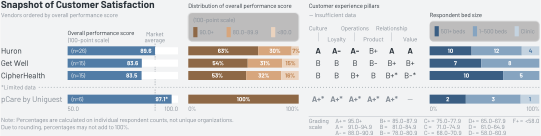
Huron CSMs Foster Customer Satisfaction via Strong Partnership & Training; pCare* Customers Highlight Responsive Vendor Communication
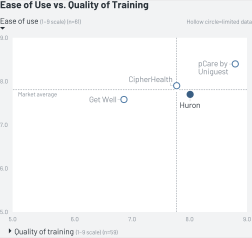
Huron—the 2024 Best in KLAS winner for digital rounding—is known for their consulting services and strong CSM partners that train users to optimize use of the solution. Highly satisfied customers see the reporting and functionality as strengths—driving outcomes like improved accountability from patient-facing staff, reduced nursing workloads, and better visibility for executives. Interviewed customers want Huron to continue to enhance the reporting with more details to support outcomes. A few less-satisfied respondents feel the technology is difficult to use and has gaps (e.g., lack of anonymous logins for patients), and a couple say CSM turnover has led to less-responsive support. Respondents also report differing levels of quality of EHR integration, depending on their organization.
Interviewed pCare by Uniguest* customers highlight the vendor’s honest, responsive communication and helpful account representatives who quickly solve issues. Respondents appreciate the user-friendly solution—citing that the mobile capabilities, QR code scanning, and robust reporting lead to time savings for nurses, better referrals, and improved HCAHPS scores. pCare is also noted for providing valuable training and responding to customers’ feedback for product enhancements. A few customers have experienced minor integration issues and brief instances of downtime, though they note these issues have been resolved.
*Limited data
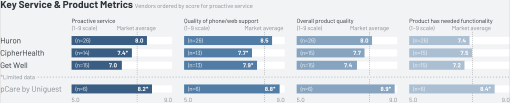
CipherHealth Offers Easy-to-Use Solution; Reporting & Analytics Lead to Variability in Achieving Outcomes
CipherHealth’s product is seen as easy to use, especially when customized well to meet organizational needs; interviewed customers say it streamlines the rounding and documentation process and supports better accountability and transparency for patient care activities. Respondents report mixed experiences with reporting and analytics—some praise the reporting quality, while others feel the reporting doesn’t meet their needs. Additionally, some customers have experienced data inconsistencies and feel the reporting and analytics have become less intuitive, preventing them from accessing needed data granularity and affecting their ability to achieve outcomes. Respondents also share varied reports on the solution’s ability to reduce the nursing workload, though those who saw either no improvement or an increased nursing burden did not always customize the solution to their needs.
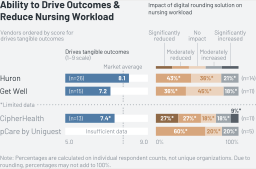
 Digital rounding tools drive many outcomes, including the ability to reduce the nursing workload. However, this outcome isn’t always easily or consistently achieved, as increased visibility into patient needs can actually increase the amount of time nurses spend rounding.
Get Well Customers Appreciate Support Staff; Gaps in Training & Reporting Leave Users Wanting More
Interviewed Get Well customers feel the vendor builds strong partnerships by providing access to leaders when needed and a support staff that communicates quickly and collaboratively solves issues (though respondents note the support is more reactive than proactive). Satisfied respondents have achieved outcomes such as reduced nursing workloads, improved housekeeping, and a better patient experience. Reported experiences with training are mixed—some customers are pleased with the train-the-trainer model; other less-satisfied respondents feel the training resources are insufficient and the videos unintuitive. Other mentioned frustrations include disparate databases within the organization, unhelpful charts, and a lack of customization. In general, customers want easier-to-use functionality (especially around survey creation) and better reporting, though some note Get Well has made improvements with the latter.
Other Validated Vendors | Nobl, Press Ganey, and Stryker also provide digital rounding solutions but currently have insufficient customer feedback to show performance scores in this report. However, Press Ganey’s digital rounding solution was rated in the 2024 Best in KLAS report; readers can view the vendor’s scores here.
About This Report
Each year, KLAS interviews thousands of healthcare professionals about the IT solutions and services their organizations use. For this report, interviews were conducted over the last 12 months using KLAS’ standard quantitative evaluation for healthcare software, which is composed of 16 numeric ratings questions and 4 yes/no questions, all weighted equally. Combined, the ratings for these questions make up the overall performance score, which is measured on a 100-point scale. The questions are organized into six customer experience pillars—culture, loyalty, operations, product, relationship, and value.
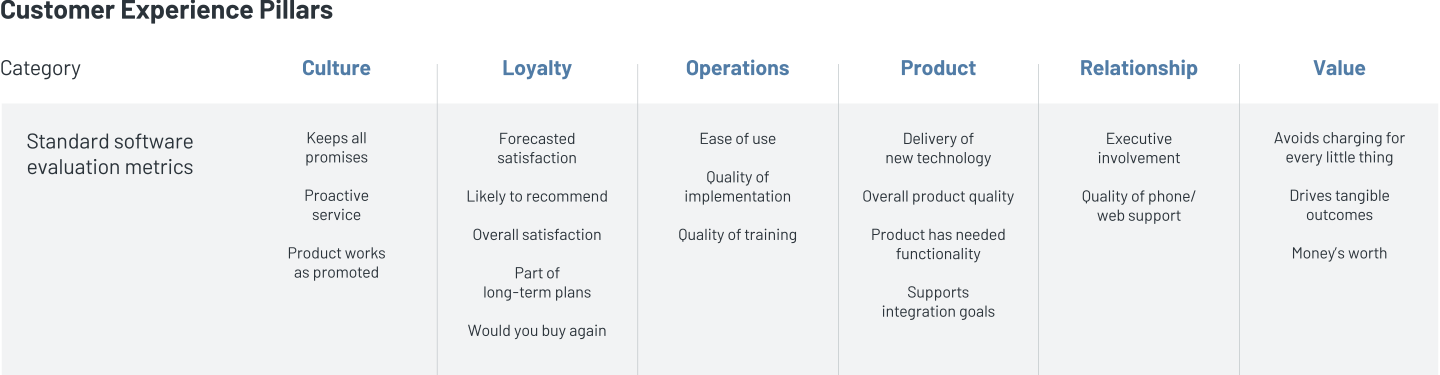
To supplement customer satisfaction data, KLAS included a supplemental question in the standard evaluation to gain insight into the impact of respondents’ digital rounding solution on their nursing staff’s workload. Data was collected between May 2023 and April 2024. (Note: This question was added after data collection began, and thus not all respondents of the standard evaluation answered this question.)
Sample Sizes
Unless otherwise noted, sample sizes displayed throughout this report (e.g., n=16) represent the total number of unique customer organizations interviewed for a given vendor or solution. However, it should be noted that to allow for the representation of differing perspectives within any one customer organization, samples may include surveys from different individuals at the same organization. The table below shows the total number of unique organizations interviewed for each vendor or solution as well as the total number of individual respondents.
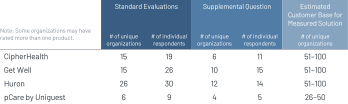 Some respondents choose not to answer particular questions, meaning the sample size for any given vendor or solution can change from question to question. When the number of unique organization responses for a particular question is less than 15, the score for that question is marked with an asterisk (*) or otherwise designated as “limited data.” If the sample size is less than 6, no score is shown. Where textual content relies on limited data, the vendor name is marked with an asterisk. Note that when a vendor has a low number of reporting sites, the possibility exists for KLAS scores to change significantly as new surveys are collected.

Writer
Natalie Hopkins

Designer
Natalie Jamison

Project Manager
Andrew Wright
This material is copyrighted. Any organization gaining unauthorized access to this report will be liable to compensate KLAS for the full retail price. Please see the KLAS DATA USE POLICY for information regarding use of this report. © 2026 KLAS Research, LLC. All Rights Reserved. NOTE: Performance scores may change significantly when including newly interviewed provider organizations, especially when added to a smaller sample size like in emerging markets with a small number of live clients. The findings presented are not meant to be conclusive data for an entire client base.