KLAS Contact

Contact KLAS
Contact KLAS
 2026 BEST IN KLAS
Preferences
Related Series

2026

2025

2023

2022

Points of Light 2024
Celebrating Payer & Provider Partnerships That Enhance Healthcare Outcomes

Author
Boyd Stewart

Author
Aurene Wilford
Strategic partnerships between payer and provider organizations and their HIT vendors are becoming a cornerstone of transformative improvements to healthcare processes and outcomes. KLAS’ annual K2 Collaborative Points of Light awards celebrate such partnerships’ successes—or “points of light”—in reducing cost and inefficiencies and improving the patient, provider, and payer experience.
22 partnerships were awarded a 2024 Points of Light award, and their strategies and outcomes are shared in this report to illustrate the art of the possible. To help payer and provider organizations and vendors more effectively collaborate to resolve major points of friction, this Executive Insights section provides a high-level summary of the challenges the award winners tackled, the outcomes they achieved, and key lessons learned on the journey; the full report provides an in-depth case study of each collaboration.
 A note about award methodology: Points of Light awards are given to payer organizations, provider organizations, HIT vendors, and other stakeholders who demonstrate close collaboration that leads to shared outcomes. KLAS validated each submission via a standard set of questions administered during in-depth interviews with representatives from all relevant stakeholders; these questions asked stakeholders to provide (1) an overview of the engagement, (2) engagement outcomes, (3) best practices and lessons learned, and (4) the overall impact the engagement has in the healthcare industry. Interviews were conducted from August 2023 to March 2024.
Points of Friction & the Technology Used to Address Them
The collaborations highlighted by the 2024 Points of Light awards represent real progress toward reducing administrative inefficiencies and improving patient outcomes. The types of challenges these collaborations sought to address fall into five areas, shown in the chart below.
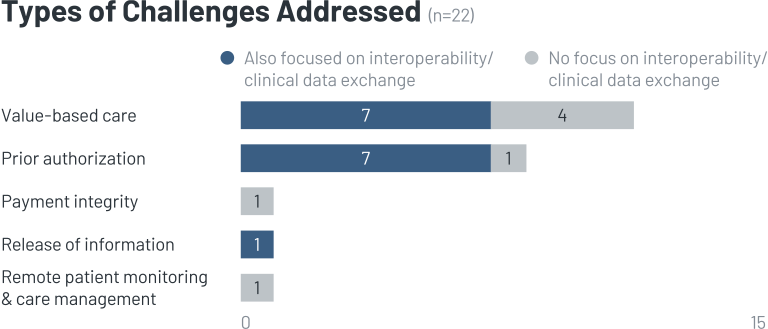 However, within these areas, many collaborations also focused on some aspect of interoperability or clinical data exchange. These collaborations were able to give both the payer and provider parties access to a more comprehensive view of patient health, thereby streamlining care coordination; reducing care gaps, medical errors, and duplicative care; and improving the accuracy of risk adjustment scores and quality measure submissions. All of these outcomes contributed to lower medical costs and more accurate CMS reimbursements for the payer and provider organizations.
Of the five types of challenges addressed, the two most common are value-based care and prior authorization.
Value-based care initiatives for cost containment and accurate CMS reimbursement: To improve patient/member outcomes and cost management, half of the collaborations focused on improving value-based care through increased access to real-time data. Using retrospective data to recapture a patient’s disease burden is an inefficient, challenging process that leaves provider staff with an incomplete view of the patient’s clinical care. Payer organizations also struggle to accurately report risk adjustment scores due to a lack of real-time clinical data. The stakeholders in these collaborations adopted a patient-centric care approach by working to improve patient/member engagement, medication adherence, and completion rates for annual wellness visits and preventive screenings. These efforts led to results such as reduced ED visits, closed care gaps, and more accurate risk adjustment scores (leading to higher CMS Star Ratings).
Automation of prior authorization: Obtaining prior authorization for medications, imaging, and procedures can be an administrative burden for both payer and provider organizations, though it is a more common pain point among provider organizations. The collaborations that aimed to streamline the prior authorization process leveraged strategies such as artificial intelligence, interoperability, and clinical decision support to standardize the submission process, reduce manual workflows, improve data sharing, increase visibility of member coverage, and accelerate access to care.
Variety of HIT Solutions Used to Address Points of Friction
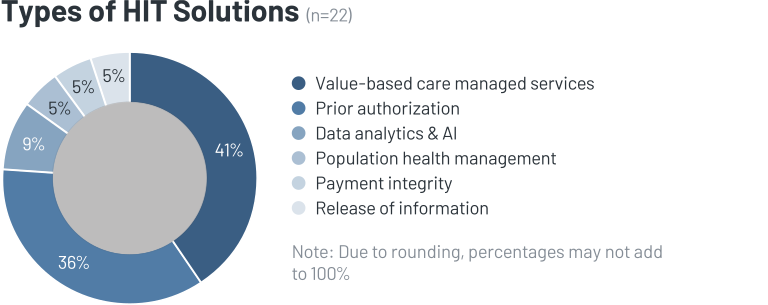
Collaborating payer and provider organizations used a diverse range of technologies to tackle the challenges they faced, reflecting the complexity of these issues and the multiple options available for achieving outcomes. KLAS’ hope is that examining these options will help other organizations identify technologies that might be helpful in their own strategies. Which option is best will largely depend on the collaborators’ resources, budget, relationship, and timeline. The table below outlines the specific challenges each group of collaborators was trying to solve, the action plan created, and the outcomes achieved.
Overview of Points of Light Collaborations—By Type of Challenge Tackled

Value-based care

Adverse patient health outcomes due to poor medication adherence; lack of insights for pharmacists to improve adherence rates and patient satisfaction
Delivered a value-based pharmacy partnership program to improve Medicare Advantage members’ medication adherence and satisfaction by integrating actionable insights into existing pharmacy workflows
Outcomes: Connected a network of 250 community pharmacies—this resulted in engagement with over 59,000 members, thus improving medication adherence and reducing benefit friction. 218,000+ actionable activities delivered to pharmacists within their regular workflows. Increased member access to correct benefits and financial assistance, reducing their financial burden. Incentive payouts for community pharmacies to provide a new source of revenue for sustainability.

Many moving parts during care transitions that can lead to issues with clinical data or care coordination, negatively impacting patient safety as well as payment for healthcare organizations
Created a solution to identify and close gaps occurring during care transitions; solution specifically automated the first two requirements for transitions of care
Outcomes: Reduced hospital readmissions and unnecessary ED utilization. Time savings and reduced administrative burden for provider organization due to elimination of chart chasing and more time for care-oriented tasks. 1,700+ admission notifications and discharge summaries sent to provider staff in a single month. Improved CMS Star Rating, leading to increased annual revenue.

Lack of timely patient data, preventing provider staff from facilitating appropriate care coordination after discharge
Increased visibility into Medicare Advantage patient data to close gaps in care, increase CMS Star Ratings, and improve patient/member outcomes
Outcomes: Improved visibility into patients’ whereabouts, increasing adherence with TRC measures by 8.2% and FMC measures by 3.2% over a 90-day period. Closed 84% of real-time patient alerts provided by Bamboo Health and successfully delivered 2x the number of relevant discharge summaries. Timelier follow-up, better care coordination, increased provider satisfaction, and improved performance with CMS measures.

Difficulties accessing accurate clinical data for deadline-driven HEDIS reporting, overwhelming provider organizations and challenging payers’ quality improvement initiatives
Automated chart retrieval to deliver timely, precise data that is configured to support HEDIS reporting and reduce provider administrative burden
Outcomes: 2%–7% improvement in care-gap closure rates over 9 months and improved ability to track and trend data for HEDIS measures. Reduced administrative burden for provider HIM team members. Alleviated bottlenecks with customer service and reduced need for contracted staff members, leading to cost savings. 164,000 charts delivered by provider organizations to payer without incurring costs or reallocating resources. 50% reduction in turnaround time for record releases.

Lack of visibility into patient/member compliance with Medicaid measures, hindering accurate HEDIS reporting
Created a continuous HEDIS review workflow to triage cases and close care gaps
Outcomes: Increased efficiency in identifying care gaps. Better population health management. Increased financial return from quality measures. Reduced manual record requests and redocumentation efforts for closed care gaps. Reduced number of charts that need manual review. Improved patient health outcomes.

Lack of payer and provider awareness of socioeconomic factors preventing patients from engaging in their health, contributing to poorer health outcomes
Established interoperability and created data transparency for home health providers to gain better visibility into patients’ socioeconomic factors
Outcomes: Comprehensive clinical profiles, enabling strong patient-provider relationships during in-home visits. 5,000 wellness appointments processed per day. Provider time savings and reduced documentation burden during in-home visits, allowing clinicians to focus on patient care. Reduced hospital readmissions.

Patients not receiving or following through with referrals for needed preventive screenings
Analyzed EHR data alongside data routinely shared by payer; mapped current state of provider referral processes to identify root causes; created an improved, efficient referral workflow that had buy-in from all team members
Outcomes: Improved understanding of barriers to closing care gaps, leading to better referral processes. Improved patient engagement and education that led to more patients following through with referrals for preventive screenings for breast cancer, colorectal cancer, and diabetic retinopathy. Improved Star Rating for provider organization (for these three preventive screening measures, based on payer data).

Provider organization’s lack of visibility into diagnoses Medicare Advantage patients receive outside of primary care network, negatively affecting patient care and CMS reimbursements
Transferred clinical information from Epic Payer Platform not already in the provider’s patient charts, providing additional data at the point of care to support quality patient care
Outcomes: 2,700+ diagnoses added to patient charts, enabling the provider organization to more accurately capture and manage patient care as well as improving risk adjustment scores. Reduction in time the payer spent manually chasing charts due to supplemental information already being in workflows. Best practices developed by Epic for implementing Epic Payer Platform, sharing patient background information, and standardizing historical patient data.

Lack of needed information or training for provider organization to accurately complete HCC coding and close care gaps
Established seamless transfer of curated data from the payer organization into clinician workflows; implemented technology to flag gaps in clinician documentation and provide clinical evidence that improves coding accuracy for chronic conditions
Outcomes: Improved HCC coding accuracy. Closed 71% of diagnosis gaps. Increased CMS reimbursement. Reduction in time provider organization spent coding, allowing them to focus more on serving patients.

Unexpected increase in membership for payer organization, creating need for payer to quickly and accurately assess new members’ risk adjustment scores
Collaborated with a telehealth organization and N1 Health to reach out to new members and schedule annual wellness visits for them, ensuring that they received the right care and that the payer was properly reimbursed
Outcomes: Provided new members with accessible, affordable care via virtual PCPs. Improved member engagement. Increased completion rate for virtual and in-person annual wellness visits as well as for any in-person visit. $4.6 million increase in risk-adjusted revenue.

Social determinants of health (SDOH) negatively impacting patients’ health, leading them to overuse the emergency department; challenges with engaging members and matching them with needed benefits to improve care and member retention
Used AI/ML and consumer data to proactively engage members with specific benefits and alleviate predicted SDOH barriers keeping those members from engaging in preventive care/reenrolling in Medicaid; provided grant-funded assistance to members with high risk of housing insecurity to reduce ED utilization/improve stability
Outcomes: Reduced ED visits for members enrolled in housing-assistance program and increased completion rates for annual wellness and well-child visits. Proactively engaged Medicaid members, leading to an increase in reenrollment of 6 percentage points.
Prior authorization

Inefficient, manual prior authorization process due to lack of integration between provider and payer organizations’ data, delaying patient access to advanced imaging services
Connected the provider and payer workflows to share prior authorization data in real time and minimize the need for manual touches
Outcomes: Automated 50%–60% of prior authorizations for advanced imaging cases, eliminating the need for provider organization to touch all cases. Reduced turnaround times for prior authorizations, enabling patients to access care more quickly. Improved provider efficiency due to prior authorization workflow being in the EHR.

Labor-intensive, time-consuming process for authorizing managed care referrals, burdening patients and provider and payer organizations
Combined API technology with robotic process automation to automate referral process and provide transparency into the status of referrals
Outcomes: Increased provider productivity due to less manual, administrative-heavy workloads. Reduced payer administrative work (e.g., fewer phone calls related to referrals). Increased number of patients/members being steered toward provider organizations who can deliver high-quality care.

Back-and-forth data requests for prior authorization, causing friction between payer and provider organizations
Created a solution for utilization, case, and disease management that facilitated better data transparency
Outcomes: Removed manual, time-consuming administrative tasks, improving turnaround time for prior authorizations. 360-degree, real-time view of patients at the point of care, enabling clinicians to provide more comprehensive care. Decreased prior authorization turnaround time.

Lengthy prior authorization process, delaying needed care for patients who had received knee surgery
Bundled prior authorizations together into a single transaction to reduce payer/provider administrative burden and improve approval time
Outcomes: Improved efficiency and administrative burden due to 35% reduction in separate prior authorization requests for surgery and preop/postop physical therapy. Improved patient adherence to physical therapy treatment. Administrative time savings. Reduction in needed postop physical therapy visits.

Delayed patient care and large payer/provider administrative burden due to complex nature of prior authorizations
Created an electronic prior authorization process via Epic Payer Platform to automate prior authorization requests, improve patient access to care, and reduce administrative burden
Outcomes: 140%–233% increase in prior authorization productivity and decreased administrative burden, allowing provider staff to focus on other responsibilities. Improved patient care experience due to reduced authorization-related rescheduling and faster turnaround times. Streamlined prior authorizations process, with many requiring no manual interventions. Time savings due to automation.

Prior authorization process that was labor and time intensive; incomplete prior authorization submissions
Automated data sharing for prior authorization to increase decision rate and patient access to care
Outcomes: 50% reduction in prior authorization turnaround time. Decision rate for certain cases increased from 33% to 94%. 40% reduction in requests for additional clinical information. Payer and provider time savings due to automatic adjudication and standardized submissions of administrative data, enabling provider staff to focus on higher-value responsibilities and deliver timelier, more efficient patient care.

Manual prior authorization workflow that created administrative burden for payer and provider as well as delayed patient access to care
Automated prior authorization by connecting payer and provider solutions, seamlessly exchanging data and thus enabling faster turnaround for approvals
Outcomes: Improved provider efficiency due to automated prior authorization process. 54% of monthly determinations required no authorization. 70% rate for instant authorization approval, and below-average denials rate. Improved care quality, as patients can receive care more quickly and achieve improved health outcomes.

Lack of effective, efficient data sharing throughout the prior authorization process due to complex data, creating administrative burden and high costs for payer/provider organizations
Leveraged eHealth Exchange’s single legal trust agreement and single set of APIs to facilitate exchange among multiple provider and payer organizations with faster, easier data sharing through FHIR technology, thus enabling stakeholders to approve prior authorizations more quickly
Outcomes: Faster prior authorization approvals, resulting in a shorter time to care and reduced costs.
Payment integrity

High volume of overpaid claims, causing administrative and time burden for both payer and provider organizations
Partnered with TREND Health Partners to review potential overpayments and facilitate communication between the organizations
Outcomes: Improved efficiency. Reduced administrative abrasion during claims resolution process for both payer and provider organizations. 76% reduction in provider organization’s credit balance inventory. 2,000 finalized payer overpayments (worth $7.7 million in cost savings) since project inception.
Release of information

Manual release of information process created large administrative burden for provider and payer organizations
Bundled and automated requests for clinical data to achieve faster turnaround times, reduce administrative work, and increase provider satisfaction
Outcomes: Average of 60% improvement in turnaround time for release of information, leading to 27% reduction in turnaround time for claims adjudications and 36% reduction in denials. Improved provider engagement and satisfaction with payer. Reduced administrative burden for provider and payer organizations.
Remote patient monitoring & care management

Lack of resources and data to identify and provide care to patients with rising risk for certain health conditions
Implemented Lightbeam Health Solutions’ deviceless remote patient monitoring (RPM) solution to better monitor rising-risk patients
Outcomes: Increased patient engagement, with 3,200+ patients enrolled in the RPM program. Many patients previously classified as high/rising risk were recategorized as low risk, leading to better patient health. Improved health outcomes and reduced costs per month per member for those with COPD and/or congestive heart failure. Lower average blood pressure for patients with high risk of hypertension. Identification of patient needs regarding social determinants of health. Reduced administrative burden for provider organization.
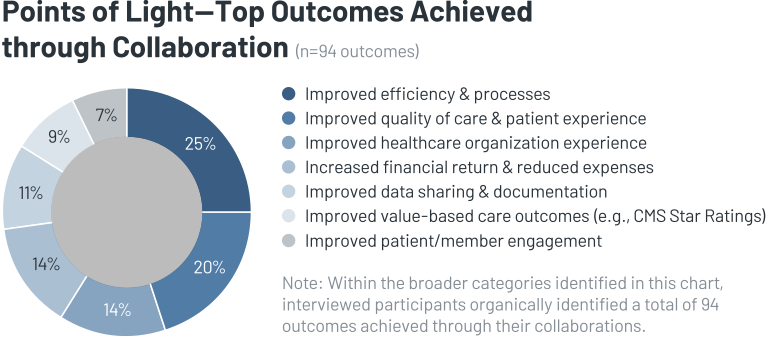
Points of Light: Most Common Outcomes Include Improved Efficiency/Processes, Improved Care/Patient Experience, and Improved Provider Experience
The collaborations highlighted in this report have achieved a variety of outcomes. The most common include:
- Improved efficiency and processes: Advanced technologies and optimized workflows have enhanced payer and provider organizations’ efficiency, contributing to more streamlined payer-provider interactions and reducing organizations’ administrative burdens. Automated prior authorization has resulted in faster approval and reduced healthcare costs; additionally, faster turnaround times for release of information, claims adjudication, and overpayment processing have optimized delivery of care. Improvements to value-based care have also yielded better CMS reimbursements for both payer and provider organizations.
- Improved quality of care and patient experience: Many collaborations were able to achieve improved care quality and patient experiences by improving the turnaround time for prior authorization, providing prompt access to care, following up on care gaps, and making affordable virtual primary care physicians an option for patients. Many participating provider organizations created comprehensive clinical profiles that enable clinicians to better foster trust and relationships with patients during point-of-care and in-home visits, enhancing patient satisfaction.
- Improved provider organization experience: Administrative staff and clinicians have experienced enhanced productivity and decreased administrative tasks due to the implementation of automated workflows. Further, provider organizations have seen reduced coding times and more accurate CMS reimbursements thanks to improved detection of care gaps. Increased data visibility has led to smoother interactions between payer and provider workflows, reducing operational friction.
Value-Based Care Outcomes & Patient/Member Engagement Increasingly Top of Mind
Value-based care outcomes are an increasing focus for payer-provider partnerships, as seen in the collaborators’ efforts to close care gaps and refine risk adjustment scoring. Increasing patient/member engagement is also becoming more top of mind, which is leading to better medication adherence, more frequent wellness visits, and greater patient involvement in care journeys. Both payer and provider organizations aim to further advance value-based care outcomes, enhance patient health, and control medical costs by increasing patient engagement.
Key Lessons Learned
Any efforts to improve collaboration and alignment between payer and provider organizations require active participation from all stakeholders. Organizations looking to implement their own collaborations can benefit from those who have already walked the path. The collaborations examined in this report yielded many best practices, but the four key lessons outlined below emerged as the most common. Additional best practices can be found in the full case studies.
 Build Partnerships of Trust & Collaboration
- Create a collaborative culture in which all stakeholders transparently communicate and practice the art of extreme listening to understand existing workflows
- Have a strong governance structure that oversees progress, drives collaboration, supports alignment, and streamlines processes for achieving KPIs
- Establish rules of engagement and a proof of concept to keep all stakeholders on track with shared goals and objectives
- Share clinical workflows up front and understand the cadence of releases and deployments for each stakeholder in order to prevent incorrect assumptions, reduce friction, and improve the implementation process
 Have a Problem-Solving Mindset That Drives Proactive, Agile Behavior
- Be collaborative and innovative in solving problems; pivot in a timely manner when faced with unexpected challenges
- Fail fast and don’t be afraid of challenges; stakeholders have to be nimble and comfortable with the messy in-between stage
- Have a growth mentality and don’t point fingers when issues occur
- Continually learn and try new things to find the most efficient processes
- Commit to learning applicable workflows to avoid misunderstandings and ensure user efficiency
 Conduct a Pilot & Focus on Change Management
- Take time to do end-to-end sandbox testing or conduct a pilot; testing enables stakeholders to identify issues in the workflow and resolve them as a team
- Invest time and capital into change management to help frontline provider and payer staff understand new processes and improve their efficiency; helping all involved teams manage the change encourages buy-in and reduces resistance
- Empower internal leaders and teams that are dedicated to the project
- Know who to communicate with and what information to share to ensure the right teams are targeted
- Be prepared to collaborate and invest time and resources into developing an educational strategy to ensure teams are properly educated
- Establish committees and appoint provider champions to set up standard operating procedures and protocols
 Measure Program Impact & Monitor Data Accuracy
- Use reliable data to measure the value of interventions; analyzing the data, checking its accuracy, and providing full data transparency will instill trust in all partners
- Provide real-time data and develop customized dashboards to track progress, measure ROI, and ensure all stakeholders adhere to contracts
- Proactively monitor performance; doing so is more cost effective than reacting to issues when they arise

Writer
Natalie Hopkins

Designer
Jess Wallace-Simpson

Project Manager
Joel Sanchez
This material is copyrighted. Any organization gaining unauthorized access to this report will be liable to compensate KLAS for the full retail price. Please see the KLAS DATA USE POLICY for information regarding use of this report. © 2026 KLAS Research, LLC. All Rights Reserved. NOTE: Performance scores may change significantly when including newly interviewed provider organizations, especially when added to a smaller sample size like in emerging markets with a small number of live clients. The findings presented are not meant to be conclusive data for an entire client base.