KLAS Contact

Contact KLAS
Contact KLAS
 2026 BEST IN KLAS
Preferences
Related Series
2026

2024

2023

2022

2020

K2 Collaborative Summit 2025
Connecting Payer & Healthcare Organizations to Improve Data Sharing, Drive Efficiency & Align Workflows

Author
Boyd Stewart

Author
Aurene Wilford
With the aim of facilitating collaboration between payer organizations, healthcare organizations, and technology vendors, KLAS hosted the fifth annual K2 Collaborative Payer/Provider Summit in May 2025. At the summit, 188 industry leaders (representing 124 payer, healthcare, and vendor organizations) came together to drive meaningful change in healthcare through aligned strategy, innovation, and shared accountability. Through such collaboration, trusting partnerships and alignment can be built to yield meaningful outcomes related to interoperability and regulations for all parties.
“Transparency will always precede trust.” —Ryan Howells, summit speaker/attendee
The summit had three key objectives: (1) Discuss payer/provider alignment on regulations and interoperability, (2) evaluate the ROI of ambient speech and agentic AI, and (3) recognize successful payer/provider collaborations. The following sections detail insights taken from keynote addresses, panels, and breakout and tabletop discussions. (Click the links to jump to each section’s insights.)
- Discuss regulatory alignment of payer & healthcare organizations on two main initiatives:
- The current state of US healthcare, including CMS 0057-F and changes with the new administration: Attendees evaluated the impact of existing CMS mandates, regulatory changes that may arise under new federal leadership, and changes to data sharing and upcoming CMS mandates.
- Data sharing for regulatory & operational success: Attendees discussed strategies for improving interoperability, emphasizing informed decision-making, shared accountability, and leveraging opportunities for workflow optimization. Parties were encouraged to move beyond conceptual alignment and toward practical, joint problem-solving based on a clear understanding of regulatory options and constraints.
- Evaluate the ROI of ambient speech & agentic AI: Attendees and panelists discussed the potential impact of AI as well as lingering concerns, emphasizing the importance of informed decision-making, shared accountability, and leveraging opportunities around AI and workflow optimization.
- Highlight successful payer/provider collaborations: Presentations from Points of Lights award recipients highlighted keys to success and outcomes from successful payer/provider engagements.

Pre-Summit Survey: Enthusiasm for Value-Based Care Unites Stakeholders, but Growing Distrust Between Parties Can Undermine Progress
Before the conference, survey attendees completed a pre-summit survey regarding healthcare’s shift to value-based care (VBC).
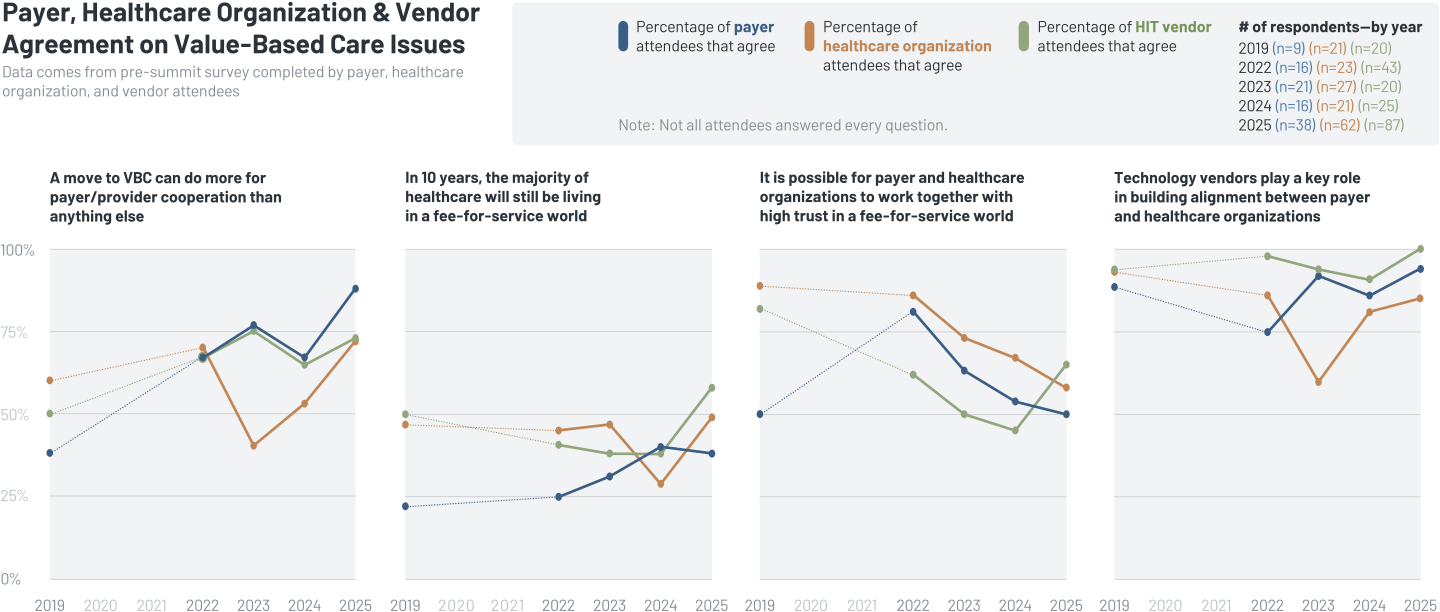
Key insights from the data:
- All parties feel growing optimism that VBC offers a strong opportunity to enhance payer/provider collaboration; momentum to VBC is becoming increasingly visible: As strain on health systems grows, both payers and healthcare organizations recognize that continued fragmentation is unsustainable. To reduce waste and operate more efficiently, collaboration is essential. Points of Light collaborations (see below) highlight real-world successes proving that sustained effort enables alignment.
- While VBC is often seen as the preferred environment for payer/provider collaboration, distrust between parties continues to grow: Concerns around data usage and the complexity of CMS-driven interoperability have led to distrust and misalignment among parties, even while organizations increasingly recognize the potential benefit of value-based care. Opaque data use, CMS interoperability mandates, and siloed workflows continue to widen communication gaps—threatening VBC’s shared accountability model and demanding a shift toward transparency and shared governance.
- A continuing trend, most 2025 attendees expect VBC to become the dominant financial model for healthcare within 10 years: For this to happen, parties need to align incentives, standardize data, comply with CMS rules, and prove ROI—all of which require sustained cultural and operational change.
- Payer and healthcare organizations increasingly recognize vendors’ pivotal role as strategic intermediaries in advancing payer/provider alignment: Technology partners now serve as strategic intermediaries, bridging trust gaps, streamlining workflows, and translating data into actionable insights—turning transactional relationships into true collaboration.
“Be willing to give to get and be a true partner.” —Summit attendee, payer organization
SUMMIT: KEY INSIGHTS ON PAYER/PROVIDER PARTNERSHIPS
The Current State of US Healthcare: Aligning Around CMS Mandates & the Evolving Landscape Under the New Administration
Fueled by CMS regulations, patient/member expectations, value-based care, and market consolidation, the healthcare industry is shifting from using transactional, claims-based processes to undergoing real-time, clinically driven data exchange. Additionally, payer and healthcare organizations both feel uncertain about how healthcare will be impacted by the new administration and potential policy changes. To meet mandates and remain competitive in the market, organizations must invest in digital infrastructure that supports real-time data sharing, standard workflows, and actionable insights. A fully digital and interoperable environment enables smarter decisions, population-level cost control, and operational efficiency.
Value-Based Care Is Shifting from Alignment Efforts to Genuine Revenue Strategies
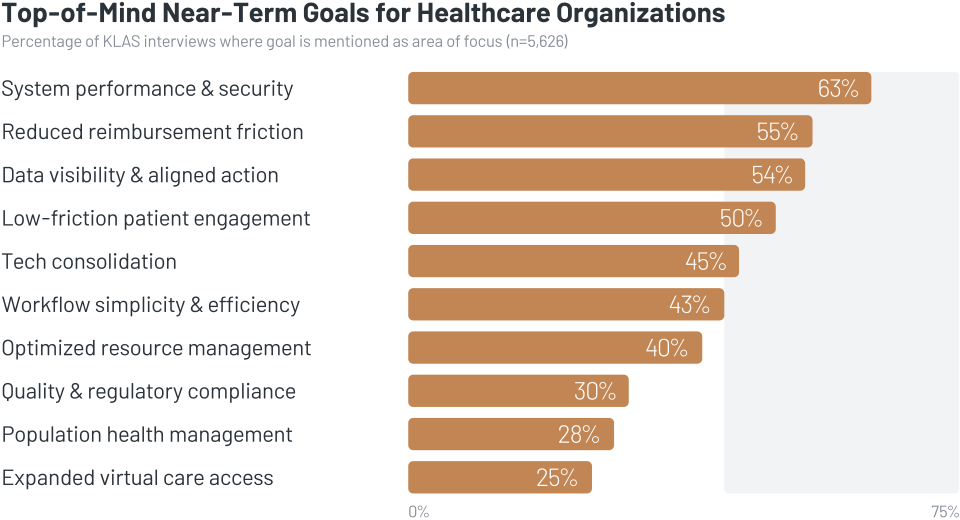
As healthcare organizations shift their value-based care initiatives to focus more on revenue-driven partnerships, they are rethinking their payer partnerships and wanting further reimbursement alignment. To do so, parties are prioritizing infrastructure and data-driven collaboration to support their strategic goals. Even smaller healthcare organizations, who often lack sufficient support and resources, are responding to this drive with the urgency and behavior of larger health systems. At the same time, policy changes are forcing concrete decisions for parties, and while pilot programs of initiatives are widespread, few organizations have found effective ways to scale them.
Key insights:
- There is variability in how data is exchanged between healthcare organizations depending on the platforms used—this significantly impacts interoperability execution. Platform-specific features operate differently, requiring individual evaluation and customization rather than a one-size-fits-all strategy.
- Data varies widely across platforms, making standardization challenging and necessitating tailored approaches to data integration and analysis.
- Recognizing and addressing these differences is critical to a successfully scaled digital initiative across diverse healthcare environments.
Ultimately, payer and healthcare organizations must enhance the efficiency of data sharing to more effectively manage patient and member populations, reduce the administrative burden on both sides, and lower the overall cost of care.
Payer & Healthcare Organizations Looking to Further Invest in IT
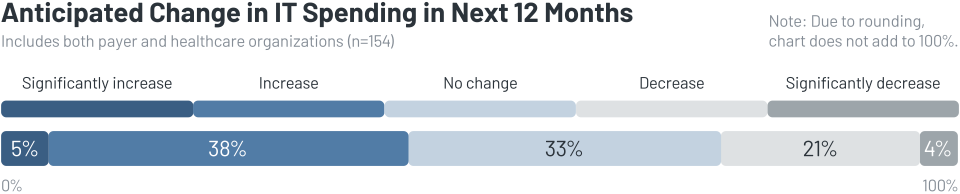
Organizations are navigating pressure by taking bold action despite limited margins for error. Instead of halting budgets due to reimbursement concerns, many are redefining them entirely—just under half of payer and healthcare organizations plan to increase their IT spending over the next year.
CMS 0057-F: A New Regulation That Parties Must Align Around to Drive Smarter, Safer & More Connected Care
As interoperability regulations evolve, all parties need to know about the changes and collaborate with other stakeholders to ensure effective data sharing. Effective January 1, 2027, CMS 0057-F mandates that all CMS payer and healthcare organizations publicly share API endpoints—emphasizing the need for shared infrastructure, standardized APIs, and semantic interoperability to enable data sharing and help overcome data challenges across parties. The open-source Patient Information Quality Improvement Framework was introduced to assess and improve clinical data quality at scale. The regulation prioritizes digital identity, as it calls for biometric-based authentication to replace outdated methods and enhance safety and trust. Additionally, the rule calls for federal policy alignment with real-world use cases (e.g., replacing redundant quality measures with FHIR- and SQL-based digital quality measures), enabling patient-centric, disease-specific data and decision support at the point of care. Broader impacts of the regulation include real-time prior authorization approval for up to 87% of requests, improved patient engagement via digital insurance cards, and app-based data access. Industry-wide adoption of open standards (such as CMS 0057-F) and voluntary governance are critical to scaling trusted data exchange and driving long-term innovation.
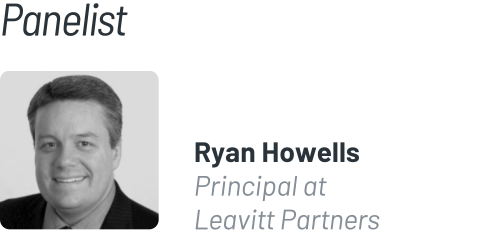
To drive discussion and insights around regulatory alignment of payer and healthcare organizations, KLAS partnered with Ryan Howells, principal at Leavitt Partners. Ryan is an industry thought leader and author of “Kill the Clipboard: A Federal Policy and Industry Roadmap to Accelerate Innovation and Cut Administrative Waste.”
“Interoperability is standards, protocols, technologies, and mechanisms that allow data to flow between systems.” —Jocelyn Keegan, summit speaker/attendee
Q&A on Top-of-Mind Questions Regarding CMS 0057-F
The following questions and answers are compiled from moderator-driven discussions, where five subject matter experts moved between breakout sessions to answer attendee’s pressing questions regarding CMS 0057-F, how it relates to the Trusted Exchange Framework and Common Agreement (TEFCA), the future of healthcare data exchange policy, and collaborating strategically to enable efficient data sharing while meeting CMS mandates.
| Questions & concerns identified in breakout sessions | Moderator response |
|---|---|
| How does TEFCA apply to the CMS 0057-F rule? | TEFCA is largely silent on 0057-F. The regulation permits payer-to-payer and payer-to-provider exchanges (including prior authorization), but it does not mandate them, nor define how they should be executed. |
| What would motivate healthcare organizations to participate in CMS 0057-F if there is no mandate? | TEFCA’s framework offers a more trusted exchange model by narrowing treatment definitions, which some healthcare organizations appreciate. However, adoption remains low and will likely depend on future mandates or incentives from CMS. |
| Getting usable clinical data into payer workflows is still too hard. | CCDAs are hard to work with, and there is a need for simplified and API-based access using HL7 FHIR. Workflow integration remains a major barrier. |
| Is there a practical alternative to TEFCA for meeting 0057-F? | Yes. National networks, such as eHealth Exchange, offer a hub-and-spoke model that supports FHIR-based exchange even without TEFCA compliance. For now, many payers are starting within these national networks instead of committing to TEFCA. |
| Can the health system scale to support broad payer/provider exchange? | Yes, but currently, limited uptake and silos exist. Scalability will depend on standards-based APIs, a single point of integration per participant, and broad stakeholder alignment. |
| Can eHealth Exchange support payer-specific prior authorization apps? | Yes. eHealth Exchange has developed a SMART on FHIR proxy app, which offers a payer-agnostic solution. With it, providers use a single app embedded in their EHR to route prior authorization requests to the correct payer app, simplifying workflows. |
| How do organizations manage privacy risks with patient-directed app access? Who bears responsibility for breaches or misuse with these apps? | Many organizations implement layered security measures as company policies, such as:
|
| Will traditional EDI clearinghouses start working in the FHIR ecosystem? | Vendors are increasingly discussing FHIR-first strategies, though there have been no major moves yet, often due to skepticism about abandoning the X12 workflows in favor of FHIR. |
| How can we get buy-in from executives, internal staff, and business leaders? | That requires honest conversations with the actuaries on the anticipated financial ROI and long-term benefits. Pilot phases need to show small wins with hard metrics to best encourage buy-in. |
| Who is responsible for adoption and compliance with CMS regulations? How do vendors, payers, and healthcare organizations effectively partner together to share burden? | Be realistic about what is achievable in the next three to five years. The TEFCA framework will stay the same, but mandates will change. Determine what “good enough” looks like for your organization and then, one step further, what it would look like to scale and sustain the initiative. |
| Which APIs in 0057-F give the most value for payers? | Payer-to-payer APIs enable faster care and better disease management. Consent management is the front door, and digital ID will enable change in member and provider interactions. |
| What is the biggest business problem for payers? | Provider adoption. Some providers feel the workflows are too hard. Organizations should start by eliminating fax and snail mail and make small, incremental daily efforts. |
Data Exchange: Trust—Not Technology—Is the Core Issue Impending Progress
Improved, effective data sharing benefits both payer and healthcare organizations: it improves efficiency and the ability to be patient- or member-centric. For healthcare organizations specifically, improved data sharing boosts speed and clarity in processes (e.g., prior authorization, risk adjustment), enhancing care quality and coding accuracy. For payers, it reduces delays and manual chart chasing, improves transparency, and accelerates provider reimbursements. Despite shared recognition of interoperability’s potential, both payer and healthcare organizations remain concerned about scaling further and feel little progress toward improved data exchange has been made.
During a panel on data exchange and the following discussions among attendees, all parties came to an honest reckoning with the main inhibitor to progress in data exchange: trust. While technological capabilities can inherently be a barrier to effective data exchange, it is often undermined by poor implementations, organizational silos, legacy incentives, and deep-rooted distrust between payer and healthcare organizations. These concerns highlight the need for practical, incremental steps, strong governance, and clearer incentives to drive meaningful progress.
Voiced Concerns & Barriers to Improved Data Exchange for Healthcare & Payer Organizations
Healthcare organizations:
- Diverging payer decisions (particularly around denials) due to misaligned incentives and a lack of transparency
- Hesitancy for open collaboration due to risk of data misuse, compliance issues, and legal entanglements
- (For smaller organizations) resource scarcity and competing survival priorities
- Inconsistent quality metrics
- Payer policy discrepancies
- Feeling left in the dark after submitting data upstream to ACOs or vendors
- Lack of will from parties to change, take shared accountability, and align on shared workflows
- Lack of standardization
- Uncertain ROI
- Limited scalability
- Unclear mandates
- Complex workflows
Payer organizations:
- Regulatory liabilities
- Risk of data stewardship
- Fragmented health systems and departments
- Culture of mistrust
- Challenge of aggregating insights across disparate systems
- Lack of standardization, including common patient identifiers
- Need to eliminate third-party data brokers
- Lack of transparency
- Lack of shared accountability
- Uncertain ROI
- Limited scalability
- Unclear mandates
- Complex workflows
Parties Need to Align on Interoperability Through Shared Strategy & Trust to Transform Data Exchange
Successful interoperability starts not with new software but with genuine engagement, relationship-building, and joint initiatives grounded in trust. Real value will only be realized when shared data is transformed into actionable insights and when both parties commit to closing the loop, aligning incentives to prioritize patient outcomes over transactional wins, legislating protections, and jointly defining success metrics. With the unique ability to act as intermediary between payer and provider organizations, vendors at the summit underscored the urgency of moving beyond acknowledging the problem into making measurable progress, saying that true interoperability requires sharing of not only data but also decision-making processes and financial incentives. Ultimately, true progress demands cultural rewiring, not just API deployment.
Strategies for Building Strong Data-Sharing Programs
Payer and provider organizations have more in common than not. To build a foundation of trust and performance that the rest of the industry can stand on, both parties need mutual accountability, strategic humility, and measurable progress.
To ensure effective progress in data exchange, attendees called for cross-functional governance, inclusive forums, and transparent, mutual goals. Specifically, starting with top-down mandates from leadership, payer and provider organizations need to identify the right champions and launch joint initiatives that prioritize trust-building over technical speed. Provider organizations need flexibility in their reimbursement structures (e.g., expanded claims itemization for complex cases), and payer organizations must support rural and underserved practices. Additionally, to scale effectively, pilots should become standard practice, driven by shared purpose to improve patient/member care and real-time data access.
Strategies for Building Strong Data Exchange Initiatives
Scalable data sharing:
- VBC contracts should reward proactive data-sharing behaviors and not just outcomes.
- For smaller or rural provider organizations who lack technical resources, payers should tailor solutions that are lightweight and scalable.
- Create and adopt standardized patient identifiers and clinical definitions to reduce confusion and variability.
- Use neutral intermediaries, or “translation layers,” (e.g., data aggregators or regional exchanges) to normalize data exchange across disparate systems without overburdening providers or payers.
- Share stories of successful collaborations—whether through internal communications or industry case studies—to build confidence, reinforce progress, and inspire broader adoption.
Effective data sharing:
- Establish joint payer/provider governance models that bring together cross-functional leaders to foster alignment and rapid issue resolution.
- Rather than attempting large-scale overhauls, payers and providers should focus on two or three targeted use cases—incremental wins build momentum and trust faster than sweeping initiatives.
- Co-develop clear, enforceable data-use agreements to address provider fears of data misuse and payer concerns around liability.
- Shift interoperability efforts to focus on previsit workflows (e.g., prior authorization, care-gap alerts) to avoid disruption during clinical encounters and make data more actionable.
- Educate frontline clinical, IT, and administrative staff on goals and available tools.
Considerations for Data Sharing amid Uncertainty
With increasing uncertainty in the healthcare market as a whole due to the new administration and upcoming mandates, payers, provider organizations, and technology partners should consider the following to continue moving forward with successful data-sharing initiatives:
Healthcare organization
You don’t have to do everything, but you do need to do something:
- Resilience comes from clarity, not just caution.
- You don’t have to cut everything; just cut intentionally.
- Even small shifts in payer strategy can create big relief.
- Collaborative partnerships are emerging as a lifeline.
- Doing nothing is still a decision—and often a risky one.
Payer organization
Your transparency and flexibility can strengthen, rather than strain, your network:
- Healthcare organizations are under pressure and looking for shared solutions.
- Reimbursement stability is a strategic conversation.
- Value-based care readiness varies, but interest is rising.
- Watch for quiet exits from low-margin care.
- Stronger relationships will require listening, not just compliance.
HIT vendor
You aren’t just delivering a product; you are a partner in how this ecosystem adapts:
- Tech spending is narrowing, not disappearing.
- Sales cycles will be gated by strategic clarity.
- Cost mitigation is a door opener for further conversation.
- “Growth support” is a better message than only “efficiency.”
- Tailor messaging to who is making the calls now.
Ambient Speech & Agentic AI: Evaluating ROI & Aligning Payers & Providers to Advance AI-Driven Care
Amid staffing cuts, organizations (especially large acute care healthcare organizations and large payers) are starting to utilize AI to ease their administrative burden and improve efficiency. Several tangible benefits are reported, including reduced clinician documentation time, streamlined administrative workflows (e.g., prior authorizations, appeals), improved accuracy in mid-revenue cycle, enhanced decision support, better provider-patient interactions, and more effective customer service.
Despite advancements in AI, multiple barriers hinder broad and collaborative AI adoption, and most AI initiatives currently remain in pilot phases. Chief barriers are regulatory and legal challenges, resource and funding constraints, lack of readiness to scale, concerns over model accuracy and safety, and lack of transparency in AI systems.
Both payer and healthcare organizations show a strong preference for evaluating both current and new vendors as they consider integration strategies. However, their priorities differ: healthcare organizations emphasize clinical documentation and workflow automation, while payers focus on member engagement, claims processing, and customer support.
The findings highlight the need for a more integrated approach to AI implementation, with a focus on cross-organizational collaboration between payer and healthcare organizations to ensure that AI, whether ambient speech or agentic AI, delivers meaningful improvements in care delivery and operational efficiency.
Tabletop Discussion
Following the panel, attendees convened to participate in tabletop discussions to continue exploring the impact of AI and ambient speech on payer and healthcare organizations.
What are the measurable ROIs of AI adoption beyond clinical documentation workflow improvements?
Summit attendees feel that the ROIs for AI tools are multifaceted, combining tangible financial gains with intangible benefits for both payer and healthcare organizations, including:
- Increased efficiency through automation of administrative tasks (e.g., prior authorizations, appeals)
- Enhanced coding accuracy from more complete documentation
- Reduced clinician burnout due to less manual note-taking, less after-hours documentation, and improved provider morale and work-life balance
- Improved documentation quality
- Improved time management, allowing some clinicians to see additional patients per day
- For payers, more structured, searchable notes that support risk adjustment and reduce claims denials
- Reduced friction
- Stronger documentation
Despite the numerous benefits, attendees note concerns around broadly adopting AI, including cost, scalability, the need for standardized implementation, and potential overdependence on AI. Overall, attendees feel that when implementing AI, they need to thoughtfully integrate it into their workflows to preserve clinical reasoning and ensure accuracy in decision-making.
Insight: Ambient speech documentation improves billing defensibility and accelerates coding accuracy.
“Cleaner documentation solves a lot of downstream issues such as justification of care decisions, supporting more complete and review-ready documentation, and reducing communication gaps that impact care quality.” —Summit attendee, healthcare organization
Insight: Ambient speech documentation enables further research and analytics to identify trends.
“I am excited about the potential for retrospective research. Imagine combining notes and demographics to detect patterns.” —Summit attendee, payer organization
How might ambient speech solutions enhance patients’ experiences or health outcomes?
- With ambient speech, providers can maintain better eye contact and remain more engaged during visits, leading to higher patient satisfaction due to a heightened sense of provider presence. Attendees note anecdotal connections to improved survey scores and timelier bill payments.
- More complete documentation improves care continuity and communication, especially in homecare and care management settings.
- Ambient speech tools can support early detection of issues through pattern recognition, contributing to fewer missed follow-ups.
Still, attendees acknowledged challenges in measuring outcomes due to variability in physician style and emphasized the importance of retaining the human element in care delivery.
How should health systems and payer organizations collaborate to assess and incentivize ambient speech innovations?
To effectively assess and incentivize these innovations, attendees recommended collaboration between payer and healthcare organizations through randomized controlled trials, outcome tracking, and open standards that promote interoperability. Payers expressed interest in better documentation that supports automation in recertification and prior authorization, while healthcare organizations emphasized the need for careful change management and clinician buy-in to ensure meaningful and scalable adoption.
NEXT STEPS FOR KLAS TO ADVANCE PAYER/PROVIDER COLLABORATION
Both payer and healthcare organizations increasingly recognize the need for deeper, more effective collaboration. KLAS’ goal is to bridge the divide between parties, foster mutual understanding, and build trust-based partnerships that enable both sides to tackle shared challenges more effectively. KLAS will work to achieve this by:
- Facilitating meaningful partnerships: KLAS will continue to bring together payer and healthcare organizations who are committed to collaboration. Our structured engagements will guide groups to identify common goals, reduce friction, and hold parties accountable through ongoing follow-ups. These sessions lead to coordinated action. To participate, contact KLAS at K2@klasresearch.com.
- Identifying examples of strategic alignment: As a third party, KLAS can impartially collect insights across the industry to illuminate where payers’ and healthcare organizations’ goals align and where friction persists. KLAS will survey healthcare organizations on their payer engagements to identify examples of strong payer collaboration, partnership, and issue resolution—helping organizations focus on high-impact opportunities for partnership. A summary of these findings will be featured at the 2026 K2 Payer/Provider Collaboration Summit and in other reports.
- Celebrating collaborative success: KLAS will continue to recognize “points of lights,” or collaborations in which healthcare organizations, payer organizations, and healthcare IT vendors have found success through collaborative partnerships to improve patient experiences and reduce system-wide inefficiencies. To share your story, email K2@klasresearch.com.
“The sentiment from [the summit] was collaboration and working towards solutions. The openness and honesty around lessons learned and achievements to be proud of created such a unique environment that brought value.” —Summit attendee, payer organization
POINTS OF LIGHT RECOGNITIONS
As part of the K2 Collaborative, KLAS celebrates successful collaborations between payers, healthcare organizations, and HIT vendors through the annual Points of Light recognition. In 2025, KLAS recognized 25 such collaborations. All Points of Light collaborations were given the opportunity to present at the K2 Collaborative Summit, where they presented an overview of their project and the outcomes achieved. See the Points of Light 2025 report for in-depth case studies of each collaboration.
Peak Award Recipients
To highlight the collaborations with the greatest impact, summit attendees selected 3 collaborations from among the 25 presentations to win a Peak Award, based on the projects’ efficiency improvements, scalability, achieved outcomes, and replicability. (See below for full list of all 25 collaborations.)
Collaboration 7: Using Epic Payer Platform to Reduce Errors & Manual Data Entry During Patient Registration
Collaborators:
Healthcare organization: Anonymous
Payer organization: Humana
Technology partners: Epic, Leavitt Partners
Executive Summary: Healthcare Organization 7’s manual patient registration process was time intensive and contributed to insurance errors. To help automate the registration process, Humana and Epic worked with the CARIN Alliance to create programs within Epic Payer Platform that could source coverage information and digital insurance cards. Since implementing these programs, the healthcare organization has been able to access insurance information directly from the payer, leading to reduced registration times.
Outcomes: For 7,000 new patients, Humana delivered 75% of coverage information in a touchless manner and over 29,000 digital insurance cards within the first four months of implementation. Delivered 270,000 digital insurance cards to all involved healthcare organizations within the first seven months. 90-second reduction in registration time for new patients.
Collaboration 11: Automating Prior Authorization via a Networked FHIR Service
Collaborators:
Healthcare organization: MultiCare
Payer organization: Regence
Technology partners: eHealth Exchange, Leavitt Partners
Executive Summary: In order to automate data exchange for prior authorization in support of CMS Interoperability and Prior Authorization Final Rule (CMS-0057-F), eHealth Exchange collaborated with several payer and healthcare organizations to create a networked FHIR service, which allows participants to exchange needed information through a single connection. This connection will significantly streamline trusted exchange in alignment with CMS-0057-F.
Outcomes: 94% of authorization requests receive an immediate response. 86% of requests do not require authorization; this is determined within 20 seconds 99% of the time. 95% of the time, the system can say within 20 seconds whether the request is approved or pending.
Collaboration 16: Streamlining Prior Authorization Through Epic Payer Platform eMPA
Collaborators:
Healthcare organization: Ballad Health
Payer organization: United Healthcare
Technology partners: Ensemble, Epic
Executive Summary: Ballad Health was struggling to manage their prior authorization process and didn’t have the ability to invest in technology that would help them. Ensemble and UnitedHealthcare helped the healthcare organization implement Epic’s electronic medical prior authorization tool to streamline the prior authorization process and reduce the administrative burden for both the payer and healthcare organization. Using this tool has led to significant reductions in the time spent processing prior authorizations.
Outcomes: 88% of accounts processed are touchless. 92% of authorization decisions are touchless. Turnaround time for decisions has decreased from 3 days to 1 hour. Denial rate is <2%. Reduced administrative burden.
2025 Points of Light Recognition
Summaries of the 2025 Points of Light case studies are shared below to illustrate the art of the possible. Such collaborations require tremendous commitment and effort from all parties.
Collaboration 1: Leveraging Innovative Technology to Streamline Medication Prior Authorizations
Collaborators:
Healthcare organizations: Anonymous, Cleveland Clinic
Payer organization: Optum Rx
Technology partner: Surescripts
Executive Summary: For certain medications, obtaining prior authorization is a necessary step to ensuring effective, safe treatment for patients. The collaborators in this study recognized that the process for obtaining this authorization was not very efficient, adding manual, time-consuming tasks to physicians’ and staff’s already heavy workload. To improve efficiency, the collaborators created innovative capabilities that helped automate the submission and approval process for select drugs, including diabetic-related GLP-1 drugs. The technology has reduced approval times, denial rates, and physician abandonment rates, resulting in quicker access for patients to needed medication.
Collaboration 2: Implementing Real-Time Data Exchange to Ensure Timely Care
Collaborators:
Healthcare organization: Anonymous
Payer organization: Humana
Executive Summary: Healthcare Organization 2 is an in-home health assessment organization that historically used a weekly data exchange process to send member data to Humana. This process led to inefficiencies and ultimately delayed care for the payer’s members. Building on a previously established API, the stakeholders created a FHIR API called Clinical Data Exchange, which enables the healthcare organization to send member data to Humana in real time. Outcomes include improved data accuracy, improved efficiency, and better health outcomes.
Collaboration 3: Digitally Transforming the Clinical Review Process Between Payer & Healthcare Organizations
Collaborators:
Healthcare organization: Anonymous
Payer organization: Anonymous
Technology partner: Epic
Executive Summary: The healthcare organization in this case study was manually submitting clinical information for concurrent review to the payer. This inefficient process often prevented the payer from receiving needed information in a timely manner to determine medical necessity. To help automate this process, the stakeholders partnered with Epic to implement Payer Platform at the healthcare organization. By using this solution, the healthcare organization can send needed information to the payer in near real time, helping to reduce the administrative burden and improve patients’ access to care.
Collaboration 4: Utilizing Near Real-Time Data from Payer HIEs to Identify Qualifying Events & Close Time-Sensitive Care Gaps
Collaborators:
Healthcare organizations: Anonymous, Anonymous
Payer organization: Healthfirst
Technology partner: InterSystems
Executive Summary: Providing timely post-discharge care to at-risk patients is a national challenge. Due to lags in claims processing, clinicians often struggle to identify recently discharged patients and schedule needed follow-up visits within the limited time frame required by HEDIS. This challenge can result in suboptimal care, costly readmissions, and avoidable acute care episodes. Working with InterSystems’ interoperability tools, Healthfirst—a provider-sponsored health plan—began leveraging clinical data from near real-time HIE feeds to identify members experiencing a qualifying event for a time-sensitive HEDIS measure. The tools then send automated alerts to clinicians so they have sufficient time to schedule follow-up care. Additionally, Healthcare Organizations 4-1 and 4-2 worked with Healthfirst to refine workflows and processes to enable quick action on the alerts. Outcomes include improved performance with targeted HEDIS measures and a reduced administrative burden.
Collaboration 5: Using a Strong Value-Based Care Analytics Platform to Improve Patient Engagement & Care
Collaborators:
Healthcare organization: Praxis Health
Payer organization: Regence
Technology partner: Cedar Gate Technologies
Executive Summary: Praxis Health needed timely patient data to improve their value-based care program and decrease costs. Regence partnered with Cedar Gate Technologies to develop a user-friendly value-based care analytics program for their healthcare partners, including Praxis. All stakeholders prioritized training for the solution. Outcomes include enhanced data sharing, decreased claims-processing lag, and improved provider quality metrics.
Collaboration 6: Streamlining Referrals Through an API-Driven Provider Directory
Collaborators:
Healthcare organization: Pikeville Medical Center
Payer organization: Humana
Technology partner: Epic
Executive Summary: A cumbersome workflow and insufficient data access were preventing Pikeville Medical Center’s clinicians from referring patients to high-quality, in-network specialists. To improve care quality, increase referral efficiency, and comply with CMS regulations, Humana partnered with Epic to create an API-driven provider directory, which they piloted at Pikeville Medical. Outcomes include enhanced referral accuracy, reduced administrative burden, and improved patient engagement and health outcomes.
Collaboration 7: Using Epic Payer Platform to Reduce Errors & Manual Data Entry During Patient Registration
Collaborators:
Healthcare organization: Anonymous
Payer organization: Humana
Technology partners: Epic, Leavitt Partners
Executive Summary: Healthcare Organization 7’s manual patient registration process was time intensive and contributed to insurance errors. To help automate the registration process, Humana and Epic worked with the CARIN Alliance to create programs within Epic Payer Platform that could source coverage information and digital insurance cards. Since implementing these programs, the healthcare organization has been able to access insurance information directly from the payer, leading to reduced registration times.
Collaboration 8: Automating Secure Release of Information for Quality & Risk Adjustment Use Cases
Collaborators:
Healthcare organization: Anonymous
Payer organizations: Quartz, Humana
Technology partners: Cotiviti, Moxe Health
Executive Summary: The payer organizations in this collaboration were struggling to access patient data in a timely manner to determine risk scores and meet quality measures. Historically, the organizations would send requests for medical records to Healthcare Organization 8 at a certain time of year, which overwhelmed that organization. To mitigate these challenges, the stakeholders collaborated with Moxe Health and Cotiviti to automate the release of information (ROI). This led to a more efficient ROI process and time savings for the payer and healthcare organizations.
Collaboration 9: Improving the Adjudication Process for Inpatient Claims Between Healthcare & Payer Organizations
Collaborators:
Healthcare organization: OSF HealthCare
Payer organization: Aetna
Technology partner: Epic
Executive Summary: At times, payer organizations need to request charts from hospitals in order to obtain the clinical evidence needed for inpatient diagnosis-related group (DRG) claims processing. This can result in delays in claims decisions and payments, an increased administrative burden, and operational inefficiencies. In this collaboration, Aetna used Epic Payer Platform to connect to health systems; the payer also built a FHIR-enabled data repository to store member clinical data. Together with OSF HealthCare, the parties were able to decrease chart requests and turnaround times for claims reviews, leading to increased efficiencies and quicker payments.
Collaboration 10: Streamlining Utilization Management & Prior Authorization with Automated, Real-Time Bidirectional Data Flow
Collaborators:
Healthcare organization: Allegheny Health Network
Payer organization: Anonymous
Technology partner: enGen
Executive Summary: Inefficient processes for utilization management led to frustration between Payer Organization 10 and Allegheny Health Network, ultimately resulting in lower patient care quality. These two parties partnered with enGen to create a two-phased plan for making it easier to receive authorizations. Stakeholders worked to remain aligned through the project and prioritized training for clinical staff. This collaboration led to a decreased administrative burden during the prior authorization process and helped Allegheny’s workflows remain compliant.
Collaboration 11: Automating Prior Authorization via a Networked FHIR Service
Collaborators:
Healthcare organization: MultiCare
Payer organization: Regence
Technology partners: eHealth Exchange, Leavitt Partners
Executive Summary: In order to automate data exchange for prior authorization in support of CMS Interoperability and Prior Authorization Final Rule (CMS-0057-F), eHealth Exchange collaborated with several payer and healthcare organizations to create a networked FHIR service, which allows participants to exchange needed information through a single connection. This connection will significantly streamline trusted exchange in alignment with CMS-0057-F.
Collaboration 12: Improving CMS Star Ratings Through a Robust Patient Experience Program
Collaborators:
Healthcare organization: Providence Clinical Network
Payer organization: Elevance Health
Technology partner: Press Ganey
Executive Summary: After changes to the CMS Star program, Elevance Health was struggling to improve their Star Rating related to member experience. They collaborated with Press Ganey to assess the quality of the patient experience at several healthcare organizations—including Providence Clinical Network—and support those organizations in making improvements. The stakeholders were able to increase their rating for the patient/member experience Star metric, leading to improved care quality, increased reimbursements, and increased member retention.
Collaboration 13: Advancing Health Equity & Clinical Care Through Standardized SDOH Data Exchange
Collaborators:
Healthcare organization: Rush University System for Health
Payer organization: Humana
Technology partner: Epic
Executive Summary: Stakeholders in this case study needed a standardized approach for exchanging social determinants of health (SDOH) data to improve care coordination and patient outcomes. Epic, Rush University Medical Center, and Humana collaborated to build a data infrastructure that flowed into the clinical workflow at the point of care. This reduced the administrative burden and increased visibility of patients’ social needs, ultimately improving patient care.
Collaboration 14: Increasing HEDIS Rates with an NLP-Driven Prospective Review Process
Collaborators:
Healthcare organization: Community Care Physicians
Payer organization: Capital District Physicians’ Health Plan
Technology partner: Astrata
Executive Summary: All stakeholders in this case study wanted to improve the accuracy of HEDIS reporting as well as the HEDIS quality rates for key populations. Astrata worked with Capital District Physicians’ Health Plan (CDPHP) and Community Care Physicians (as well as other healthcare organizations) to build an NLP software that easily extracts needed data from clinical notes, easing the administrative and physician documentation burden. Continual alignment was maintained throughout the process, and as a result, HEDIS quality measures improved and the speed of getting HEDIS reports increased, all while maintaining high report accuracy.
Collaboration 15: Boosting Provider Engagement & Reducing Administrative Burden Through Streamlined Electronic Reporting Tools
Collaborators:
Healthcare organization: Kell Medical
Payer organization: Humana
Technology partner: Availity
Executive Summary: Kell Medical and Humana were burdened by time-consuming, manual processes for reporting care gaps that hindered provider engagement. The high administrative cost and documentation burden led to poor access to patient information and challenges in maintaining high care quality. Humana collaborated with Availity to develop two reporting tools that would digitize the process and also prioritized provider awareness of the tool and engagement in its use. As a result, provider engagement was substantially increased, and care gaps are able to be closed more efficiently.
Collaboration 16: Streamlining Prior Authorization Through Epic Payer Platform eMPA
Collaborators:
Healthcare organization: Ballad Health
Payer organization: United Healthcare
Technology partners: Ensemble, Epic
Executive Summary: Ballad Health was struggling to manage their prior authorization process and didn’t have the ability to invest in technology that would help them. Ensemble and UnitedHealthcare helped the healthcare organization implement Epic’s electronic medical prior authorization tool to streamline the prior authorization process and reduce the administrative burden for both the payer and healthcare organization. Using this tool has led to significant reductions in the time spent processing prior authorizations.
Collaboration 17: Closing Care Gaps & Reducing the Administrative Burden Through Improved Data Sharing
Collaborators:
Healthcare organization: Your Health
Payer organization: Humana
Technology partner: athenahealth
Executive Summary: Healthcare organizations often struggle to access insights at the point of care that would enable them to close patients’ care gaps. In this collaboration, Your Health and Humana partnered with athenahealth to address this challenge by implementing athenahealth’s tool for care and diagnosis gaps. Since implementing the tool, the stakeholders have improved the quality of patient care and reduced the administrative burden.
Collaboration 18: Optimizing Value-Based Care by Delivering Insights at the Point of Care
Collaborators:
Healthcare organization: Anonymous
Payer organization: Humana
Technology partner: Veradigm
Executive Summary: Healthcare Organization 18’s process for pulling the data needed to close quality care gaps was inefficient. Their clinicians had to spend a significant amount of time searching for the data, leading to increased burnout. To help combat this, Humana and Veradigm integrated alerts into the healthcare organization’s EHR to improve clinical decision support. This has resulted in reduced clinician burnout and improved patient care.
Collaboration 19: Using a Hub-and-Spoke Solution to Enhance Payer-to-Payer Data Exchange
Collaborators:
Healthcare organization: Centene Corporation
Payer organization: Humana
Technology partner: Availity
Executive Summary: In an effort to decrease fragmented patient care and reduce administrative costs, payer organizations are required by CMS to build specific payer-to-payer data-sharing capabilities by 2027. The stringent requirements in this mandate led Centene Corporation and Humana to collaborate and fund a hub-and-spoke architecture developed by Availity for payer-to-payer data exchange. Through this collaboration, stakeholders were able to standardize data exchange between themselves, potentially driving long-term cost savings.
Collaboration 20: Utilizing AI to Automate the Management of Provider Directories, Improving Provider Satisfaction & Patient Access to Care
Collaborators:
Management services organization: Anonymous
Payer organization: Anonymous
Technology partner: HiLabs
Executive Summary: Payer organizations are pressured to maintain accurate provider directories for members but struggle to do so with resource-intensive manual processes as well as high volumes of unstructured, unstandardized provider data. Inaccuracies can lead to patient frustration, reduced access to care, and potential CMS penalties and fines. In this collaboration, HiLabs developed a solution with a proprietary large language model (LLM) to automate the maintenance process, and all stakeholders promoted alignment and training to aid adoption. The project led to increased data exchange, more up-to-date provider directories, and increased savings on administrative work.
Collaboration 21: Using EHR-Agnostic Point-of-Care Alerts to Improve Care Gap Closure & Risk Scores
Collaborators:
Healthcare organization: Anonymous
Payer organization: Humana
Technology partner: Vim
Executive Summary: Healthcare organizations using small or niche EHRs were struggling to receive timely, actionable payer data so that they could deliver quality care and close care gaps. To solve this challenge, Humana partnered with Vim to digitize data exchange and data capture. This partnership resulted in risk adjustment and quality alerts being delivered to clinicians’ point-of-care workflows, enabling them to deliver better care.
Collaboration 22: Improving Payment Efficiency & the Payer-Provider Relationship via a Modern Payment Platform
Collaborators:
Healthcare organization: Anonymous
Payer organization: Anonymous
Technology partner: Zelis
Executive Summary: An integrated delivery network, Payer Organization 22 and Healthcare Organization 22 struggled with inefficiencies in their healthcare payments processes. The payer was manually sending portions of payments via paper checks to Healthcare Organization 22 and other organizations, leading to delayed payments, data errors, heightened exposure to fraud, and payer-provider friction. Partnering with Zelis, the payer transformed their payment process by implementing a single electronic payment solution. With this solution, the payer has been able to deliver faster payments at scale—reducing friction, fragmentation, and costs as well as increasing transparency, productivity, and collaboration. The project also led to enhanced operational efficiency and better patient care.
Collaboration 23: Relieving Financial Pressures & Increasing Member Engagement Using Machine Learning
Collaborators:
Healthcare organization: Anonymous
Payer organization: Anonymous
Technology partner: N1 Health
Executive Summary: Payer Organization 23 wanted to decrease costs and improve clinical care by engaging Medicare-Medicaid Plan (MMP) members who had historically been unengaged in their health. Additionally, the payer needed accurate risk adjustment and CMS metrics in order to receive higher CMS reimbursements. Identifying and prioritizing the right members required time-intensive, manual processes that were difficult for both Payer and Healthcare Organization 23, so they partnered with N1 Health to utilize an AI offering that helped automate the process. The stakeholders identified the members most likely to engage and the methods of care that would be the most effective, using that information to optimize outreach. Ultimately, the stakeholders increased member engagement and CMS reimbursements through adjusted HCC scores.
Collaboration 24: Reducing Administrative Burden & Time to Care Through Touchless Prior Authorization
Collaborators:
Healthcare organization: Ohio State University Wexner Medical Center
Payer organization: Medical Mutual Ohio
Technology partner: Rhyme
Executive Summary: Due to a lack of direct integration between Medical Mutual of Ohio’s portal and Ohio State University Wexner Medical Center’s EHR, the prior authorization process was time intensive and manual. Misalignment and mistrust between parties also contributed to difficulties, as automation required mutual collaboration. Rhyme acted as a third-party facilitator between the parties, working with them to develop an automated prior authorization process to reduce unnecessary administrative work. The stakeholders all collaborated to align themselves on goals and outcomes, ultimately leading to cost savings, increased approval rates, and decreased decision turnaround times.
Collaboration 25: Removing Inefficiencies During Prior Authorization Using an AI-Enabled Clinical Reasoning Engine
Collaborators:
Healthcare organization: Anonymous
Payer organization: Anonymous
Technology partners: Anterior, HealthHelp
Executive Summary: Healthcare Organization 25’s prior authorization processes were creating an administrative burden on office staff and delaying patient care. Healthcare Organization 25 began working with Payer Organization 25 to find better solutions. The organizations partnered with HealthHelp, a WNS company, for utilization management and with Anterior for AI. The stakeholders collaborated on an AI-driven prior authorization solution that led to a 99% reduction in the time needed for authorization approvals, a high clinical accuracy rate, and increased savings.
Summit Attendees
HIT Vendors & Firms
Spencer Adams, Lightbeam, VP
Oron Afek, Vim, CEO
Nathalie Allam, Experian Health, Senior Director of Strategy
Joe Anstine, Rhyme, CEO
Sarah Armstrong, Trend Health Partners, CEO
Bret Barnhart, Solventum, Client Engagement & Business Development
Ashley Basile, Availity, Chief Product Officer of Clinical Solutions
Brian Benson, Zelis Healthcare, Director of Business Solutions
Steven Berkow, InterSystems, Senior Advisor of Value-Based Care
Percy Bhathena, DeliverHealth, VP of AI & Product
Colin Blaney, HealthScape, Senior Partner
Nancy Blaydes, InterSystems, Account Executive
Stephanie Brookings, Zelis Healthcare, Director of Provider Enablement
Mandie Brzon, R1 RCM, Sr. VP of RCO & Payer Accountability
Jason Considine, Experian Health, President
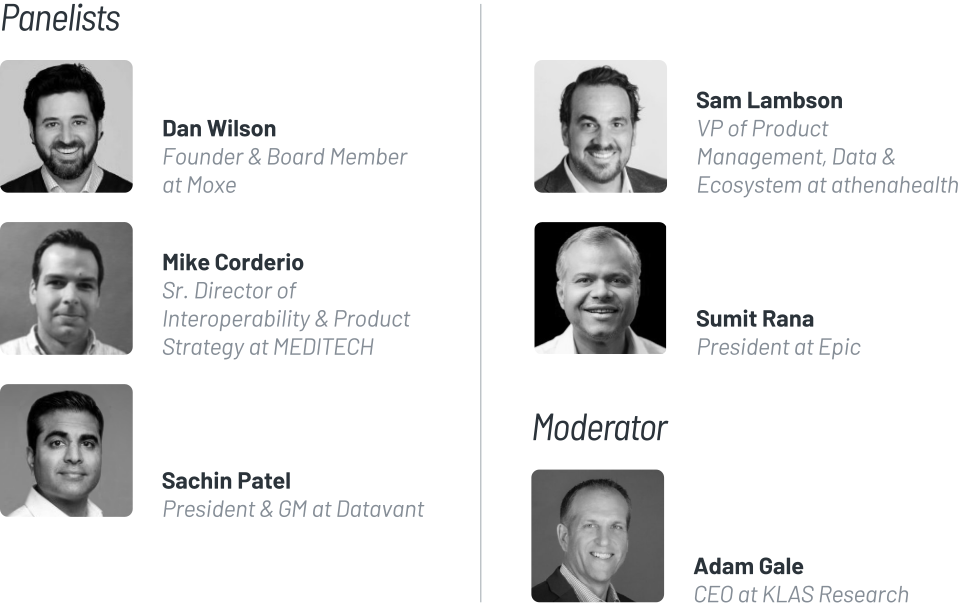
Mike Cordeiro, MEDITECH, Senior Director of Interoperability Market & Product Strategy
Andrea Corona, Tegria, Managing Director of Care Operations
Jed Cusimano, Signify Health, Exec Director of Digital Product
Christine Davis, HealthEdge, SVP of Marketing
Andy Dé, Lightbeam Health Solutions, Chief Marketing Officer
Rick Dipper, Veradigm, Business Operations & Chief of Staff
Kali Durgampudi, Apprio, CEO
Lev El-Askari, N1 Health, Senior Data Scientist
Jeremy Friese, Humata Health, Founder & CEO
Jonathan Fullerton, Ambience Healthcare, Strategic Growth Executive
Brad Gingerich, Ensemble Health Partners, VP of Payer Strategy
Giridhara Varma Gottumukkala, HTC Global Services, Health BU Delivery Lead
Brad Hawkins, MRO Corporation, National Director of Health Plan Sales
Mark Hellewell, Datavant, SVP of Payer Growth
Nicole Hess, Vim, VP of Marketing
John Hickey, Smarty, Sr. Product Marketing Manager
Kyle Hicok, R1 RCM, President of Revenue Performance Solutions
Bill Howard, eHealth Exchange, Consultant
Brent Jones, Signify Health, Director of Client Data Relationship Management
Chris Jones, Astrata, VP of Business Development
Eric King, Solventum, Solventum Ventures
Michael Kolb, Humata Health, Chief Growth Officer
Sam Lambson, athenahealth, VP of Product Management & Data and Ecosystem Platform
Greg LeGrow, athenahealth, Executive Director of Payer Product Strategy
Matt Leshy, Signature Performance, Chief Commercial Healthcare Officer
Monica Lovelace, Azara Healthcare, VP of Alliances
Jacob Luria, N1 Health, President & Founder
Scott MacKenzie, RevSpring, CEO
Gretchen Manica, Infinx Healthcare, AVP of Buyer Enablement
Heather Marberry, HealthEdge, Regional VP of Sales - Source
Shane Mayfield, Trend Health Partners, VP of Client Success
Erin Mellas, R1 RCM, VP of RCO & Payer Accountability
Gary Meyer, Cognizant, Strategic Markets Executive
David Morris, Cedar Gate Technologies, EVP & Chief Commercial Officer
Jay Nakashima, eHealth Exchange, President
Rodney Napier, Apprio, Chief Marketing Officer
Anne Neal, Availity, VP of Product Management
Lindsey Nelson, Infinx, Product Marketing Manager
Brendan O’Connor, Waystar, SVP of Strategy & Corporate Development
Phil Parker, Azara Healthcare, Sr. VP of Client Analytics
Sachin Patel, Datavant, President & General Manager, Payer
Mike Penich, Tegria, Sr. Vice President of Payer
Sumit Rana, Epic, President
Marykate Reese, Omega Healthcare, SVP of Influencer Marketing
Chris Rigsby, Omega Healthcare, SVP of Payer Solutions
Scott Rochowiak, Surescripts, Manager, Clinical Informatics
Joseph Ryan, Veradigm, Solutions Manager
Amit Sarwal, HTC Global, AVP
Andrea Schlosser, DeliverHealth, Assistant VP of Marketing & Sales Operations
Mike Selvage, Deloitte Consulting, Senior Manager
Priti Shah, Iodine Software, Chief Product & Technology Officer
Neal Smart, Abridge, Sr. Director of Strategic Sales
Julie Smith, InterSystems, Sr. Manager, Product Management
Karsten Smith, Epic, VP, Health Plan Applications
Kellen Sorensen, Cedar Gate Technologies, VP of Solutioning & Client Success
Lily Stephens, Abridge, Director of Enterprise Development
Mustafa Sultan, Anterior, Clinical & Growth
Stacie Sutter, Ensemble Health Partners, AVP of Payer Strategy
Jamie Teadale, Astrata, COO
Chris Vairo, Signature Performance, Chief of Staff
Bill Vickers, HealthEdge, Regional VP of Sales
John Vonhof, Surescripts, Strategic Marketing Manager
Casey Williams, RevSpring, Senior VP of Engagement, Analytics & Payment Applications
Cassie Williamson, Moxe Health, VP of Payer Sales
Derek Wilson, Ambience Healthcare, Strategic Growth Executive
Kevin Worrall, Epic, Payer Platform Lead
Audra Yankton, KLAS, Senior Insights Director of Consulting
Meg Zakrewsky, Veradigm, VP of Product
Jonathan Zimmerman, Holon Solutions, CEO
Beth Zuehlke, Moxe Health, Chief Customer Officer
Healthcare Organizations
Kumar Aditya, Atlantic Health System, Executive Director of IT
Kate Amidei, Asante, Manager ITS Ambulatory & Revenue Cycle Applications & Outreach
Tiffany Anderson, Stanford Health Care, Director
Susan Arens, Nebraska Methodist Health System, Sr. Director of Data Administration
Kelley Aurand, Legacy Health, CMIO
Scott Barlow, Revere Health, CEO
Kristine Bartley, Ascension, AVP of National Payer Performance & Episodic Models
Nick Bassett, Intermountain Health, VP of Revenue Services
Leo Bay, Essentia Health, Associate CMIO
Cathy Beebe, OSF Healthcare System, Director of Managed Care
Philip Boyce, Baptist Health, Chief Revenue Officer
Jarrod Brown, Banner Health, Sr. Director of PAS
Kris Brukl, Community Health Systems (HIM Central Services), Sr Director of Hospital Coding
Keri Charron, Methodist Physicians Clinic, VP of Clinic Operations
Courtney Clifton, Memorial Regional Health, Revenue Cycle Auditor
Kevin Davis, Gillette Children’s, Director Contracting & Payor Strategy
Matthew DeCarlo, ARUP Laboratories, IT Director
Laurie Duncan, RedMed Urgent Care, VP of Revenue
Mimi Espinales, Cole Health, Sr. Director of Operations & Systems
Velnette Fenker, Team Rehabilitation Physical Therapy, VP of RCM
Angela Ferguson, The Ohio State University Wexner Medical Center, Director of Patient Access
Nathan Fitton, MSU Health Care, CMIO
Dan Geffre, Rush, D&IS Manager - Epic Community Partnerships & Interoperability
Ryan Graham, Privia Health, VP of Practice Operations & Value-Based Care
Robin Griswold, Froedtert Theda Health, Director of Analytics Consulting
Ellen Guerin, Community Care Physicians, Manager of Clinical Quality Initiatives
Jason Hill, Ochsner, Clinical Innovation Officer
David Jeans, Parkview Health, SVP of Payer, Employer & Health Plan Strategy
John Joe, Vigor Health, CEO
Alexander Koster, Nemours Children’s Health, AVP of Value Transformation
Bill Manard, Intermountain Health, AVP/ACHIO
Michael Marchant, Sutter Health, Director of Digital Applications - Interoperability and Community Connect
Santrell Marsh, UMMC, Director of Health Information Management (CDI and Hospital Coding)
Dan McCarthy, Praxis Health, CEO
Greg McCarthy, Denver Health, CEO, Denver Health Medical Plan
Alketa Mezini, Neighborhood Health Plan of RI, Director of Operations & Strategy, Primary Care
Tamara Moores Todd, Intermountain Health, Chief Health Informatics Officer
Rydell Mynatt, New Day/Phoenix Home Care and Hospice, Senior Executive Director of RCM
Jeremy Nugent, Southern Oregon Orthopedics, CFO
Sean O’Reilly, Nemours, IS Business Applications Manager
Charlton Park, University of Utah Health, CFO
Amanda Pollock, Odyssey House of Utah, Revenue Cycle Manager
Brad Prestwich, Intermountain Health, Family Physician / Informatics Medical Director
Niobis Queiro, Nashville General Hospital, Chief Strategy Officer
Kaci Ramsey, Confluence Health, VP of Revenue Cycle
Jacob Reid, St. Luke’s Health System, SNR Director of Revenue Cycle Business Office
Debbie Robinson, Texas Health Resources, ITS Director of Business Applications
Bruce Rogen, Cleveland Clinic, CMO Cleveland Clinic Employee Health Plan, & Chair, Cleveland Clinic Quality Alliance CIN
Shane Salmon, Rocky Mountain Care, VP of RCM
Jake Sangster, Intermountain Health Ventures, Ventures Principal
Steve Scharmann, CommonSpirit Health, System VP of Revenue Cycle
Julee Snelgrove, Odyssey House, Revenue Cycle Manager
Kaleigh Stetler, Asante Health System, Director of Revenue Cycle
Crystal Strosahl, ThedaCare, ACO Program Manager
Shana Tate, Ballad Health, Chief Revenue Officer
Vanessa Tullie, Ahehee’ Shidine’e Homecare, CEO
Amber Turvey, Formerly at Memorial Regional Health, Former Revenue Cycle Director
Rachel Verville, Tufts Medicine, SVP of Revenue Cycle
Brodie Wall, Your Health, Executive VP of Analytics
Torrie Webb, Odyssey House, Medical Billing & Coding Manager
JC Young, Nemours Children’s Health, Director of Data Science & Analytics
Payer Organizations
Kirk Anderson, Cambia Health Solutions, VP & Chief Technology Officer
Nancy Beavin, Medica Health Plan, Director of Provider Interoperability Strategy
Kate Beck, Healthfirst, AVP of HIE
Jeff Bostelman, Centene, VP of Interoperability & Clinical Technology Strategy
Royce Bradley, Blue Cross and Blue Shield of Alabama, Provider Engagement Operations Manager
John Cope, Humana, Directory, Stars Technology
Christian Corzine, Medical Mutual, VP of Clinical Services & Operations
Michael Farina, CDPHP, VP of Healthcare Quality
Alan Ford, Cambia Health Solutions, Director of Provider Relations
Stephanie Franklin, Humana, Director of Health Equity Strategy
Liz Giel, Highmark Health, Director of Product Management – Interoperability
Lauren Hackenberg, Optum Rx, Sr. Director of Capabilities
Brenton Hefner, Humana, Lead Product Manager
Sonal Jain, CVS Health, Lead Director
Jocelyn Keegan, Aetna, a CVS Health company, VP of Interoperability
Kristin Kelly, Oscar Health, Director, Strategy & Insights
Lezlie Kephart, Humana, Product Manager
Autumn Kerr, Healthfirst, AVP of Clinical Quality
Bridget Kiser, Humana, Value & Interoperability Lead
Ravindra Kondiparthi, Cambia Health Solutions, Software Engineering Manager
Rakesh Mathew, HPP/JHP, Interoperability Leader
Kristen Monk, Aetna, Product Owner
Srihari Muthyala, Cambia Health Solutions, Director of Technology, Healthcare Solutions & Interoperability
Glenn Raley, Humana, Interoperability Product Management Fellow
Zak Ramadan-Jradi, Cambia Health, Head of Network Management
Scott Regenstein, Stellarus, Sr. Director of Pay-for-Value
Erica Rodgers, Regence, Provider Relations Executive
Rahul Singal, HealthHelp, CMO
Samantha Skaggs, Humana, Business Intelligence
Anna Slattery, Humana, Interoperability Principal Product Manager
Jason Teeple, Evernorth, Interoperability Strategy & Enterprise Architect
Angela Thomson, Banner Health Plan, Finance Director
Michael VonSick, Humana, Program Delivery Principal
Justin Weatherford, UnitedHealthcare, VP of Interoperability Solutions
Rebecca Welling, Select Health, VP of Risk Adjustment
Dave Wilcox, University of Utah Health Plans, IT Director
Elizabeth deLacy-Almeida, Neighborhood Health Plan of RI, Director of Financial Analysis
Other Industry Leaders
Michael Clark, Raapid, President
Michael Finke, GrowthCurve Capital, Chief AI Architect
Alix Goss, Point-of-Care Partners, Senior Consultant & Da Vinci Project’s Program Manager
Ryan Howells, Leavitt Partners, Principal
Adam Myers, TELUS, President of TELUS Health Centers
Daniel Wilson, Moxe Health, Founder

Writer
Carlisa Cramer

Designer
Jess Wallace-Simpson

Project Manager
Kristen Egbert
This material is copyrighted. Any organization gaining unauthorized access to this report will be liable to compensate KLAS for the full retail price. Please see the KLAS DATA USE POLICY for information regarding use of this report. © 2026 KLAS Research, LLC. All Rights Reserved. NOTE: Performance scores may change significantly when including newly interviewed provider organizations, especially when added to a smaller sample size like in emerging markets with a small number of live clients. The findings presented are not meant to be conclusive data for an entire client base.