
KLAS Arch Collaborative Executive Scorecard
Measuring Physician & Nurse EHR Experience, Burnout & Financial Risk
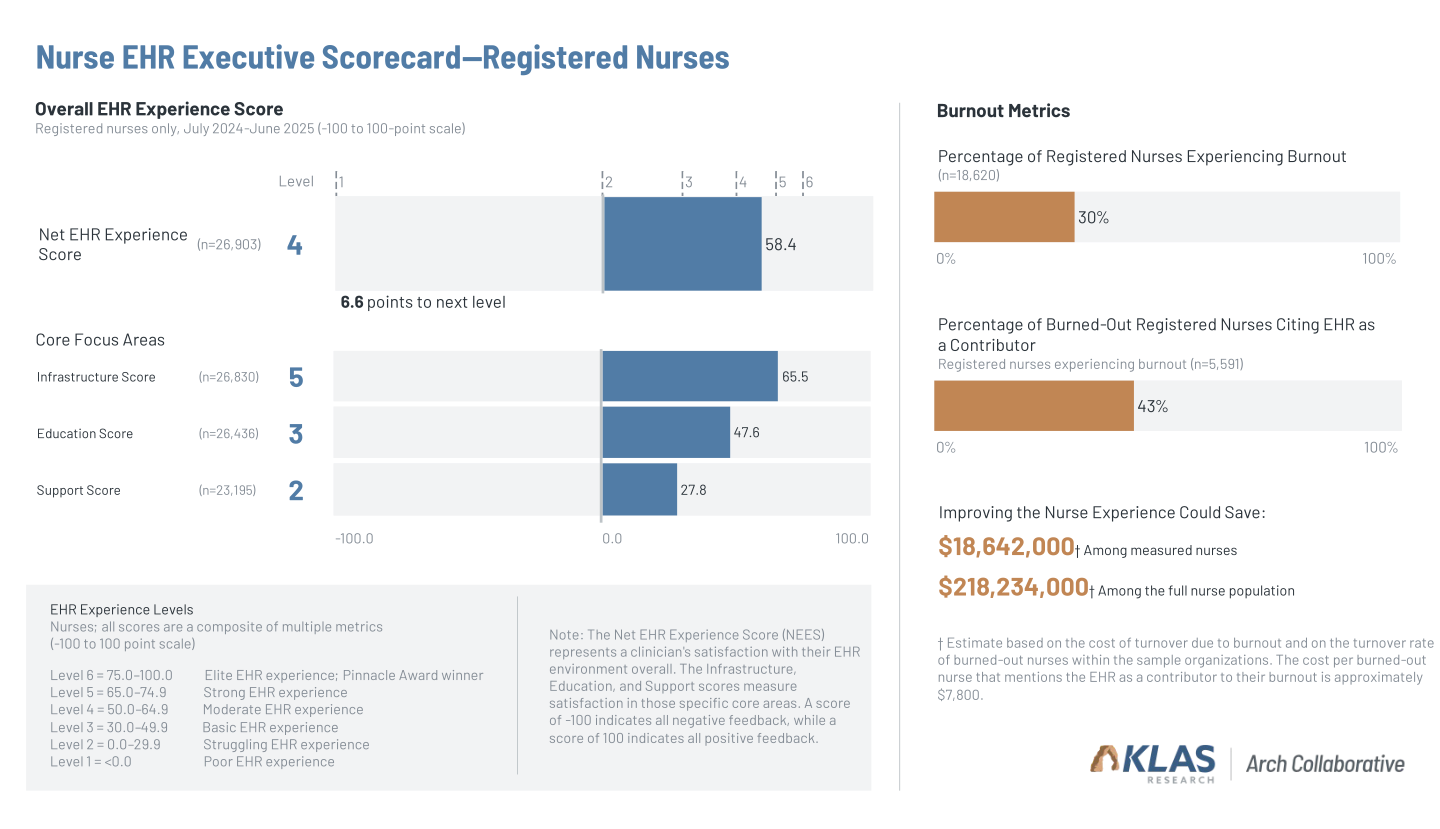
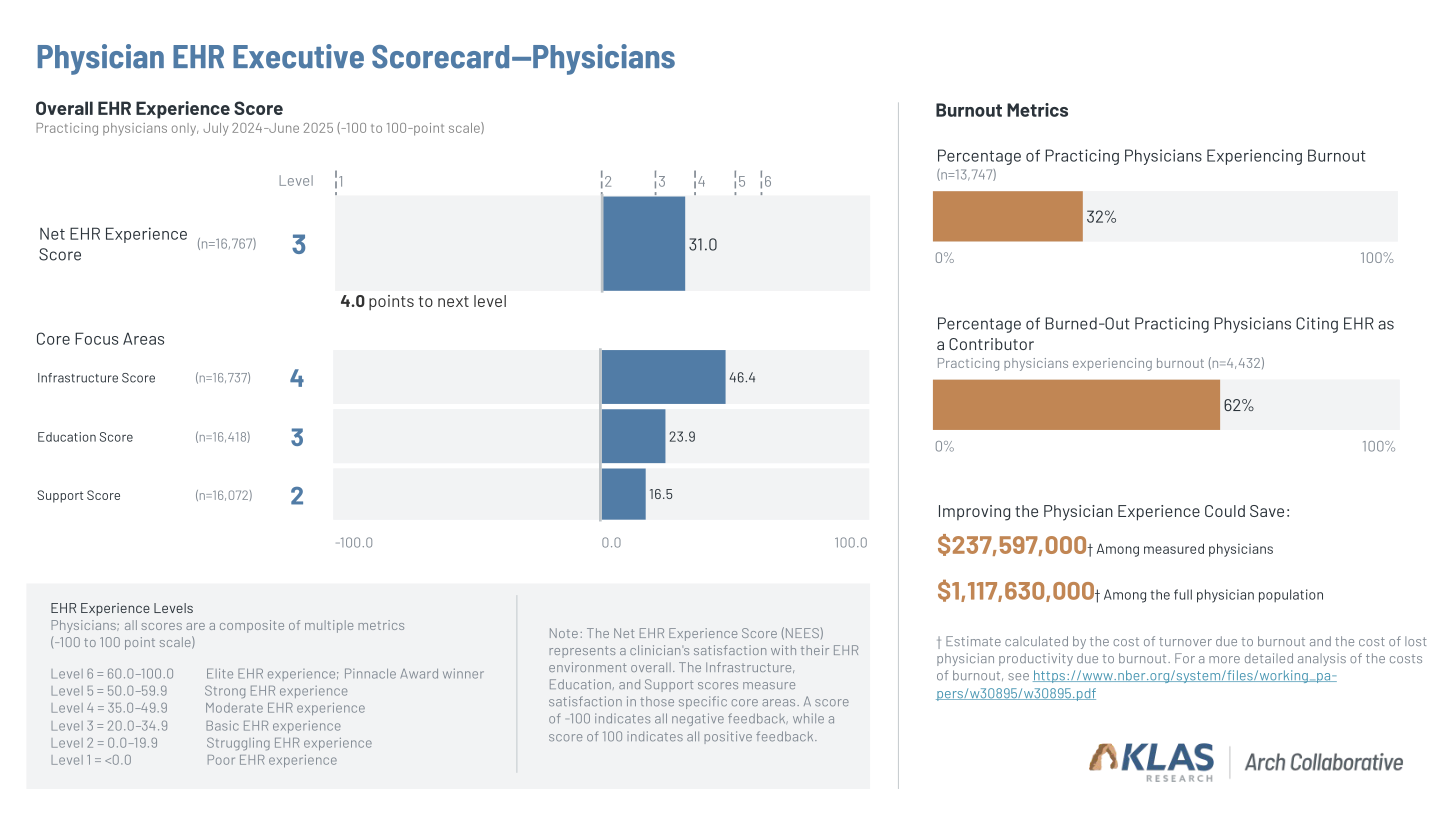
KLAS’ Arch Collaborative has the singular goal of improving the clinician EHR experience worldwide. As part of this goal, KLAS has developed the Arch Collaborative Executive Scorecard, which provides healthcare organizations with a snapshot of how well they train and support clinicians in using the EHR—as well as the financial risk if organizations don’t act to improve the EHR experience. KLAS’ latest research on burnout (see scorecards below) shows that 30% of registered nurses and 32% of physicians report some level of burnout. The EHR is a major contributor to this burnout, cited by 43% of burned-out nurses and 62% of burned-out physicians. Given these facts, it is imperative that organizations focus on enhancing the EHR experience to improve physician and nurse satisfaction, well-being, and retention.
Access the feedback of
700,000+ clinicians worldwide
Access the feedback of
700,000+ clinicians worldwide
Here is my information:
When healthcare organizations work with the Arch Collaborative to measure their clinicians’ EHR experiences, they get a breadth and depth of insights that can feel overwhelming. The Executive Scorecard will help organizations know where to begin their improvement journey and how to gain leadership buy-in to drive change.
About the KLAS Arch Collaborative
Since 2017, KLAS has partnered with healthcare organizations to measure and benchmark their clinicians’ EHR satisfaction through the Arch Collaborative. To date, over 500,000 clinicians have responded, enabling KLAS to not only deeply understand and share best practices that drive clinician EHR success but also set industry standards. KLAS’ standardized EHR Experience Survey captures clinicians’ perspectives on many critical areas, such as EHR reliability and response time, education, IT support, governance, personalization, and outcomes (e.g., enhanced efficiency and ability to deliver high-quality care).
What Is the Arch Collaborative Executive Scorecard?
The Arch Collaborative Executive Scorecard is a one-page summary of the EHR experience at an organization, distilling the complex data from the EHR Experience Survey into visuals and EHR Experience Levels that give executive leaders clear insights at a glance. The Executive Scorecard also calculates EHR-related burnout as well as possible financial impacts† and risk. The scorecard below shows the aggregate performance of all organizations who have measured with the Arch Collaborative in the last year.
Note: Burnout calculations can be included in an organization's executive scorecard only when the organization includes burnout and burnout contributor questions in their EHR Experience Survey.
† See section titled About the Data Behind the Arch Collaborative Executive Scorecard for details on how KLAS calculates the financial impact of EHR-related burnout.
To access your organization’s Arch Collaborative Executive Scorecard, please reach out to your KLAS Client Success Manager or send an email to archcollaborative@klasresearch.com.
About the Data Behind the Arch Collaborative Executive Scorecard
Overall EHR Experience Metrics
Four scores related to the clinician EHR experience are included in the scorecard—the Net EHR Experience Score, Education Score, Infrastructure Score, and Support Score. Each is calculated based on clinicians’ responses to specific questions/statements asked on a 1–5 Likert scale (from strongly disagree to strongly agree), with all questions/statements weighted equally. See below for the questions/statements used to calculate each score:
Net EHR Experience Score
Based on clinician agreement with the following statements.
This EHR:
- Is available when I need it (has almost no downtime)
- Has the fast system response time I expect
- Provides expected integration within my organization
- Provides expected integration with outside organizations
- Has the functionality for my specific specialty/clinical care focus
- Is easy to learn
- Makes me as efficient as possible
- Enables me to deliver high-quality care
- Keeps my patients safe
- Has alerts to prevent care delivery mistakes
- Allows me to deliver patient-centered care
Infrastructure Score
Based on clinician agreement with the following statements:
This EHR:
- Is available when I need it (has almost no downtime)
- Has the fast system response time I expect
Education Score
Based on clinician agreement with the following statements:
- My initial training prepared me well to use this EHR
- Overall, ongoing EHR training/education is helpful and effective
- I was trained on how to use the EHR for workflows specific to my specialty and/or practice area
Support Score
Based on clinician agreement with the following statements:
- Our organization has done a great job of implementing, training on, and supporting the EHR
- The IT department actively seeks to improve the EHR for clinicians
- There is someone assigned to help my department with the EHR
- Changes to the EHR are well communicated
- EHR fixes are made in a timely manner
- I have a voice in trying to improve the EHR
- I know how to request a fix to the EHR
- I am able to get support in a timely manner when I have an EHR issue
EHR Experience Levels for these scores are calculated based on the scale shown below.
Score (-100 to 100 point scale) | |||
|---|---|---|---|
Nurse | Physician | EHR Experience Level | |
75.0+ | 60.0+ | Level 6: Elite EHR experience | Pinnacle Award winners. Organizations have a mature, well-integrated EHR system. Clinicians feel confident in EHR infrastructure, education, and support, and they are highly satisfied and efficient. |
65.0–74.9 | 50.0–59.9 | Level 5: Strong EHR experience | Organizations have a strong EHR system but could improve education and support. Most clinicians see benefits of EHR; some still experience workflow challenges. |
50.0–64.9 | 35.0–49.9 | Level 4: Moderate EHR experience | Organizations have a reliable EHR but may struggle with consistent training and support. Clinicians’ satisfaction is mixed, with some benefiting from EHR and others finding it cumbersome. |
30.0–49.9 | 20.0–34.9 | Level 3: Basic EHR experience | Organizations have an operational but not optimal EHR. Clinicians struggle with usability, lack comprehensive training, and receive limited support. |
0.0–29.9 | 0.0–19.9 | Level 2: Struggling EHR experience | Organizations face significant challenges with the EHR—unreliable infrastructure, inconsistent training, and limited support. Many clinicians struggle to effectively integrate the EHR into their workflows. |
<0.0 | <0.0 | Level 1: Poor EHR experience | Organizations have the lowest EHR effectiveness. Clinicians have major frustrations with infrastructure, usability, and support, leading to dissatisfying, inefficient clinician workflows. |
Calculations for Burnout & Financial Impact
Burnout Calculations
Percentage of Physicians Experiencing Burnout is based on the number of respondents reporting one of the following three levels of burnout:
Definitely burning out
Symptoms of burnout won’t go away
Completely burned out
Percentage of Burned-Out Physicians Citing EHR as a Contributor is based on the number of respondents reporting at least one of the following as reasons for burnout:
EHR or other IT tools inhibit my ability to deliver quality care
EHR or other IT tools hurt my efficiency
Lack of training/proficiency on EHR or other IT tools
Financial Impact Calculation
Based on this article from the National Bureau of Economic Research, KLAS calculates the cost of burnout as roughly $87,000/physician.
Example from EHR Experience Executive Scorecard for physicians:
- 13,747 physicians responded to the questions about burnout
- Of those physicians, 32% (4,399) reported experiencing some level of burnout
- Of the 4,399 physicians reporting burnout, 62% (2,727) reporting the EHR as a reason for their burnout
- 2,727 physicians x $87,000 = around $237,000,000 in financial risk
What Is the KLAS Arch Collaborative?
The Arch Collaborative is a group of healthcare organizations committed to improving the EHR experience through standardized surveys and benchmarking. To date, almost 300 healthcare organizations have surveyed their end users and over 600,000 clinicians have responded. Impact reports such as this one seek to synthesize the feedback from these clinicians into actionable insights that organizations can use to revolutionize patient care by unlocking the potential of the EHR.
Report Non-Public HTML Body
Report Public HTML Body
This material is copyrighted. Any organization gaining unauthorized access to this report will be liable to compensate KLAS for the full retail price. Please see the KLAS DATA USE POLICY for information regarding use of this report. © 2019 KLAS Research, LLC. All Rights Reserved. NOTE: Performance scores may change significantly when including newly interviewed provider organizations, especially when added to a smaller sample size like in emerging markets with a small number of live clients. The findings presented are not meant to be conclusive data for an entire client base.