
Clinician EHR Experience 2026
State of the Industry
Healthcare organizations face many competing priorities, making it difficult for executives to know where to focus their limited resources. However, recent research from the KLAS Arch Collaborative shows that organizations that prioritize the clinician experience see a positive ripple effect on other organizational priorities, including costs and the patient experience. Satisfaction with the EHR is a critical component of clinicians’ overall satisfaction and well-being, yet it can vary widely from organization to organization, even across users of the same EHR technology.
Access the feedback of
700,000+ clinicians worldwide
Access the feedback of
700,000+ clinicians worldwide
Here is my information:
This report, an update to 2025's inaugural research, looks at the current state of EHR satisfaction among the 92 organizations (121,000+ clinicians) who have measured with the Arch Collaborative over the last year—how are these organizations distributed across the Collaborative's six EHR Experience Levels, what has improved since last year, and which areas still need work?
Year in Review
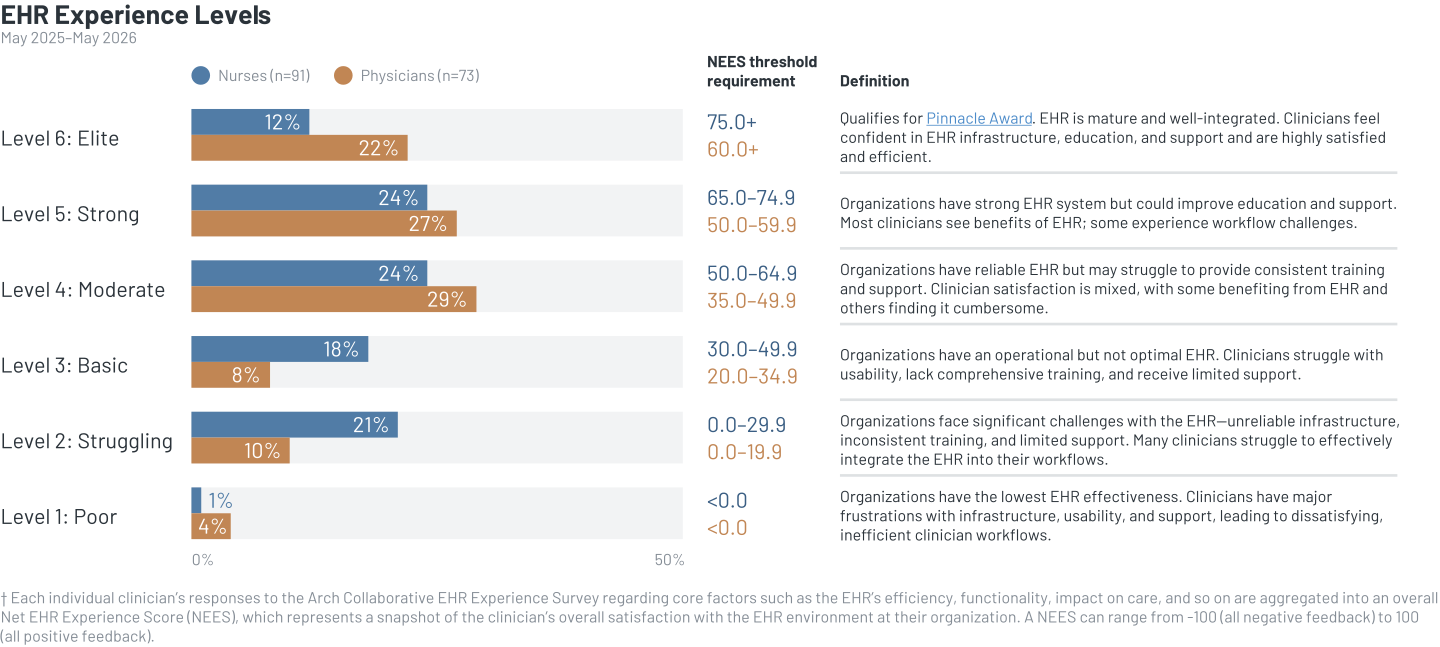
Majority of Measured Clinicians Report an At Least Moderate EHR Experience; Nurses More Likely Than Physicians to Be Stuck Near the Bottom
Many of the clinicians whose organizations have measured EHR satisfaction via the Arch Collaborative over the last year report a fairly strong EHR experience. Of the organizations that surveyed their physicians, 22% report a Net EHR Experience Score (NEES)† that puts their organization in the highest levels of EHR satisfaction (Level 6: Elite); 12% of organizations that surveyed their nurses achieved Level 6. The majority of organizations fall within Level 4 or Level 5, meaning their clinicians report a moderate to strong EHR experience.
Compared to physicians, nurses are more likely to report a basic or struggling EHR experience (Levels 2 or 3). The bar for satisfaction is higher among nurses, but given that they are the largest clinical group and are consistently interacting with patients and a variety of other clinicians, it is crucial they not be forgotten or left behind in the quest to improve the EHR experience.
Repeat Measurements See Overall Improvement in EHR Experience
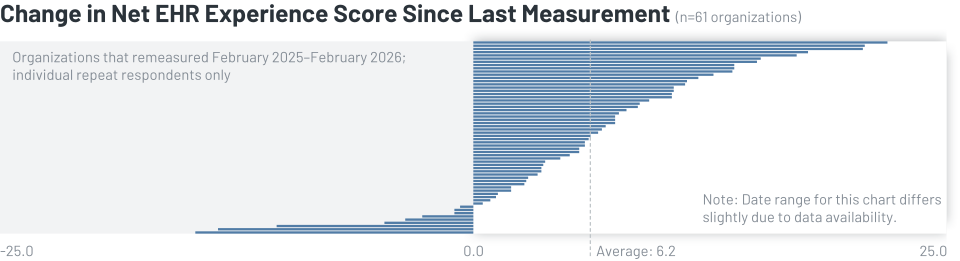
Organizations that remeasured their clinicians’ EHR satisfaction have overall seen improvement in their repeat respondents’ EHR satisfaction. While a handful of organizations saw their scores decline, the average change was a 6.2-point increase in the NEES; seven organizations saw score increases of 15 points or more.
Improvements & Challenges from the Past Year
Interviewed clinicians highlight a variety of factors that have improved their EHR experience over the past year. The following sections explore the most commonly reported, as well as the areas that clinicians feel still need improvement. The findings are based on commentary collected from surveyed clinicians.
What Has Improved?
Nurses
- Documentation and charting: Nurses highlight reduced duplicate charting; standardized notes, templates, and flowsheets; and easier access to key information while documenting. They especially value features that save clicks and keep documentation in one place. Despite improvements, documentation burden is still nurses’ most wished-for fix; many describe the process as still too redundant, cumbersome, and burdensome, even after recent changes.
- Usability and navigation: Nurses report reduced clicks, easy-to-access information, and the ability to retain context while moving through charts, tasks, notes, and review screens. The strongest praise goes to cleaner layouts, better chart review and worklist behavior, and more “one-screen” workflows.
- Smart tools: Macros, copy-forward, smart phrases/smart sets, shortcuts, and quick-click tools are seen as genuine time-savers that speed charting, reduce repetitive documentation, and make workflows easier to manage.
Note: In the 2025 report, the biggest nurse improvements were training, enhanced user interfaces, and secure messaging.
Physicians
- Ambient speech/documentation: Physicians most value documentation changes that cut toggling and clicks and help them finish notes faster. Ambient AI is one of the clearest bright spots, with many physicians describing major time savings, less after-hours charting, and meaningful quality-of-life improvement. They still see the need for better integration, more consistent output quality, and better optimization by specialty and visit type. Other wins include problem-based note writing, better templates, copy-forward behavior, auto-populated note elements, and easier access to chart sections, result notes, and outside documentation.
- Workflows/usability: Physicians report improved speed, fewer clicks, and easier navigation, and keeping more of the needed workflow visible in one place. Physicians appreciate one-click actions, persistent side panels, multi-select functions, and smoother performance.
- Orders/order sets: Ordering has gotten faster and more embedded in existing workflows. This includes better order sets, quick orders, smartsets, repeat ordering, and the ability to place orders directly from results, inbox, storyboard, or care gap views. Ordering changes are valued when they are reliable and intuitive.
Note: In the 2025 report, the biggest physician improvements were ambient speech, enhanced user interfaces, and secure messaging.
What Still Needs Work?
The sections below explore the metrics with the lowest current satisfaction and the highest potential to positively impact how clinicians view their EHR technology and the support they receive from their organization.
What Clinicians Need from Their Organizational Leadership
The following were identified as high-impact opportunities via a correlation analysis between key EHR, training, and support metrics and clinicians’ agreement with the statement “My organization/IT department does a good job delivering and supporting the EHR.” Data-backed best practices for these recommendations can be found in KLAS’s 2025 Physician Guidebook and 2024 Nursing Guidebook.
Initial and ongoing training
Stagger initial training: Initial training should not all happen in the same day or even week. Start with the essentials and continue to layer education over the first 90 days as clinicians build confidence. Work with your EHR vendor to identify onboarding best practices and help clinicians learn the EHR within the context of their workflow.
Make ongoing education accessible: As little as one hour of ongoing education per year can make a big difference in EHR satisfaction, but clinicians cannot participate in training that they don’t know about or that they have to dig through a database to find. Any educational resources, from trainers to tip sheets, should be marketed to clinicians and easily accessible at their fingertips.
Upgrades and communication
Provide high-quality upgrades: High-quality EHR upgrades need to be accompanied by a high-quality upgrade process and communication/education. Organizations should work with vendors to ensure they follow best practices for when, how, and how often to implement upgrades.
Communicate changes effectively: The level of communication should match the impact of the upgrade. Set clear expectations and overcommunicate. Communication should come from a trusted source via multiple channels and be tailored to the reader.
Clinician participation in EHR governance
Give clinicians a voice in EHR changes: Have a process for requesting fixes and optimizations with a clear feedback loop so clinicians know they have been heard and what to expect, when, and why (especially if their request is denied). Clinicians should also have someone who represents their department in decision-making and someone who is assigned to help their department with the EHR.
Efficiency
Ensure EHR drives efficiency: The EHR should enhance a clinician’s ability to care for patients, not take time away from patient care. While efficiency is improving, it is still a leading cause of dissatisfaction. Truly driving efficiency requires proactive teamwork between clinicians, their organization, and the vendor to remove clutter and bring what’s important to the surface.
Vendor partner
Partner with your EHR vendor: Clinician perceptions of their EHR vendor and their organizations’ EHR support are closely connected. End users have a hard time differentiating. Your reputation depends on working effectively with your EHR vendor parter. Consider sharing your Arch Collaborative EHR Experience Survey results with your EHR vendor partner. This data can help create a common language for planning improvements.
What Clinicians Need from Their EHR Vendor
The following were identified as high-impact opportunities via a correlation analysis between key EHR, training, and support metrics and clinicians’ agreement with the statement “My EHR vendor delivers a high-quality EHR.”
Partner with customers to support the EHR: Clinicians see their EHR vendor through the lens of their organizations’ EHR experience. To ensure effective implementation, support, and training, partner with organizations to ensure their clinicians can share feedback and ask for changes. Clinicians should be kept informed about the status of changes (what, when, why), even if their requests cannot be implemented.
Drive efficiency: Work with customers to understand the most common and inefficient workflows each clinician group faces. Consider whether AI or other technologies could be used to automate these workflows in highly impactful ways.
Make the EHR easy to learn: The EHR should be as user-friendly and intuitive as possible. EHR vendors need to account for the unique needs of different organizations, clinical backgrounds, and specialties/focus areas.
Provide meaningful upgrades: High-quality EHR upgrades require a high-quality upgrade process paired with thoughtful communication/education. EHR vendors should be clear about best practices for when, how, and how often to implement upgrades and provide guidance and resources for educating clinicians on changes. Vendors must understand the impact their upgrades will have and then match the level of communication to the level of impact.
Optimize usability of external data: Clinical and IT leadership often feel like they have exhausted their ability to improve external integration, and they expect more from their EHR vendor in this area. This is a challenge across the industry but is a much bigger factor for clinicians using non-Epic solutions. This is an area where AI capabilities can prove useful (e.g., patient chart summarization).
Ensure fast system response time: Good system response time is foundational to EHR satisfaction, and clinicians blame poor performance in this area on the EHR vendor. Vendors need to deliver expected system speed, not just with the EHR itself but with all other systems in the surrounding infrastructure.
The Journey to Improvement
As the data above illustrates, improvement is possible. The following sections celebrate those organizations that have achieved EHR excellence or improvement over the last year and highlight strategies other organizations can adopt to replicate these successes.
What Sets Apart the Elite from the Mediocre?
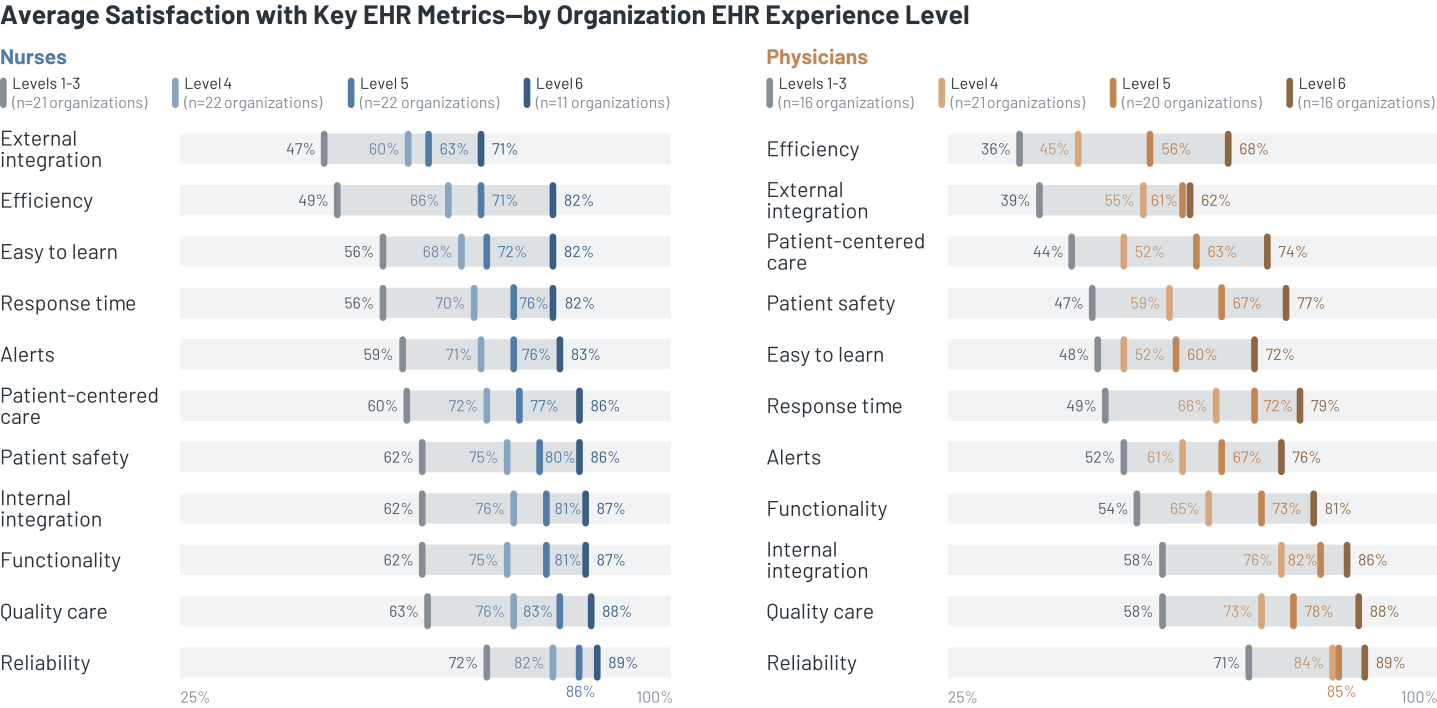
There are important insights to be gleaned by examining the differences between organizations that have achieved an Elite EHR experience for their clinicians and those that are still working to build a solid EHR foundation. See below for areas to focus on to move your organization to the next level.
Moving Beyond Basic
Organizations currently in Levels 1–3 that want to help their clinicians move into Levels 4 or 5 should focus on the following:
Efficiency
Nurses
Previous KLAS research found that 79% of nurses (out of 80,000+) report losing time to unproductive charting, including click-heavy workflows and duplicative or not useful documentation. Among nurses, reducing documentation is the top-requested fix.
Response time
Nurses Physicians
Login challenges and slow loading times caused by Wi-Fi/internet issues, old/broken hardware, missing software updates, and other factors are highly disruptive for clinicians and are often missed by high-level testing. Rounding and other strategies that give clinicians the opportunity to report challenges directly will uncover issues that systemwide scans miss.
Internal/external integration
Nurses Physicians
Data from outside sources (or even other internal departments) is too often inaccurate, irrelevant, or difficult to find. KLAS data shows that 47% of respondents (out of 33,000+) report they can’t quickly find important patient information from outside organizations, and another 47% say they have to sift through duplicate data.
Becoming Elite
Organizations currently in Levels 4 or 5 that want to help their clinicians move into Level 6 should focus on the following:
Efficiency
Nurses Physicians
Even at the higher satisfaction levels, efficiency is a key hurdle for leveling up nurse and physician EHR satisfaction. In previous research, KLAS found that 59% of physicians (out of 25,000+) don’t feel their EHR enables efficiency. Ambient speech has had a significant positive impact on their efficiency, but lack of quality training remains a barrier to adoption and effective use.
External integration
Nurses Physicians
Across all EHR Experience Levels, external integration is the lowest-scoring area for nurses, and it’s also the lowest-scoring metric among organizations at Level 6. Other KLAS research indicates that 55% of physicians (out of 25,000+) are not satisfied with their EHR’s external integration.
Ease of learning
Nurses Physicians
Clinicians need EHR education early and often, with easy, real-time access to people or resources that can answer their questions. EHR education should be layered to provide more opportunities to learn once clinicians have mastered previous material. Advances in virtual education can scale access to tailored learning materials and free up educators to find ways to add depth to training.
2025 Arch Collaborative EHR Experience Pinnacle Award & Breakthrough Recognition Winners
We are delighted to highlight the following organizations, who qualified for Arch Collaborative awards in 2025. Their efforts demonstrate that clinician satisfaction with the EHR is an achievable goal; where available, links are included below to case studies that offer more details about how these organizations achieved their success. 2026 winners will be announced on July 29, 2026, at KLAS’s annual Arch Collaborative Learning Summit.

2025 EHR Experience Pinnacle Award Winners
Nurses (NEES of 75.0 or greater)

Case study: By continually refining processes, CHOP ensures that frontline nurses remain central to the healthcare technology evolution, leading to higher satisfaction among staff and better overall care delivery.

Case study: Key contributors to high clinician EHR satisfaction include EHR support and shared ownership and governance structure. Governance committee members and IT analysts have a deep sense of responsibility to support clinicians and go the extra mile to improve and optimize the EHR.

Case study: Houston Methodist created a service transformation initiative in which nurse informaticists worked alongside bedside nurses, collaborated with clinical application analysts, and engaged in system-level governance.




Physicians (NEES of 60.0 or greater)
Case study: Key contributors to high clinician EHR satisfaction include EHR support and shared ownership and governance structure. Governance committee members and IT analysts have a deep sense of responsibility to support clinicians and go the extra mile to improve and optimize the EHR.

Case study: Parkview Health moved away from passive, one-size-fits-all education in favor of personalized, data-driven, and highly engaging approaches, including a mix of targeted coaching, creative content, and continual support.

Case study: Reid Health transformed their culture into one of collaboration and high EHR satisfaction by centering their strategy on a clinician-driven culture, creating sustainable governance, education, and personalization frameworks with direct clinician involvement.


2025 EHR Experience Breakthrough Recognition Recipients (15-point or greater increase in NEES)
Nurses

Case study: Mercy Health leveraged the Project ANEW (Advancing Nursing Efficiencies and Workflows) initiative to improve nurse efficiency and documentation burden by capturing and acting on nurse feedback.

Case study: Anchored by frontline engagement and executive support, the organization streamlined workflows, reduced redundant tasks, and empowered nurses to play a central role in designing better documentation.

Case study: The organization boosted clinician access to both internal and external data by leveraging Evidently to transform how internal and external data is aggregated, viewed, summarized, understood, and used in clinical care.



Physicians

Case study: The organization implemented a sprint program to drive measurable improvements in clinician EHR satisfaction. They focused on specialty-based, rapid-cycle improvement efforts that engage providers and clinical staff directly in workflow improvements and training.
Want to Know How Your Organization Is Doing? Measure with the Arch Collaborative
By working with the Arch Collaborative, healthcare organizations can gain a deeper understanding of their clinicians’ experiences as well as specific guidance on what to improve.

Measure your clinicians’ experiences and learn your EHR Experience Level

Adopt best practices from your peers

Measure your interventions and see your improvement year-over-year

Celebrate progress through the EHR Experience Breakthrough Recognition

Continue progressing to achieve the EHR Experience Pinnacle Award
Updates to the EHR Experience Survey
Our goal in updating the EHR Experience Survey each year is to ensure it continues to reflect the current healthcare environment and deliver meaningful insights to Arch Collaborative members. The 2026 survey is available for review here.
What’s New for 2026?
- Expanded focus on AI: New required questions explore clinicians’ current use of AI, education opportunities related to AI, and areas where AI support is still desired. This will help track adoption trends over time.
- Refined survey structure: Several formerly required questions have become optional to improve flow and relevance.
- New optional content: Additional optional questions allow organizations to explore training clarity and scheduling in greater depth.
- Question wording and logic improvements: Minor wording updates, streamlined response options, and updated display logic enhance clarity and benchmarking.
- Survey cleanup: A small number of questions have been removed to reduce unnecessary burden and keep the survey focused.
What Is the KLAS Arch Collaborative?
The Arch Collaborative is a group of healthcare organizations committed to improving the EHR experience through standardized surveys and benchmarking. To date, over 300 healthcare organizations have surveyed their end users and over 700,000 clinicians have responded. Impact reports such as this one seek to synthesize the feedback from these clinicians into actionable insights that organizations can use to revolutionize patient care by unlocking the potential of the EHR.
Report Non-Public HTML Body
Report Public HTML Body
Featured in Learning Tracks
Topics
Report Topics
Ambient Speech, Clinician Relationships & Communication, EHR Governance, Measured Improvement, Nursing EHR Success, Onboarding EHR Education, Ongoing EHR Education, System Reliability & Response TimeThis material is copyrighted. Any organization gaining unauthorized access to this report will be liable to compensate KLAS for the full retail price. Please see the KLAS DATA USE POLICY for information regarding use of this report. © 2019 KLAS Research, LLC. All Rights Reserved. NOTE: Performance scores may change significantly when including newly interviewed provider organizations, especially when added to a smaller sample size like in emerging markets with a small number of live clients. The findings presented are not meant to be conclusive data for an entire client base.