
AI Insights from the Arch Collaborative 2026
An Early Look at How Epic Customers Are Leveraging AI to Improve the Clinician Experience
AI has moved quickly from future-state potential to everyday clinical workflow. Epic customers in particular are using it to take on work that clinicians have struggled with for years: documenting visits, summarizing patient histories, finding the right information in crowded charts, and keeping up with the constant stream of follow-up work. The potential benefits are practical and deeply personal to clinicians: less time spent digging, typing, retyping, and catching up after hours. To explore the reality of these outcomes, this report brings together early findings from two data sets: (1) data from 12 Epic organizations that have surveyed their clinicians about AI adoption and impact since January 2026 and (2) interviews with executive leaders at Epic organizations in the Arch Collaborative.
Access the feedback of
700,000+ clinicians worldwide
Access the feedback of
700,000+ clinicians worldwide
Here is my information:
This report focuses on Epic organizations because they currently represent the Collaborative’s largest sample of AI users. KLAS intends to publish subsequent reporting within the next year to show the impact at organizations using other EHR vendors.
A Note About the Report Sample
- The organizations in the sample all have above-average EHR satisfaction among their clinicians, indicating that they have already tackled foundational barriers to EHR satisfaction and are thus better prepared to leverage the benefits of AI.
- The AI tools referred to in the report may be native to Epic, third-party tools embedded into Epic workflows, or third-party tools used outside Epic workflows.
- Sample sizes vary by chart and clinical role because not every organization included every AI-related question in their clinician survey.
- The data reflects early AI implementations and should be interpreted as directional rather than causal.
AI Use Boosts Clinicians’ EHR Efficiency & Satisfaction
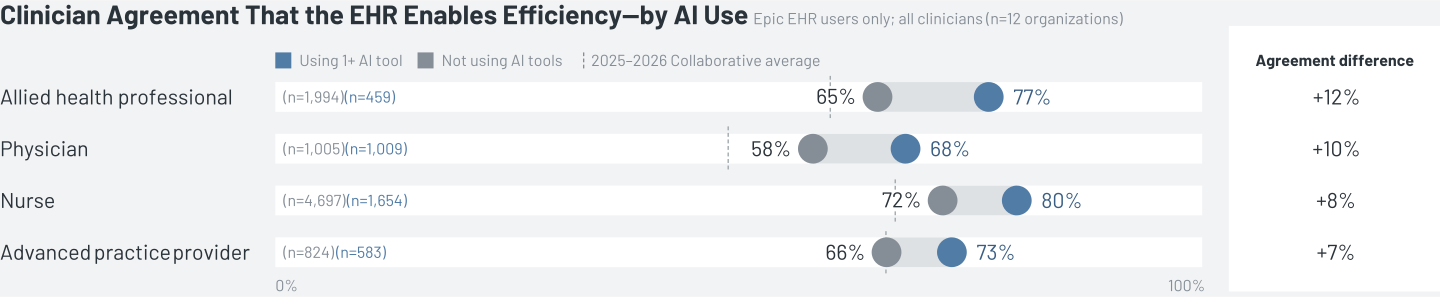
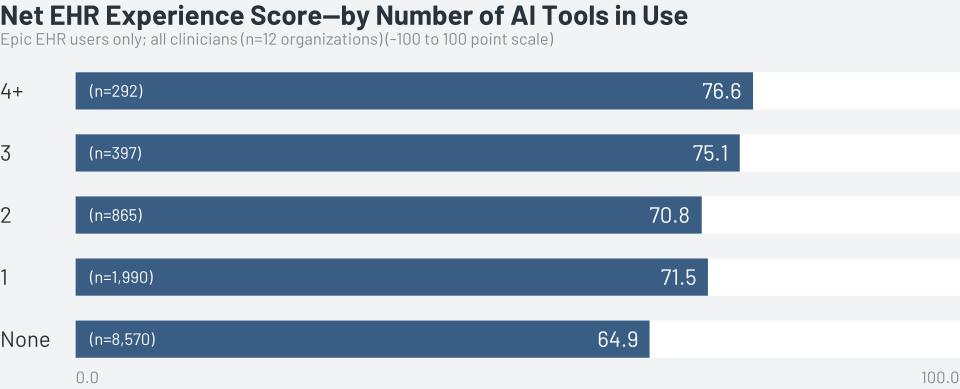
The early findings around efficiency and satisfaction are promising and demonstrate that AI should be part of the clinician-experience conversation. While it’s possible there is a natural bias in the finding—i.e., more competent (and thus more efficient) technology users could be the most likely to adopt AI tools—the data shows that clinicians who use AI are more likely to feel the EHR enables efficiency. The percentage of clinicians who agree that the EHR enables efficiency is 7 percentage points higher among clinicians who use at least one AI tool (Epic or otherwise) compared to peers who don’t use any AI tools. Similarly, clinicians who use AI tools also report higher overall EHR satisfaction; they have an average Net EHR Experience Score (NEES)† of 72.2, compared to 64.9 among clinicians who don’t use AI tools.
As clinicians adopt more AI, their overall EHR experience continues to improve, but early data suggests there are limits to this improvement. Satisfaction rises as clinicians take on up to four AI tools, but it then begins to plateau—the small sample of clinicians who report using five or more AI tools do not report additional gains in EHR experience. This early finding among fast adopters provides a useful takeaway—while AI tools can provide relief, they can also become noise if clinicians are handed too many choices or too many half-finished workflows to manage.
† Each individual clinician’s responses to the Arch Collaborative EHR Experience Survey regarding core factors such as the EHR’s efficiency, functionality, impact on care, and so on are aggregated into an overall Net EHR Experience Score (NEES), which represents a snapshot of the clinician’s overall satisfaction with the EHR environment at their organization. A NEES can range from -100 (all negative feedback) to 100 (all positive feedback).
The surest way to lose clinician trust is to frame AI mainly as a way to squeeze more productivity from already strained teams. Related Arch Collaborative research has found higher burnout at organizations that place cost reduction above all other priorities. AI will land better when it is positioned as support infrastructure: something that gives clinicians time, focus, and confidence back, not just another lever for throughput.
Clinician AI Use Is Taking Root Most Strongly Around a Few Workflows
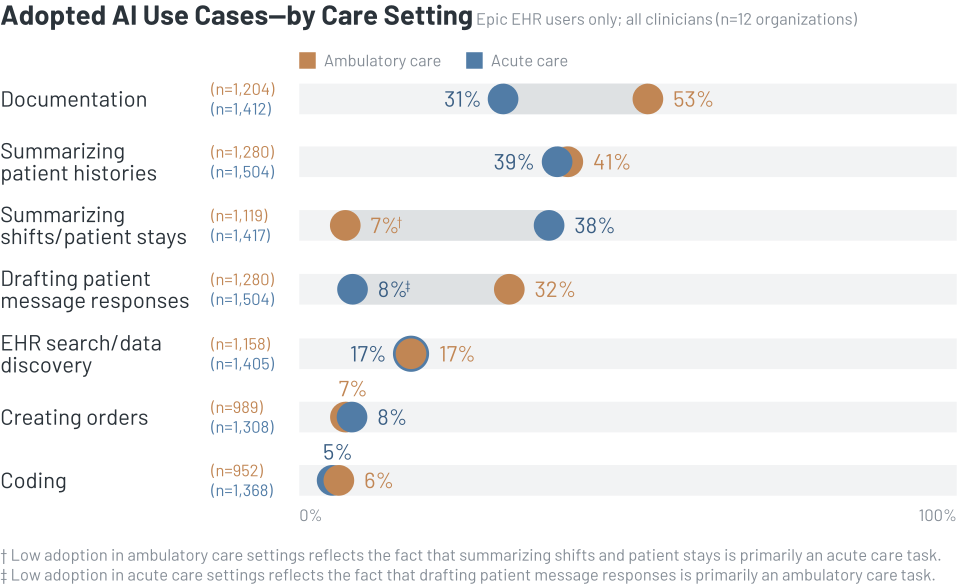
Clinician AI use is no longer theoretical, but it is still concentrated, with the first wave of adoption following the strongest pain points. Across the 12 measured organizations and the variety of tools in use, the most common workflow for which clinicians have adopted AI is documentation, followed by summarizing patient histories and summarizing shifts or patient stays. These are all tasks that require undue time and attention from clinicians but that are also contained enough for a tool to provide immediate relief. Other use cases—including patient-message drafting, EHR search/data discovery, order creation, and coding—are present but earlier in their adoption curve.
AI Gains Depend on Matching the Tool to the Workflow & the Role
The AI conversation often starts with documentation, but clinician burden does not end when a note is signed. Clinicians also spend time hunting for the right information, piecing together the patient story, managing messages, and making sure the chart is usable for the next person who touches it. A strong AI strategy has to help clinicians put information into the EHR and get meaning back out of it.
Examining clinician perceptions of EHR efficiency based on which use cases they have adopted doesn’t tell a simple story. Some of the largest positive differences in perceptions of EHR efficiency are seen among clinicians who have adopted AI to help with shift or patient stay summaries, EHR search/data discovery, and order creation. Other documentation-focused workflows show smaller or neutral differences overall. The variation pushes leaders toward more specific questions to pursue: which workflow is being fixed, for whom, and how mature is the implementation?
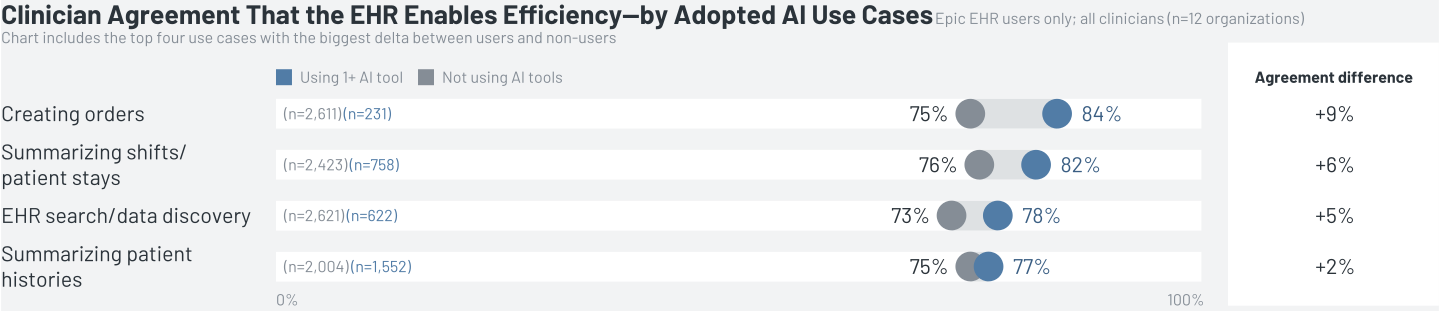
Examining AI adoption by role sharpens the point. The same AI menu will not feel equally relevant to every clinical group.
- Physicians and APPs are more likely to use AI for visit-note drafting and patient-history summaries, reflecting AI’s early emphasis on provider documentation.
- Nurses show more use of shift/patient-stay summaries, charting discrete elements, and patient-message workflows.
- Allied health professionals also report meaningful use of patient-history summaries and EHR search/data discovery.
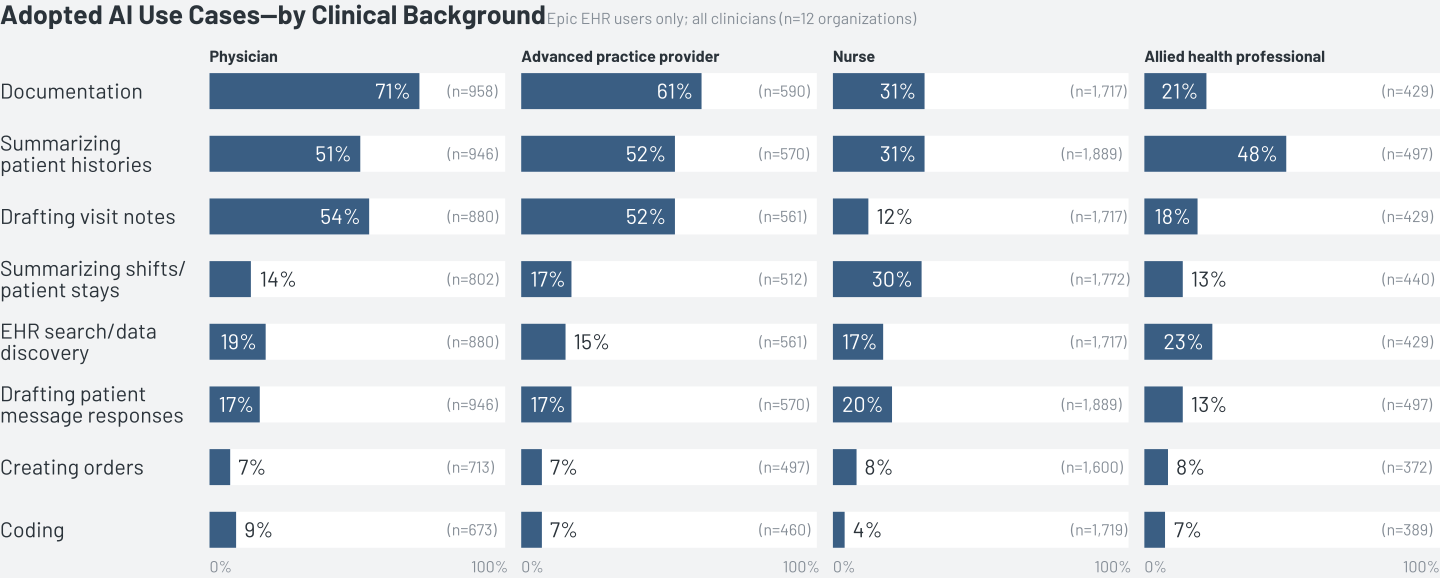
Organizations that get the most from their AI tools (whether from Epic or third parties) will likely build from role-specific pain points instead of broad tool availability. Usage alone will not carry the strategy. The real test is whether AI is helping with the part of the job that is wearing clinicians down.
- For physicians, that may mean documentation and visit preparation.
- For nurses, it may mean handoffs, flowsheet documentation, and the constant work of keeping the chart current.
- For allied health professionals, it may mean faster access to the patient story.
Don’t Forget Nurses & Allied Health Professionals
A provider-centered AI strategy will leave major experience gains on the table. Nurses and allied health professionals need dedicated governance, training, and workflow-specific AI use cases, not a delayed version of a physician-focused rollout.
 “Implementing AI tools isn’t as simple as just turning them on. Epic has a wide variety of AI tools, some with tremendous utility and others with less. Each AI tool requires careful attention to workflow, adoption, and whether users actually find value. That takes time and effort from IT and informatics staff. Epic promotes all these tools as things that we can just turn on and that people will use, but it is not that easy.” —CMIO
A Better AI Question
Rather than ask what tasks AI can automate, organizations should ask where the chart makes clinicians work too hard to understand the patient, complete the right action, or trust the information in front of them. When clinicians were asked where AI could help the most, they largely mentioned AI use cases they had already seen but not yet experienced (documentation, chart summarization, EHR search, etc). The majority of clinicians want AI to help them; those who resist AI use are more likely to adopt AI that reduces painful clerical and cognitive load rather than automating things they prefer to do.
“I don’t need AI to think for me, I need AI to assist me. I would be so bored if AI did all the critical thinking tasks and my job was to help people figure out how to reach radiology, like an operator.” —Nurse
“AI could add substantial value through automated chart summarization, clinical data synthesis, and AI-assisted documentation. . . . These capabilities would meaningfully reduce charting burden and cognitive load.” —APP
For Successful AI Adoption, You Must Be Ready to Train, Not Just Implement
Many executive leaders feel ready to implement the next wave of Epic AI capabilities. Yet the majority of clinicians don’t feel ready to use what is already in front of them. Less than 25% of the clinicians who have adopted AI tools agree they have received adequate training on how to use AI-generated content in their workflows. This training gap can make promising technology feel risky, confusing, or like one more task clinicians have to figure out alone.
Training is closely tied to how clinicians experience the EHR in general. Clinicians who strongly disagree they have received adequate EHR training report an average NEES of 65.2; EHR satisfaction among clinicians who agree they have received adequate training is about 20 points higher. The spread is hard to ignore. Clinicians who feel equipped to use AI also tend to feel better about the EHR environment they are working in.
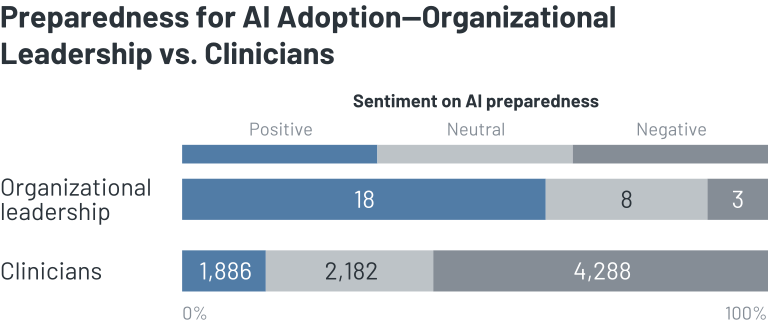
The post-go-live work may determine whether AI feels like relief or like another task to manage. Organizations need training that goes beyond a launch demo: specialty-specific examples, personalization support, clear expectations for reviewing AI output, and fast feedback loops when the tool misses the mark. Clinicians should not have to discover on their own how to make AI fit the way they practice. Organizations should train clinicians on when to use AI-generated content, how to review and edit it, where human judgment is still required, what documentation accountability remains with the clinician, and how to adapt the tool to the role, specialty, and care setting.
Ambient Speech as a Training Case Study
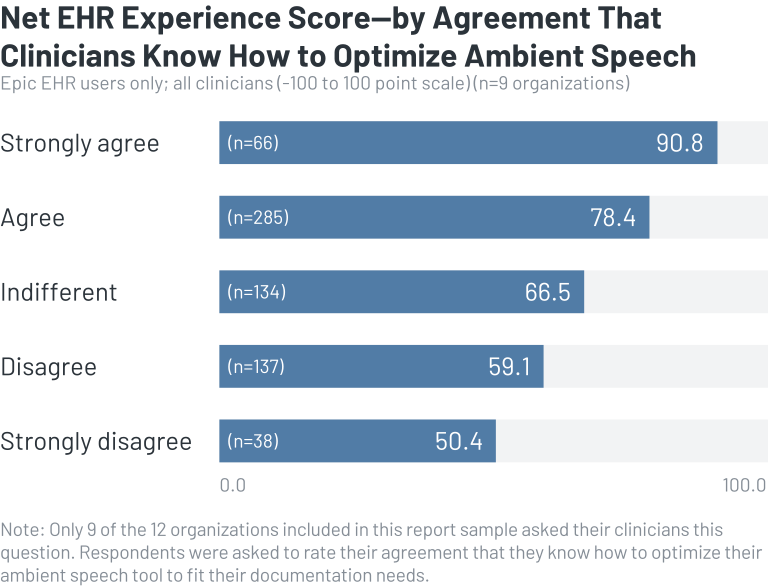
Ambient speech provides a helpful example illustrating the importance of training. Clinicians with the best results say ambient speech gives them something they have been requesting since long before generative AI became a boardroom priority: less after-hours documentation and more attention available for the patient. But the tools do not deliver the same experience for everyone. Among Epic clinicians using ambient speech, those who strongly agree they know how to optimize the tool report a NEES of 89.7, compared to 46.7 among those who strongly disagree. (For a broader look at ambient speech outcomes, check out our Ambient Speech Outcomes 2025 report .)
Implementation takeaway: Ambient speech training doesn’t have to be one-on-one, but it must be hands-on, workflow-specific, and iterative (see this report for details on how to do virtual training right). A successful rollout should help clinicians refine note structure, edit output efficiently, understand documentation expectations, and provide feedback when the tool does not fit the workflow.
“We need dedicated one-on-one training for this. Trusting a new technology with the most labor-intensive part of your job is a huge leap of faith when you've never received official training on this technology.” —APP
“I would love to learn how to use the ambient speech solution, but I cannot do the team meetings and need more one-on-one help or more than poor-quality videos that go too fast.” —APP
Move from AI Deployment to AI Enablement
The next phase of AI work will be less about activation and more about enablement. Organizations can turn on tools faster than clinicians can safely absorb them. To improve the EHR experience, leaders need to build the muscle around AI adoption: choose workflows deliberately, train clinicians in the context of their work, listen when the output creates more work, and keep optimizing after launch.

Healthcare organizations should:
Target AI to specific workflow problems: The goal is not to maximize the number of tools in use; it is to solve the right pain points for the right users.
Train for use, trust, and optimization: Clinicians need practical guidance on reviewing AI output, editing efficiently, understanding limitations, and adapting tools to their documentation needs.
Measure impact at the workflow and role level: Overall adoption rates hide important variation. Track AI use, perceived usefulness, training confidence, optimization confidence, NEES, burnout, and intent to stay by clinician background and care setting.
Build feedback loops into governance: Frontline clinicians should have a defined path to report what works, what creates risk, and what needs to be optimized.
Define accountability for safe AI use: Governance should clarify clinician-review expectations, escalation paths for incorrect output, privacy and security requirements, vendor-change monitoring, and who owns support when a tool fails in the workflow.
Frame AI as part of clinician experience strategy: Cost and productivity benefits are more sustainable when AI first reduces burden and strengthens clinicians’ ability to deliver care.

Vendors should:
Make ROI measurable inside the workflow: Provide dashboards for adoption, time saved, documentation quality, message turnaround, chart closure, and clinician confidence.
Package role-specific implementation playbooks: Customers need different guidance for physicians, APPs, nurses, allied health professionals, inpatient, outpatient, and specialty workflows.
Provide strong change-management support: Do not stop at go-live checklists; help customers optimize prompts, defaults, workflow placement, and governance.
Be transparent about tool maturity: Separate tools that are ready for broad use from tools that need pilots, specialty validation, or local build before scaling.
Support third-party reality: Customers are using Epic-native tools and third-party tools together; integration, workflow clarity, and data liquidity are important, and no single solution or platform can do it all.
How the Arch Collaborative Can Help
Healthcare organizations
As your organization pilots various AI tools and use cases, consider administering a pre/post survey as part of an Arch Collaborative membership with KLAS. These surveys allow organizations to benchmark AI adoption and efficiency along with before-and-after results.
Vendors
If you’re rolling out new AI functionality that will impact clinicians’ EHR productivity or well-being, consider joining the Arch Collaborative to partner with your customers and measure the outcomes of your solutions.
Where to Start? Related Arch Collaborative Research
When deciding where to start, you don’t have to reinvent the wheel. The research below shares additional Arch Collaborative insights as well as case studies of organizations that have already seen success.

CMIO & CNIO Perspectives on the Clinician Experience 2026: Balancing Financial Pressures with Clinician Well-Being
Healthcare organizations today face intense challenges, from financial pressures to an uncertain political climate to clinician burnout and turnover rates that remain higher than pre-pandemic levels. Amid these concerns, executives must make critical decisions about how to support their organizations and prioritize the multiple goals of the Quadruple Aim. While clinician well-being is widely recognized as important, it often receives less strategic attention. However, data from the Arch Collaborative shows that focusing on the clinician experience has a ripple effect that yields benefits across multiple other areas.

Case Study: University of Vermont Health & Abridge
The University of Vermont Health (UVM Health) partnered with Abridge to deploy clinician-led ambient speech technology that reduced burnout from 69% to 24% while improving satisfaction, productivity, and note quality through a data-driven, trust-based rollout across diverse clinical settings.

Case Study: Legacy Health & Microsoft DAX Copilot
Legacy Health implemented Microsoft’s DAX Copilot to help reduce provider burnout, decrease the cognitive load for providers, and bring back the joy in medicine. Initial funding was approved in October 2023, and because of the pilot program’s success, DAX Copilot was expanded for broader rollout by October 2024.

Case Study: Cleveland Clinic & Ambience Healthcare
After a rigorous vendor selection and pilot process, Cleveland Clinic collaborated with Ambience Healthcare to deploy ambient AI technology at enterprise scale, reducing documentation burden, improving provider satisfaction, and enabling one of the broadest ambient AI deployments measured to date in the KLAS Arch Collaborative.
What Is the KLAS Arch Collaborative?
The Arch Collaborative is a group of healthcare organizations committed to improving the EHR experience through standardized surveys and benchmarking. More than 300 healthcare organizations have surveyed their end users, and over 700,000 clinicians have responded. Reports like this one turn that feedback into practical insight leaders can use to make the EHR less burdensome and more supportive of patient care.
Report Non-Public HTML Body
Report Public HTML Body
This material is copyrighted. Any organization gaining unauthorized access to this report will be liable to compensate KLAS for the full retail price. Please see the KLAS DATA USE POLICY for information regarding use of this report. © 2019 KLAS Research, LLC. All Rights Reserved. NOTE: Performance scores may change significantly when including newly interviewed provider organizations, especially when added to a smaller sample size like in emerging markets with a small number of live clients. The findings presented are not meant to be conclusive data for an entire client base.