



Clinician Turnover 2025
Improving the EHR Experience Is a Leadership Imperative for Reducing Turnover
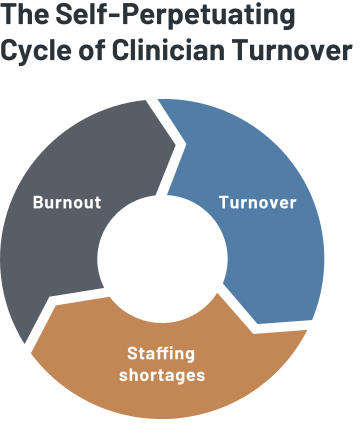
Workforce instability threatens your organization’s ability to achieve mission-critical outcomes, including a positive patient experience, improved clinical care, strong financial performance, and strategic growth. Yet the cycle of clinician turnover seems inescapable—burned-out clinicians leave, causing workforce shortages, which lead to greater burnout for those who remain, resulting in even more turnover. Despite KLAS’ finding that burnout rates have declined since all-time highs during the pandemic, there is projected to be a global shortage of 11 million health workers by 2030.
Access the feedback of
700,000+ clinicians worldwide
Access the feedback of
700,000+ clinicians worldwide
Here is my information:
In our last report on clinician turnover, the KLAS Arch Collaborative examined the likelihood and cost of turnover and how the EHR experience impacts burnout. This year’s report delves deeper to understand why clinicians are leaving and reveals how healthcare organizations can leverage strong organizational leadership to address their turnover challenges head-on, improve the EHR experience, and break the cycle of costly clinician turnover.
THE REALITY: LEADERSHIP IS FAILING CLINICIANS
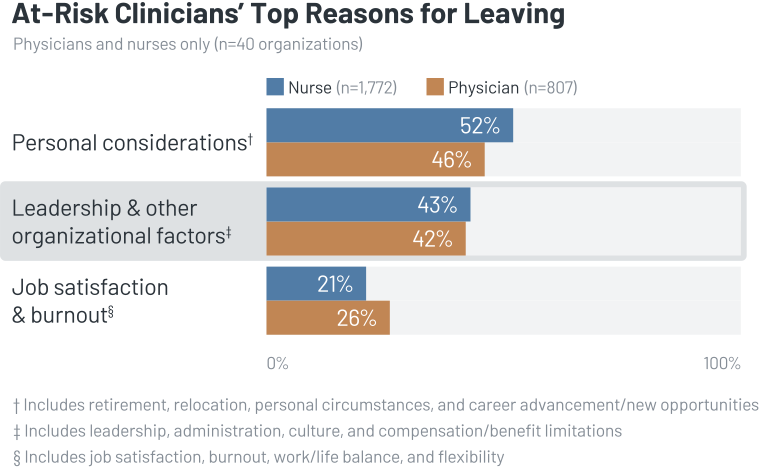
Outside of Personal Considerations, Organizational Leadership Is the Number-One Cause of Clinician Turnover
Aside from personal considerations, such as retirement or career advancement, dissatisfaction with organizational leadership is the number-one reason that at-risk clinicians (at the end of this section) plan to leave their organization. Clinicians—especially nurses—don’t feel sufficiently supported in all the responsibilities that have fallen to them due to staffing shortages, including tasks that go beyond the scope of patient care. Amid the current climate of reimbursement concerns and pressures to cut costs, this reason for leaving is perhaps not surprising. However, it is alarming and represents a significant financial risk to healthcare organizations given that the organizational cost of losing a nurse is $52,350 (2024 study), while the cost of losing a physician can be up to $1,000,000 (2017 study).
Dissatisfaction with Leadership Often Arises in the Aftermath of a Poor EHR Experience
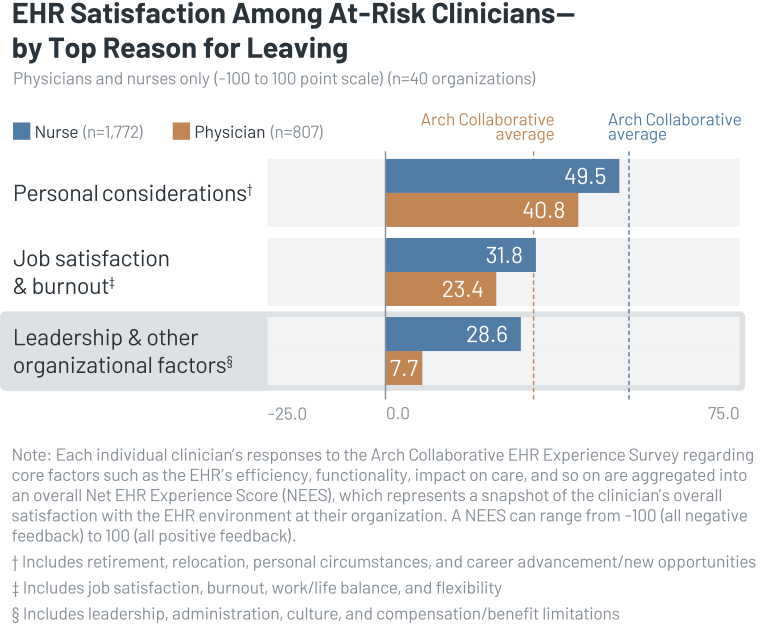
The EHR experience is a significant factor in how positively or negatively clinicians view their leadership, and dissatisfaction with the EHR often manifests in dissatisfaction with leadership. Among at-risk clinicians, those who cite misalignment with leadership as the primary reason for leaving are also the group most dissatisfied with their EHR experience. This is especially true among at-risk physicians, who have an average Net EHR Experience Score of just 7.7 (on a -100 to 100 point scale). When leaders fail to provide a fast, reliable EHR bolstered by strong support and education, clinicians don’t just feel inefficient or burned out—they feel that leadership has failed them, and they begin to make plans to leave.

Voice of Clinicians: Why Is Leadership Causing You to Leave Your Current Organization?
Nurses
 “I’m leaving because of a lack of shared values, specifically with upper leadership; we as an organization do not enforce and stand by the promises and values we promote.”
“I’m leaving because I am burned out from a chaotic work environment and because of the lack of shared values from leadership. There has been inconsistent, poor, and sometimes even a complete lack of communication from leadership. I love my job, the nurses, and the interdisciplinary relationships with other medical professionals; however, leadership is what has driven me away.”
“I am seeking opportunities that offer more competitive overall compensation that reflects the education, skills and experience I have acquired. Despite earning an advanced degree, desired advancement opportunities do not exist within my current role or organization. The current workplace culture does not align with my values. My workload continues to increase without leadership discussing the potential impact on my current workflow, which creates unclear expectations.”
Physicians
 “The current leadership has no interest in our input and only wants control of how we practice, our hours, and every other aspect of our job through the EHR. I feel like we are being watched and documented and like we are just hamsters on a wheel for this organization.”
“The leadership does not care about clinicians anymore; for them, it is all about the bottom dollar. Workloads constantly increase across multiple hospitals, but the pay never does, which is why everyone is leaving. This hospital system no longer meets any of their goals and certainly does not put the patient or the clinician first. The fact that our CEO wants this to be a hospitality service shows how far off the goals are. We are drowning constantly and begging for help.”
“I have lost confidence in my organization’s administration. What was once a culture of speaking up and influencing change has shifted into one of silence and suppression. After more than a decade here, I can no longer recognize the organization I once believed in. Administrators should be supporting us, not abusing or dismissing us.”
“I am leaving because this organization no longer aligns with my values. Despite my dedication and expertise, I feel unrecognized; my skills are unique, yet administration has chosen to hire locums at three times my salary.”
 Defining “At-Risk” Clinicians
KLAS asked clinicians how likely they are to leave their organization in the next two years. Clinicians could choose from the following options: very unlikely, unlikely, neither unlikely nor likely, likely, or very likely. Arch Collaborative data shows that clinicians in the latter three groups (bolded) are the most likely to leave their organization. They are referred to collectively as “at risk.” Note that since KLAS’ last report on clinician turnover, the number of at-risk clinicians has remained stagnant.
THE IMPERATIVE: LEADERS MUST IMPROVE THE EHR EXPERIENCE
EHR Experience Is Strongly Linked with Clinician Turnover; Healthcare Leaders Must Invest in EHR Experience to Better Align with Clinicians—but Urgency Is Needed
Rebuilding bridges with clinicians and stemming the tide of turnover is critical, yet it can seem a daunting undertaking, especially when attempted through broad initiatives such as improving organizational culture (a slow process) or increasing staff reimbursement (an option that may be financially unfeasible). The good news is that investing in the EHR experience is a concrete method that healthcare leaders can—and must—use to align with clinicians, which naturally leads to a better organizational culture.
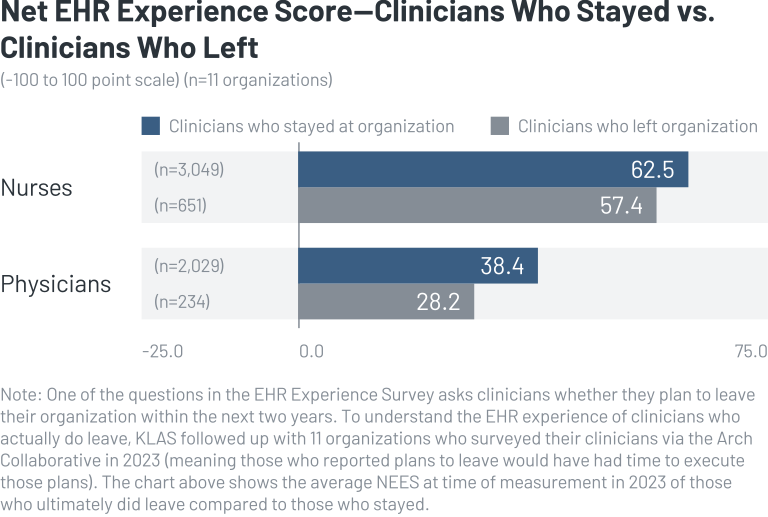
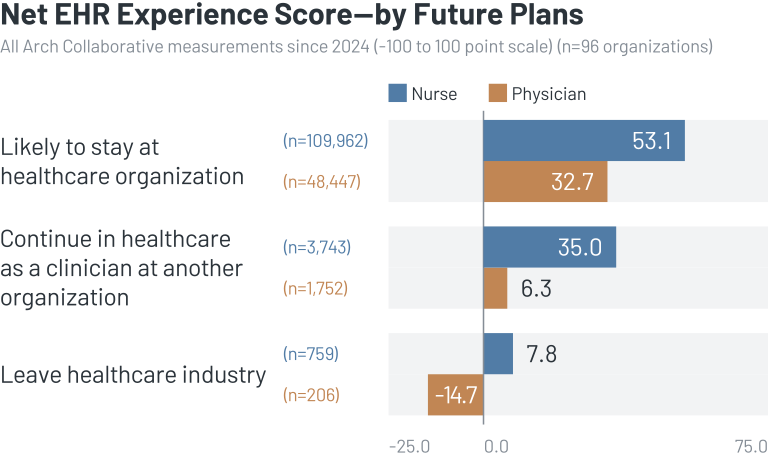
However, time is of the essence, as Arch Collaborative data shows that at-risk clinicians today are even more dissatisfied with the EHR than those who have already left. At the time of their Arch Collaborative measurement, at-risk physicians who have since left their organization had an average NEES 10.2 points lower than physicians who reported plans to stay; for nurses, the NEES is 5.1 points lower (see “Past Attrition” chart below). Today, the disparity in EHR satisfaction between clinicians who plan to stay and those who plan to leave the healthcare industry is even greater; the disparity for physicians is 47.4 points (see “Future Outlook” chart below). Given the predicted workforce shortages, this trend is distressing both for individual healthcare organizations working to retain clinical talent and for the healthcare industry as a whole.
Past Attrition
Future Outlook

Voice of Clinicians: What Do Clinicians Want from Leadership When It Comes to the EHR?
Clinicians with a poor EHR experience want leaders to have a patient-first mentality and to value clinicians’ perspectives on the EHR’s impact across departments. They want to be key players in their organization’s strategy to improve clinical workflows and optimize EHR functionality but currently feel dismissed, underappreciated, or left out of decision-making. They feel that the visibility that EHR data provides to leadership is sometimes weaponized, and some clinicians report being micromanaged by leaders who value the bottom line above clinician and patient experiences.
 “Fix the EHR, now. My job is tied to patient satisfaction. Why isn’t the pay of the head of IT tied to provider satisfaction? That might fix the EHR problem.” —Physician
“The EHR should be a collaborative effort between IT and providers. At best, IT is very protective of their privileges and little fiefdom. Sometimes, it seems as if they think providers are here to make their work smooth and efficient. IT management, as opposed to the trainers and helpers, really doesn’t understand our needs or even seem interested in what they are.” —Advanced practice provider
“I like my job and organization, but I will likely leave if the organization continues to make top-down decisions, not include direct service staff in decision-making, and not improve communication about decisions before they are implemented. The EHR training we got was incredibly insufficient, and leadership hasn’t taken any accountability for that, nor is my voice taken seriously when I ask for support to understand an EHR function or share an issue related to the EHR.” —Allied health professional
Note: While this report focuses on physicians and nurses, the same trends are seen among allied health professionals and APPs.
Organizations That Have Focused on the EHR Experience as a Retention Strategy Are Seeing ROIs
Several organizations that actively measure the clinician experience via the Arch Collaborative are starting to lean into EHR measurement, benchmarking, and improvement as a retention strategy. KLAS shares the ROIs that organizations have seen in this panel and this report. In the former, four panelists touch on outcomes such as workforce stability, operational efficiency, positive organizational reputation and recognition, and improved staff morale and trust. The panelists note that the ROIs aren’t always purely financial—in particular, mission alignment and clinician well-being are critical but nonmonetary ROIs. Meanwhile, the report examines how prioritizing the clinician experience drives measurable ROI for organizations; the following comments are from the report’s data set.
“We recognized that we needed to put more resources into clinical informatics support to improve the clinician experience. Post-pandemic, that focus on clinician wellness continues. If we want to provide the best possible patient care, we need well-trained and motivated clinical staff. In order to recruit and retain the best clinicians, we need to have an environment in which they are properly supported in providing care. This includes a commitment to making the EHR as efficient and effective for them as possible.” —CMIO
“We recognize the importance of addressing provider wellness and understanding the drivers behind burnout. About two to three years ago, we initiated intentional conversations around this topic, and we have been fortunate to have senior leaders who are committed to dedicating resources to this effort, despite budget constraints. Aligning clinician experience with organizational goals has been crucial in making the case for investment, especially in the context of recruitment and retention.” —CMIO
“Culture is a soft metric that is highly consequential. It’s not the kind of thing people can enter in a spreadsheet to prove a monetary ROI, but culture is a massive metric. Our culture has improved because we invested in improving the clinicians’ experience. There are innumerable factors to culture, but we have created a strong presence with our providers. We let them know we are listening to them and making changes.” —Physician leader and director of clinical informatics
Clinicians Who Changed Their Mind About Leaving Say EHR Experience Has Improved
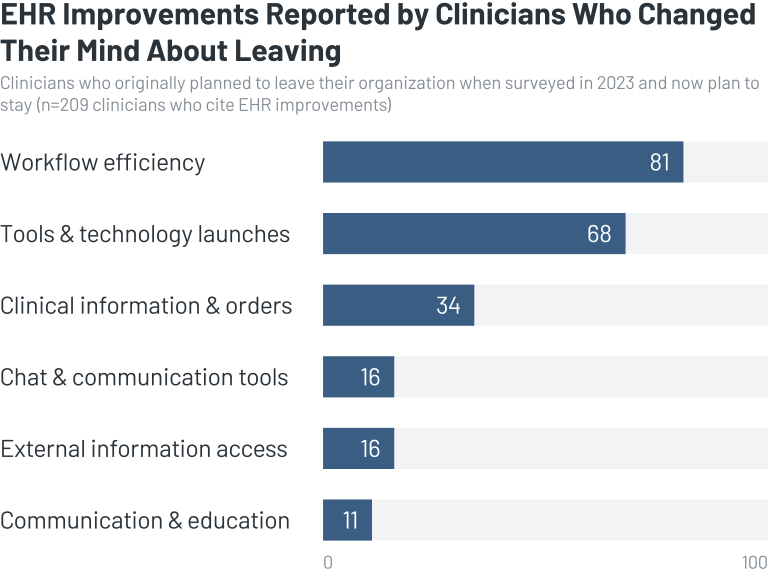
Many at-risk clinicians are starting to feel the positive effects of their healthcare organizations’ efforts to improve the EHR. Over the last two years, 288 clinicians who reported plans to leave when initially surveyed in 2023 now say they plan to stay. The majority of these clinicians point to improved EHR technology and workflows, mentioning changes such as the implementation of macros, quick text, and ambient speech technology; an improved login experience; and enhanced clinical communication tools. Importantly, the success of these advancements is not tied to functionality alone; organizations that pair technology changes with ongoing education and effective support help clinicians understand how new tools fit into their broader workflows, making adoption smoother, quicker, and more sustainable. This aligns with findings from KLAS’ previous clinician turnover report, which shows that reduced burnout, enhanced EHR education, and enhanced IT support were the top factors that altered the future plans of at-risk clinicians. Together, these areas not only streamline daily tasks but also have meaningful ripple effects on clinician satisfaction and retention. One CMIO expressed, “We think there will be a doctor shortage, which will be a huge problem, so I pitched to our executive team that we needed to use technology to make our organization the place where people would want to come and work. That was how we started looking at ambient dictation.”
73%
of clinicians who changed their mind and now plan to stay with their organization cite EHR improvements
THE NEXT STEP: IMPLEMENT STRATEGIES FOR EHR EXCELLENCE
To make their organization a place where clinicians love to work, healthcare leaders must work to improve the EHR experience. However, KLAS recognizes that leaders are being asked to do more with less. To support them in this effort, KLAS offers the following resources that can help leaders assess their organization’s current state and identify practical starting points for improvement.
KLAS Arch Collaborative Resources
Each year, the KLAS Arch Collaborative identifies EHR best practices validated by healthcare organizations and compiles them into guidebooks intended to be a one-stop shop for organizations looking to improve. The physician and nurse guidebooks outline how organizations can be successful with their EHR infrastructure, EHR education, EHR personalization, and EHR governance.


KLAS Arch Collaborative Award Winners
The following healthcare organizations have demonstrated great leadership and an ability to deliver an exceptional EHR experience. We hope their stories inspire your organization to prioritize clinicians by supporting their use of the EHR (click the logos for more information).

EHR Experience Pinnacle Award
Celebrates outstanding achievement and is awarded to member organizations with a NEES of 75.0 or greater for nurses, or 60.0 or greater for physicians







EHR Experience Breakthrough Recognition
Honors significant improvement and is given to member organizations whose NEES (for physicians, nurses, or both) has increased by at least 15 points between measurements



Another Valuable Resource for Improving the Clinician Experience & Retention
Addressing Health Worker Burnout:
The US Surgeon General’s Advisory on Building a Thriving Health Workforce
“We have a moral obligation to address the long-standing crisis of burnout, exhaustion, and moral distress across the health community. We owe health workers far more than our gratitude. We owe them an urgent debt of action. This Surgeon General’s Advisory helps show what’s needed, and how we can do it. The stakes are high. If we fail to act, we will place our nation’s health at increasing risk.”
Vivek H. Murthy, MD, MBA
Vice Admiral, US Public Health Service
Surgeon General of the United States
What Is the KLAS Arch Collaborative?
The Arch Collaborative is a group of healthcare organizations committed to improving the EHR experience through standardized surveys and benchmarking. To date, over 300 healthcare organizations have surveyed their end users and over 650,000 clinicians have responded. Reports such as this one seek to synthesize the feedback from these clinicians into actionable insights that organizations can use to revolutionize patient care by unlocking the potential of the EHR.
Report Non-Public HTML Body
Report Public HTML Body
Featured in Learning Tracks
Topics
Report Topics
Burnout Reduction & Clinician Wellness, Clinician Relationships & Communication, EHR GovernanceThis material is copyrighted. Any organization gaining unauthorized access to this report will be liable to compensate KLAS for the full retail price. Please see the KLAS DATA USE POLICY for information regarding use of this report. © 2019 KLAS Research, LLC. All Rights Reserved. NOTE: Performance scores may change significantly when including newly interviewed provider organizations, especially when added to a smaller sample size like in emerging markets with a small number of live clients. The findings presented are not meant to be conclusive data for an entire client base.